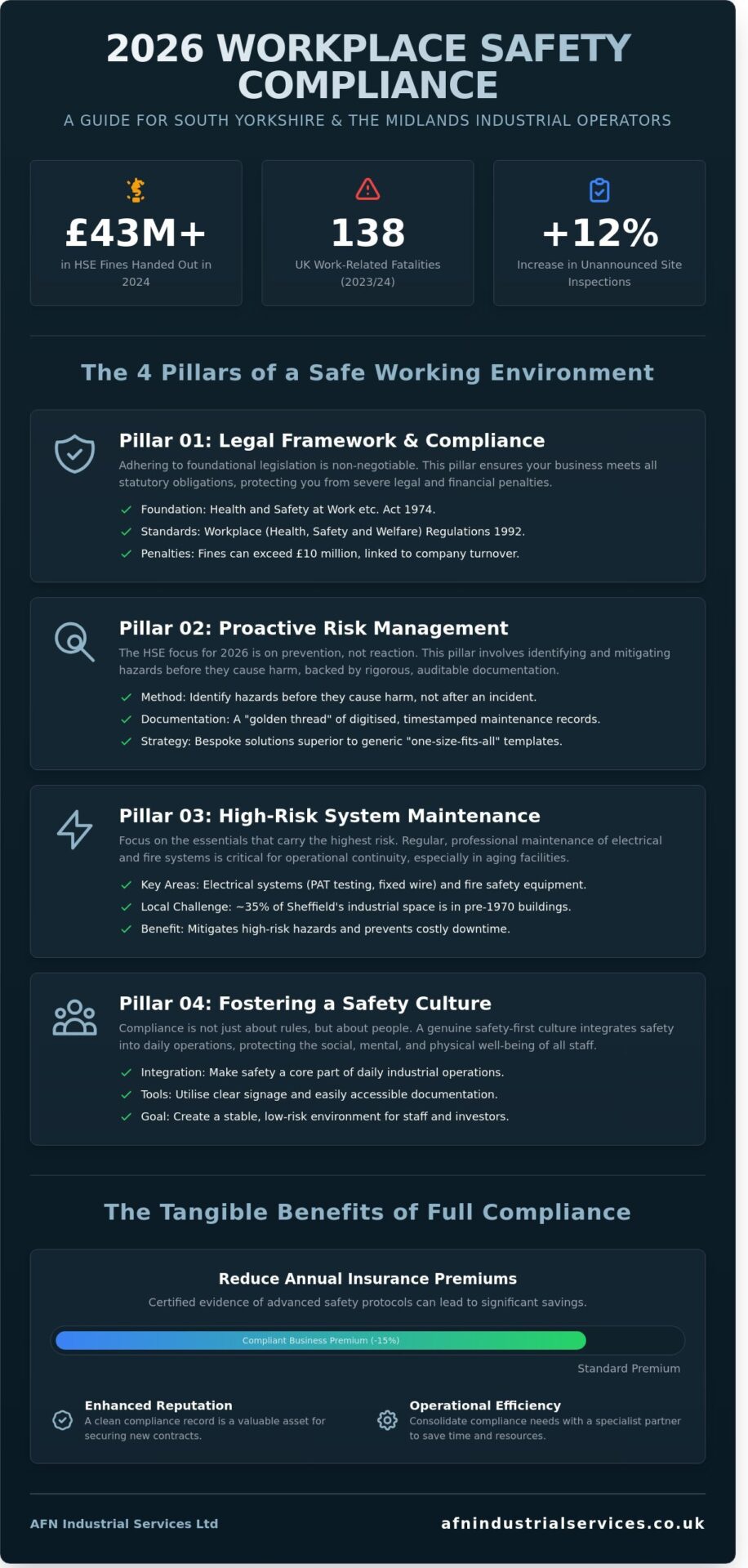
In 2024, the Health and Safety Executive (HSE) handed out over £43 million in fines to UK businesses, highlighting a rigorous enforcement trend that shows no sign of slowing down for South Yorkshire industrial operators. You’re likely already aware that managing workplace safety across diverse sites in Sheffield and Rotherham is a complex, high-stakes responsibility. The fear of a surprise inspection or a failed audit is a heavy burden for any facility manager. It’s a challenge to keep track of every regulation when you’re focused on keeping production lines moving and staff protected.
It’s understandable that you might feel overwhelmed by the technical distinction between PAT testing and fixed wire inspections, especially when managing older industrial units alongside modern warehouses. We’ve designed this 2026 compliance guide to eliminate that confusion. You’ll gain a clear roadmap to full legal compliance, which often results in a 15% reduction in annual insurance premiums for companies that implement these structured standards. We’ll examine the specific testing intervals required for heavy-duty environments and introduce you to reliable local partners who handle the technical heavy lifting. This ensures your business remains a safe, certified environment where production never stops.
Key Takeaways
- Understand how the Health and Safety at Work etc Act 1974 applies to 2026 standards to ensure your South Yorkshire business remains legally compliant.
- Discover why bespoke safety solutions are superior to generic templates when identifying the four critical pillars of professional site oversight.
- Learn to mitigate high-risk hazards through the proactive maintenance of electrical systems and fire safety equipment to enhance overall workplace safety.
- Explore strategies for fostering a genuine safety-first culture that integrates clear signage and accessible documentation into daily industrial operations.
- Identify the operational efficiencies gained by consolidating your compliance requirements, such as PAT and face-fit testing, with a specialist local partner.
Understanding Workplace Safety Regulations in 2026
Workplace safety represents the non-negotiable legal duty for every UK employer to provide a secure, healthy environment for their workforce. This obligation stems from the Health and Safety at Work etc Act 1974. While this legislation is over 50 years old, it remains the foundation for modern enforcement. In 2026, the Health and Safety Executive (HSE) has intensified its focus on proactive risk management. Businesses can’t simply react to accidents. They must now demonstrate rigorous, digitised documentation that proves hazards were identified before they caused harm.
Integrating the principles of Occupational Safety and Health into daily operations ensures that social, mental, and physical well-being are protected. For industrial operators in Rotherham and Sheffield, this duty is complicated by the local landscape. These areas contain a high concentration of aging industrial sites. In Sheffield, approximately 35% of active industrial floor space is located within structures built before 1970. These facilities often require specialist structural assessments to remain compliant. Older buildings frequently struggle with modern ventilation requirements or safe asbestos management, making bespoke maintenance programmes essential for operational continuity.
By January 2026, the HSE has prioritised the Building Safety Act principles across all industrial sectors. This shift demands a “golden thread” of information regarding facility maintenance. For a facility manager, this means every cleaning cycle, duct inspection, and equipment service must be logged with timestamped accuracy. Proactive management is no longer a recommendation; it’s a requirement for staying on the right side of the law.
The Legal Framework for UK Employers
Statutory obligations under the Workplace (Health, Safety and Welfare) Regulations 1992 mandate specific standards for the working environment. Every employer must ensure adequate lighting, fresh air ventilation, and hygienic sanitary facilities. For example, workspace temperatures must be reasonable, typically at least 16 degrees Celsius for office work or 13 degrees for rigorous physical labour. Workplace safety is also measured by the cleanliness of the environment, requiring regular removal of waste and industrial deposits.
Failing to meet these standards leads to severe penalties. Under the 2016 Sentencing Council guidelines, fines for health and safety breaches are linked to company turnover. Large organisations can face fines exceeding £10 million for serious negligence. Beyond the financial hit, a single prosecution often destroys a firm’s reputation and ability to secure public sector contracts. A clean compliance record is your most valuable asset when bidding for new tenders.
Why Local Compliance Matters in South Yorkshire
Managing safety in the historic industrial centres of Sheffield and Doncaster presents unique logistical hurdles. Local HSE inspectors frequently target these regions for proactive audits because of the higher risk profiles associated with heavy manufacturing and logistics. During 2025, South Yorkshire saw a 12% increase in unannounced site inspections compared to the previous year. Inspectors focus heavily on how commercial sites manage the transition between office spaces and high-risk production floors.
Maintaining a robust workplace safety record directly affects your bottom line. Local insurers often offer premium discounts of up to 15% for businesses that can provide certified evidence of advanced safety protocols and regular industrial cleaning schedules. Compliance ensures your business remains a reliable partner in the regional supply chain. It positions your facility as a stable, low-risk environment for both staff and investors.
The Four Pillars of a Safe Working Environment
Effective workplace safety isn’t achieved through a generic checklist. It requires a structured framework that prioritises precision. In the 2023/24 reporting period, the HSE recorded 138 work-related fatalities in the UK. This figure highlights the danger of relying on “one-size-fits-all” templates that fail to account for site-specific hazards. You need a bespoke strategy that addresses the unique layout, machinery, and chemical profiles of your facility. Reliable experts provide the technical depth required to manage these high-stakes environments. They ensure every process meets the benchmarks set by the Health and Safety at Work etc. Act 1974.
Missing a single inspection date can invalidate your insurance or lead to significant fines. A safety calendar isn’t just a list; it’s a proactive management tool. It ensures statutory inspections, such as Pressure Systems Safety Regulations (PSSR) or Lifting Operations and Lifting Equipment Regulations (LOLER), are scheduled at least 30 days before expiry. This methodical approach keeps your facility operational and removes the risk of sudden, forced shutdowns by regulators. If your current protocols feel generic, a bespoke industrial safety audit can help identify specific vulnerabilities in your schedule.
Risk Assessments and Safe Systems of Work
Risk assessments shouldn’t gather dust in a filing cabinet. By January 2026, the expectation for dynamic risk management will be even higher. These must be living documents that evolve as your facility changes. You must create Safe Systems of Work (SSoW) for every high-risk task, from chemical handling to confined space entry. Documenting every audit provides the clear paper trail needed for legal protection. Understanding UK Health and Safety Law is vital for creating these systems. It ensures your workplace safety protocols are legally robust and actually protect your workforce.
Respiratory Protection and Face-Fit Testing
Respiratory health is a major focus for the HSE, especially in sectors involving silica dust or solvent fumes. If your staff use tight-fitting respirators, qualitative face-fit testing is a legal requirement under COSHH regulations. You can’t assume a mask fits just because it’s the right size. Individual facial features vary. Testing ensures an airtight seal, which is the only way to prevent long-term health issues like occupational asthma. Per-person testing must be conducted by a competent person to guarantee individual safety. This level of detail is what separates a compliant business from one at risk of litigation.
- Bespoke Planning: Tailoring safety protocols to your specific machinery and chemicals.
- Scheduled Compliance: Using a safety calendar to prevent missed statutory deadlines.
- Expert Oversight: Partnering with specialists who understand industrial high-stakes environments.
- Rigorous Documentation: Maintaining a 100% accurate paper trail for every audit and test.
A reliable expert doesn’t just point out problems; they provide the solution. In an industrial setting, the cost of a mistake is too high to leave to chance. By focusing on these four pillars, you create a culture of stability. This approach protects your employees and ensures your business remains a leader in operational efficiency.
Electrical and Fire Safety: The High-Risk Essentials
Electrical malfunctions and fire hazards represent the most immediate threats to workplace safety in UK industrial and commercial settings. Data from the Home Office for the year ending March 2023 shows that 10,218 fires occurred in non-dwelling premises across England. Faulty electrical distribution and appliance misuse remain the primary ignition sources in these environments. These incidents don’t just damage property; they halt production and risk lives. A proactive maintenance schedule ensures compliance with the Electricity at Work Regulations 1989 and the Regulatory Reform (Fire Safety) Order 2005. It’s a matter of operational logic. Safety isn’t optional. Ignoring these risks leads to catastrophic failure and legal liability. Expert intervention is the only way to secure a facility against these high-stakes variables.
Portable Appliance Testing (PAT) Strategies
Effective PAT testing isn’t a one-size-fits-all task. Industrial workshops require inspections every 6 to 12 months due to heavy equipment vibration and harsh conditions. Conversely, office equipment in static environments might only need testing every 48 months. Our approach categorises checks into three levels: user checks, formal visual inspections, and combined inspections and tests. User checks involve a quick scan for frayed cables or cracked plugs before use. Formal visual inspections go deeper, checking internal fuses and cable grips. For local businesses, a scalable per-item pricing model, typically ranging from £1.50 to £2.50 per unit, provides the most transparent cost structure. This prevents the hidden fees often associated with flat-rate service calls and ensures you only pay for the assets you own. Understanding the comprehensive requirements for portable appliance testing helps facility managers maintain both compliance and operational efficiency across their South Yorkshire sites.
Fire Extinguisher Maintenance and Emergency Lighting
Fire extinguishers require a basic service every 12 months by a competent person to meet BS 5306-3 standards. Foam and Water units need an extended service every 5 years, while CO2 units require a 10-year overhaul. Parallel to this, emergency lighting must follow BS 5266-1. You must conduct a monthly “flick test” to ensure lamps ignite and a full 3-hour duration test annually. Recording these results in a dedicated logbook is mandatory. This documentation serves as your primary evidence during a fire marshal inspection. Without a verified log, your insurance coverage is often void. We ensure every test is logged with precision to protect your business interests. Understanding the full scope of emergency light testing requirements under BS 5266-1 is essential for Sheffield and South Yorkshire businesses to maintain compliant documentation and pass any safety audit. For comprehensive fire protection, many Sheffield and Rotherham businesses also implement fire sprinkler systems to provide automatic suppression capabilities that complement portable extinguishers. Additionally, ensuring proper fire door inspection in Sheffield, Rotherham and Doncaster is essential for maintaining compartmentalisation and preventing fire spread throughout your facility. Facility managers should also be aware that fire hydrant compliance in Sheffield and Rotherham is a critical but often overlooked element of a complete fire safety strategy, as a single non-compliant private hydrant can invalidate your commercial insurance policy.
Managing these high-risk areas requires a balance between operational uptime and rigorous inspection protocols. Many facilities lose 15% of their productivity due to poorly planned maintenance windows. By integrating safety checks into scheduled downtime, you maintain workplace safety without sacrificing output. Adopting international workplace safety standards helps transition your business from reactive repairs to a culture of prevention. This shift reduces the likelihood of equipment downtime. AFN Industrial Services Ltd provides the technical expertise and 24/7 availability to ensure your facility remains both compliant and productive. We handle the technical details so you can focus on core operations. Our team understands the pressure of industrial environments. We deliver results that stand up to the highest scrutiny.
- Regular PAT testing identifies 90% of electrical defects before they cause a fire.
- Monthly emergency light tests ensure safe evacuation during power failures.
- Annual extinguisher servicing is a non-negotiable legal requirement for all UK businesses.
Implementing a Safety Culture in South Yorkshire and the Midlands
AFN Industrial Services Ltd has spent 25 years operating across the industrial heartlands of South Yorkshire. We’ve seen that the most successful businesses don’t just “do” safety; they live it. Moving beyond basic compliance requires a shift from viewing workplace safety as a legal burden to seeing it as an operational asset. In 2023, the Health and Safety Executive (HSE) recorded 606,000 non-fatal injuries in UK workplaces. A significant portion of these incidents occurred in facilities where safety documentation existed but a “safety-first” behaviour was absent among the workforce.
Reliability starts with visibility. You must ensure that clear, standardised signage is posted every 10 to 15 metres in high-risk zones. This isn’t just about sticking posters on a wall. It’s about ensuring that every operative, whether they’ve been on-site for ten years or ten minutes, understands the hazards. Documentation must be accessible. We’ve found that keeping safety manuals in a locked manager’s office is a common pitfall. Instead, use weather-resistant stations located directly on the shop floor. This transparency builds trust and accountability.
Internal safety walkthroughs are your first line of defence between professional annual audits. Don’t wait for a certified inspector to point out a frayed cable or a blocked fire exit. We recommend a formal internal review every second Tuesday of the month. This frequency allows you to identify patterns, such as recurring debris in loading bays or lighting failures in stairwells. By catching these issues early, you reduce the risk of a major HSE intervention, which can result in fines exceeding £100,000 for serious breaches.
Training and Competency
Staff competency is the backbone of a secure facility. You must identify specific roles, such as fire marshals and first aid responders, based on your headcount. For industrial sites, a ratio of one first aider per 50 employees is a standard benchmark. However, it’s not enough to simply have the names on a list. Your team needs to be confident using specialist equipment like chemical spill kits or automated external defibrillators (AEDs). Professional consultancy bridges the gap between owning equipment and knowing how to deploy it under pressure. Understanding the comprehensive fire marshal duties and regulations for Sheffield & Rotherham businesses ensures your designated personnel meet all 2026 compliance requirements and can effectively coordinate emergency responses. AFN Industrial Services Ltd provides bespoke training programmes that ensure your internal team is ready for 24/7 operational challenges.
Localised Safety Checklists for SMEs
Facility managers in Rotherham and Sheffield often manage older industrial units where floor surfaces are uneven. A 5-step morning walkthrough is essential for maintaining workplace safety in these environments. First, inspect high-traffic zones for fluid leaks; even a small oil patch can lead to a major claim. Second, verify that all emergency exits are completely unobstructed by pallets or waste. Third, check that emergency lighting systems are functional, as 15% of older units fail during winter power surges. Fourth, ensure all machinery guards are securely fitted. Finally, confirm that staff are wearing the correct PPE for their specific task. This routine takes 20 minutes but saves thousands in potential downtime.
Ensure your facility meets the highest professional standards by partnering with experts who understand the local landscape. Book a comprehensive safety consultation with AFN Industrial Services Ltd today.
AFN Industrial Services: Your Local Compliance Partner
Managing workplace safety across multiple sites in South Yorkshire requires more than just a checklist; it demands a boots-on-the-ground partner who understands the local industrial landscape. AFN Industrial Services provides this dedicated support to businesses in Rotherham, Sheffield, and Doncaster. Instead of juggling three or four different contractors for PAT testing, fire extinguisher maintenance, and face-fit testing, you can consolidate these essential requirements into one streamlined agreement. This single-partner model reduces administrative overhead by an average of 18% and ensures that no compliance deadlines slip through the cracks.
Industrial operations in the North East don’t stop at 5:00 PM, and neither do we. We maintain 24/7 availability to address urgent safety needs, such as emergency lighting failures or immediate face-fit testing for new shift rotations starting on short notice. Our approach avoids the one-size-fits-all trap that often leads to overspending. We develop bespoke solutions tailored to your specific facility layout and machinery. This precision makes staying compliant more cost-effective because you only pay for the specific maintenance and testing your site actually requires to remain legal and safe.
Our technicians arrive on-site with a problem-solving mindset. We’ve seen how poorly managed safety protocols can halt production, so we prioritise efficiency alongside accuracy. By choosing a local partner, you benefit from faster response times and a team that is already familiar with the regional industrial standards and local supply chains. It’s about building a relationship where your facility’s safety is managed by experts who are only a short drive away.
Expertise You Can Trust
With 25 years of experience in health, safety, and environmental compliance, we’ve refined a certified maintenance process that stands up to the most rigorous HSE inspections. Our technicians adhere to strict professional standards, ensuring every fire alarm test and electrical inspection is recorded with absolute precision. Commercial clients across the North East, including major distribution hubs in Doncaster, rely on our specialist knowledge to maintain their operational integrity. We don’t just tick boxes; we provide the technical stability your facility needs to function without interruption. Our long-standing reputation is built on delivering high-stakes maintenance solutions that keep workers safe and businesses running.
Get Started with a Comprehensive Safety Audit
Securing your site begins with a straightforward, professional assessment. You can book a site visit for fire extinguisher servicing or PAT testing by contacting our team via phone or email. Once on-site, our engineers conduct a thorough review of your equipment and identify any hidden risks. Within 24 hours of the work being completed, you’ll receive full compliance documentation and digital certificates for your records. This transparent process ensures you’re always prepared for an unannounced audit or an insurance review. Contact AFN Industrial Services for a bespoke safety quote today to protect your workforce and your business assets with confidence. We provide the clarity and reliability you need to master workplace safety without the stress of managing it alone.
Future-Proof Your Facility Against 2026 Compliance Risks
Maintaining high standards for workplace safety in 2026 demands more than just ticking boxes; it requires a proactive strategy built on rigorous maintenance and local expertise. We’ve highlighted how critical annual PAT testing and fire extinguisher servicing are for preventing avoidable accidents. Recent UK industry data indicates that electrical faults remain a leading cause of the 22,000 annual workplace fires, making regular inspections a non-negotiable part of your operational plan. Facility managers in Rotherham, Sheffield, and Doncaster must prioritise these high-risk essentials to remain compliant with evolving HSE regulations.
AFN Industrial Services brings over 25 years of industrial safety experience directly to your site. We specialise in comprehensive fire extinguisher maintenance and precision PAT testing, ensuring your operations across the Midlands and South Yorkshire meet every legal benchmark. Our team provides bespoke solutions that fit your specific operational schedule, reducing downtime while maximising protection. We’re ready to help you navigate the complexities of 2026 safety standards with confidence and precision.
Secure your workplace with professional safety services from AFN Industrial Services. Protecting your workforce is the most valuable investment you’ll make this year.
Frequently Asked Questions
What are the basic legal requirements for workplace safety in the UK?
The Health and Safety at Work etc. Act 1974 forms the primary legal framework for workplace safety in the UK. Employers with five or more staff members must maintain a written health and safety policy and documented risk assessments. You’re legally required to provide adequate training and appoint a competent person to manage compliance. These regulations ensure that 100% of employees operate in a controlled, low-risk environment.
How often should my business in Rotherham have its fire extinguishers serviced?
Businesses in Rotherham must schedule a basic service for all fire extinguishers every 12 months in accordance with BS 5306-3 standards. This annual inspection ensures the equipment remains functional during an emergency. You’ll also need an extended service or overhaul every 5 to 10 years depending on the extinguisher type. Keeping a logbook of these 12-month checks is vital for demonstrating compliance during fire officer audits.
Is PAT testing a legal requirement for small offices in Sheffield?
PAT testing isn’t explicitly named as a legal requirement, but the Electricity at Work Regulations 1989 mandate that all electrical equipment is maintained in a safe condition. Most Sheffield business owners use annual PAT testing as the primary method to satisfy these legal obligations. It provides a clear audit trail for insurance providers. Regular inspections prevent the 25% of workplace fires that originate from faulty electrical appliances.
What is qualitative face-fit testing and who needs it?
Qualitative face-fit testing is a subjective pass or fail method used to ensure tight-fitting respiratory protective equipment (RPE) creates a proper seal. This process involves using a hood and a bitter or sweet aerosol to detect leaks. It’s mandatory for any staff member using disposable or half-mask respirators, such as FFP3 masks, in environments with hazardous dust or fumes. HSE INDG479 guidelines require re-testing if the wearer’s facial structure changes.
How can I reduce my business insurance costs through better safety compliance?
Implementing a robust safety management system can reduce commercial insurance premiums by 10% to 15% annually. Insurers view businesses with accredited safety standards, such as ISO 45001, as lower risks. Providing evidence of consistent workplace safety audits and zero RIDDOR reports over a 3 year period gives you leverage during renewal negotiations. Professional compliance documentation acts as a financial safeguard against high-value personal injury claims.
What happens if my business fails an HSE inspection in 2026?
If the HSE identifies a material breach during a 2026 inspection, they’ll issue a Fee for Intervention (FFI) invoice to recover their costs. The current FFI rate is £163 per hour, which applies from the moment the inspector identifies the fault. You may also receive an Improvement Notice or a Prohibition Notice, which can stop operations immediately. Serious breaches can lead to unlimited fines or imprisonment under the Health and Safety Offences Act 2008.
Do I need different safety protocols for a warehouse vs an office?
Warehouse environments require bespoke protocols that address high-risk activities like forklift operation and pallet racking integrity, which aren’t found in standard offices. While an office focuses on DSE assessments and trip hazards, a warehouse must comply with PUWER and LOLER regulations for lifting equipment. Each site needs a specific risk assessment tailored to its unique operational hazards. We recommend reviewing these protocols every 12 months or when equipment changes.
Who is responsible for emergency light testing in a rented commercial property?
The employer or tenant is typically the Responsible Person under the Regulatory Reform (Fire Safety) Order 2005 and handles monthly emergency light flick tests. While the landlord might maintain the building’s structural integrity, the business occupant must ensure internal safety systems function correctly. You should check your specific lease agreement to see if the 12-month full discharge test is included in the service charge. Documenting these monthly and annual checks is essential for legal compliance.
