Could your business survive the legal and financial fallout if your safety systems failed during a surprise inspection? In 2024, UK fire services conducted over 48,000 fire safety audits, and lighting failures remain a primary reason for non-compliance. Keeping up with emergency light testing isn’t just a box-ticking exercise; it’s a critical safety mandate for every industrial facility in Sheffield and South Yorkshire.
Managing the 12-month cycle of annual discharge tests alongside mandatory monthly checks is a logistical burden that many facility managers find overwhelming. We understand that missing a single deadline puts your insurance and your staff at risk. This guide provides a clear roadmap to mastering your legal obligations under BS 5266-1 standards for 2026. You’ll learn how to implement a manageable testing schedule and maintain the precise documentation required to pass any safety audit with total confidence.
Key Takeaways
- Understand your legal obligations under the Regulatory Reform (Fire Safety) Order 2005 and the essential BS 5266-1 standards for UK businesses.
- Implement a compliant emergency light testing schedule, alternating between monthly functional checks and comprehensive annual duration tests.
- Determine whether maintained or non-maintained lighting systems provide the most effective safety solution for your specific industrial facility.
- Master logbook management to ensure you are prepared for Fire Officer inspections with accurate records of test dates and remedial actions.
- Leverage bespoke specialist services to maintain 24/7 operational safety and meet the unique compliance challenges of the 2026 guidelines.
What is Emergency Light Testing and Why is it Legally Required?
Emergency light testing is a systematic procedure designed to verify that backup illumination systems activate instantly during a primary power failure. This process involves simulating a mains failure to ensure batteries and lamps provide the required light levels for a specified duration, usually three hours. Understanding What is Emergency Light Testing helps facility managers identify the difference between maintained and non-maintained systems and ensures their site remains operational during a crisis.
The legal framework for this requirement is rooted in the Regulatory Reform (Fire Safety) Order 2005. This legislation mandates that all UK businesses maintain their fire safety equipment in efficient working order and in a state of good repair. BS 5266-1 serves as the primary British Standard governing these systems. It outlines the exact parameters for design, installation, and the monthly and annual testing cycles required to keep a building compliant and its occupants safe.
Sheffield businesses face strict oversight from regional authorities. Since the 2023 updates to fire safety regulations, enforcement has intensified across South Yorkshire. Non-compliance results in more than just a safety risk; it carries the threat of unlimited fines and custodial sentences of up to 24 months. AFN Industrial Services provides the specialist support needed to avoid these outcomes through rigorous, certified inspections that meet every professional benchmark.
The Role of Emergency Lighting in Workplace Safety
Effective emergency lighting is a cornerstone of industrial health and safety. It ensures that exit routes are clearly illuminated even when smoke reduces visibility or a total power cut occurs. In high-risk task areas, such as those involving heavy machinery or chemical processing, specific lighting prevents operators from sustaining injuries during a sudden blackout. These systems also ensure that fire alarm points and extinguishers are easy to locate when every second matters.
Consequences of Non-Compliance in South Yorkshire
Facility managers and business owners bear significant legal liability for the safety of their premises. If a fire occurs and emergency light testing records are missing or incomplete, insurance companies frequently use this as grounds to reject multi-million pound claims. This leaves the business financially exposed and the leadership legally vulnerable. The ‘Responsible Person’ is the individual, employer, or owner who holds the legal obligation to implement and maintain fire safety measures within a commercial property.
Regular emergency light testing ensures that safety systems are not just present, but functional. Our team delivers bespoke testing schedules that align with your specific industrial requirements, providing the documentation needed to satisfy both fire marshals and insurance inspectors.
The Testing Schedule: Monthly Checks vs. Annual Full Duration Tests
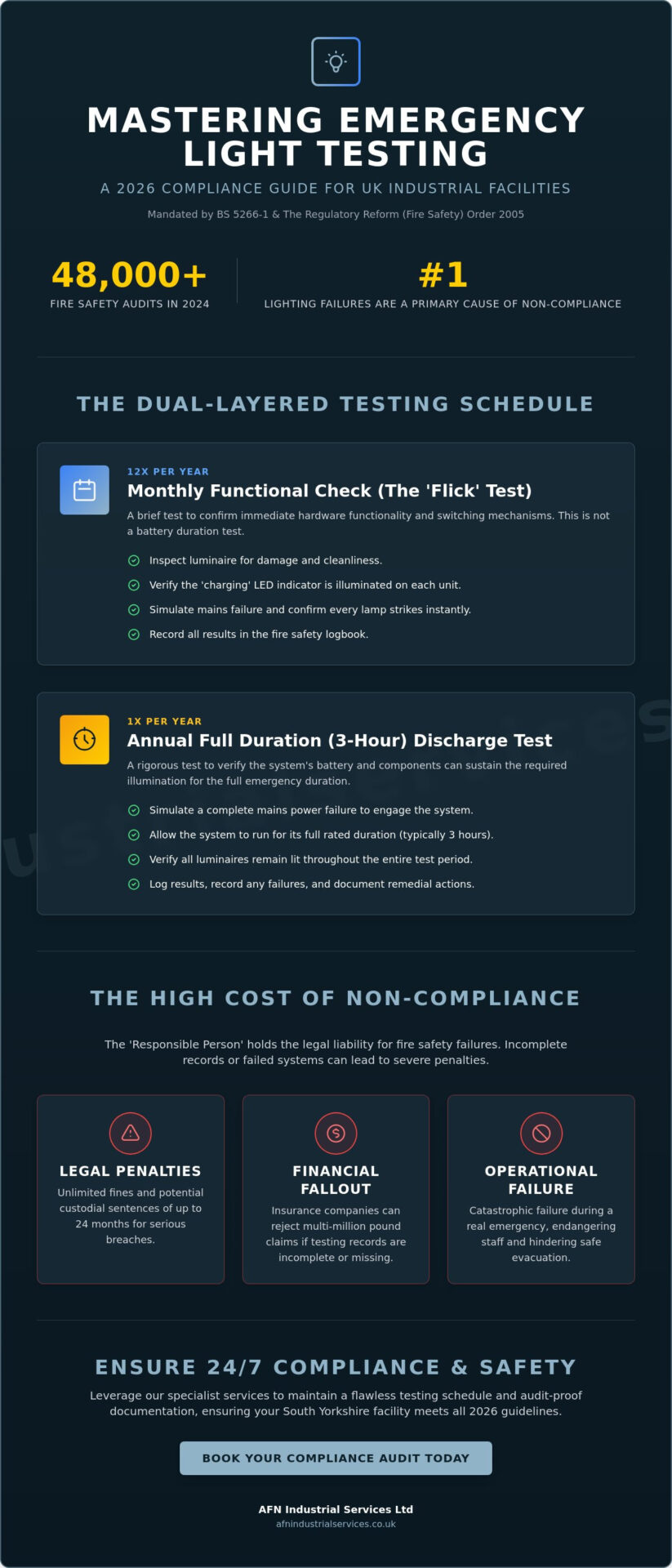
Maintaining regulatory compliance requires a dual-layered approach to emergency light testing. This strategy ensures hardware remains functional while verifying that power reserves meet legal minimums. Consistency is the primary factor in battery health; regular cycling prevents the internal degradation and sulfation that leads to premature failure. This technical oversight is mandated by the Regulatory Reform (Fire Safety) Order 2005, which is detailed in this 2026 Compliance Guide. Facility managers must distinguish between a quick functional check and a comprehensive discharge test to avoid common audit failures during health and safety inspections.
The Monthly ‘Flick’ Test Procedure
The monthly check is a brief functional test designed to identify immediate hardware failures. It’s not intended to drain the battery, but rather to confirm the switching mechanism works. The primary objective is to verify that every lamp illuminates immediately when the local mains supply is interrupted. During this walk-through, technicians should perform the following tasks:
- Inspect every luminaire for clean casings and ensure no physical damage obstructs the light path.
- Verify the ‘charging’ LED indicator is illuminated on each unit before the test begins.
- Check that the lamp strikes clearly without flickering or delay.
- Log every result in the fire safety logbook to maintain a clear audit trail for 2026 standards.
The Annual Full Duration (3-Hour) Discharge Test
The annual test is a rigorous 3-hour discharge that pushes the system to its operational limits. This 2026 requirement tests the battery’s ability to power the lights for the full rated duration. Over time, batteries lose capacity; a unit might stay lit for 30 minutes but fail at the two-hour mark. This test identifies ‘dim’ units or those with failing cells that would leave occupants in the dark during a prolonged power outage. Because this test leaves the batteries depleted, the building is vulnerable until they recharge. Scheduling is critical. We recommend conducting these tests when the building is empty or by implementing alternative safety measures such as temporary lighting or fire wardens. For complex sites, our guide to the annual emergency light test compliance requirements for Sheffield and Rotherham can help stagger testing to ensure continuous protection across the facility.
Scheduling these tests requires a methodical approach to minimize disruption. In commercial environments, 24/7 operations often require testing in zones. This prevents the entire site from being without emergency backup simultaneously. Our specialists use a problem-solution framework to identify the most efficient windows for testing, ensuring your Sheffield or South Yorkshire business remains compliant without halting production.
Comparing Emergency Lighting Systems: Maintained vs. Non-Maintained
Selecting the correct system for your South Yorkshire facility isn’t just about brightness. It’s a strategic decision that affects your long-term operational costs and your 2026 compliance status. Every building has a unique risk profile. A high-footfall retail space in Sheffield city centre requires a different approach than a secured distribution hub in Rotherham. Your choice determines how your building behaves during a crisis.
Maintained Emergency Lighting
Maintained units operate continuously. They function as standard room lighting during normal hours and switch to battery power if the mains fail. You’ll find these systems in public assembly points, theatres, and hospitals where total darkness is never an option. Because the lamps are always active, they undergo more wear and tear. Our specialist teams often find that maintained units require a more rigorous maintenance schedule to replace dual-purpose bulbs before they fail. While they offer constant visibility, they consume more energy because they’re powered 24/7.
Non-Maintained Emergency Lighting
Non-maintained units stay dormant during standard operations. They only trigger when they detect a failure in the primary power supply. This is the standard configuration for 85% of industrial warehouses and office blocks across Doncaster and Sheffield. These systems are more energy-efficient because the lamps aren’t burning throughout the day. Battery longevity is often superior in non-maintained setups, as the components aren’t subjected to constant heat from active circuitry. However, they don’t contribute to everyday illumination, meaning you’ll need a separate primary lighting system.
Operational Efficiency and Legal Obligations
The type of system you install directly impacts your emergency light testing procedures. Under BS 5266-1, both systems require a full three-hour discharge test annually. Choosing the wrong system can lead to unnecessary energy expenditure. Upgrading older fluorescent maintained units to modern LED alternatives can reduce lighting energy costs by up to 60%.
Your building’s specific use case dictates the system type. This decision is rooted in your Fire Risk Assessment. If you’re unsure Why is it Legally Required? to match your lighting to your occupancy type, consult the latest fire authority guidelines. Failure to provide adequate illumination for escape routes is a major compliance breach.
- Maintained: Best for cinemas, clubs, and shops where people aren’t familiar with the layout.
- Non-Maintained: Ideal for workplaces where staff know the exit routes and primary lighting is sufficient.
- Testing Impact: Maintained units often show higher failure rates during emergency light testing due to constant use.
Managing Your Emergency Lighting Logbook for 2026 Compliance
A Fire Officer’s inspection in South Yorkshire often begins and ends with your documentation. Under the Regulatory Reform (Fire Safety) Order 2005, your logbook serves as the definitive legal record of your safety protocols. If an incident occurs, a missing or incomplete logbook is viewed as a failure of duty. It’s the first thing an inspector will request because it provides a chronological history of your emergency light testing and maintenance efforts. Without this proof, you cannot verify that your building is safe for occupation or that you’ve met your legal obligations.
Effective record-keeping requires more than just a date and a signature. Every entry must include specific data points to remain compliant. To satisfy an audit, your records should include:
- The exact date and time of the inspection.
- The specific result of the test, clearly marked as a pass or fail.
- The precise location and unique ID of the unit tested.
- A detailed account of any remedial actions taken or parts replaced.
For South Yorkshire businesses, choosing between physical and digital formats is a matter of operational efficiency. Physical logbooks are reliable and don’t require power, but they’re easily lost or damaged in heavy-duty industrial environments. Digital systems offer real-time tracking and automated reminders, which is crucial for documenting emergency light testing results accurately across multiple sites. For a complete breakdown of how to structure these records, refer to our monthly emergency light test log book guide.
What Your Fire Safety Documentation Must Include
Compliance isn’t just about the tests; it’s about the entire lifecycle of the system. Your documentation must include certificates of installation and commissioning for any new systems installed since 2020. You also need a clear site map that identifies the location and unique ID of every emergency light on the premises. This map allows technicians to locate units quickly during annual emergency light test procedures. Finally, you must provide evidence of repairs and battery replacements. If a unit fails a monthly flick test, the logbook must show exactly when the new battery or LED module was fitted by a specialist.
Common Logbook Mistakes to Avoid
Gaps in your testing history are a major red flag for auditors. Even a single month of missing data suggests negligence rather than a simple oversight. Another frequent error is failing to sign off on remedial work. If a technician fixes a fault, a responsible person from your management team must verify and sign that the work is complete. In the UK, the legal retention period for fire safety records is five years, though keeping them for the life of the system is a safer professional standard. Don’t let poor paperwork compromise your site safety.
Specialist Emergency Light Testing Services in Rotherham, Sheffield & Doncaster
AFN Industrial Services brings 25 years of technical expertise to the South Yorkshire industrial sector. Managing compliance isn’t just about ticking boxes; it’s about operational continuity and the protection of your workforce. For large-scale facilities in Sheffield and Rotherham, a full three-hour discharge test can be disruptive if handled poorly. We coordinate these annual tests to ensure your site remains productive. Our technicians understand the specific demands of heavy industry, providing bespoke solutions that align with the BS 5266-1 standards.
We streamline your compliance by integrating portable appliance testing with your emergency lighting schedule. This unified approach reduces the number of site visits and minimizes downtime. Our team manages the entire process, from initial site mapping to the final certification. We ensure every luminaire performs exactly as required during a power failure, giving you peace of mind that your exit routes are secure. Our 25 years in the field means we’ve seen every type of industrial configuration and know exactly how to handle complex layouts.
Why Choose AFN Industrial Services?
- Local expertise across Sheffield, Rotherham, Doncaster, Worksop, and Retford ensures rapid response times.
- We provide authoritative reporting that satisfies both Fire Officers and insurance providers.
- Our proactive approach to workplace safety identifies potential faults before they lead to accidents.
- We offer 24/7 availability to suit your operational shifts, ensuring emergency light testing happens at the most convenient time for your business.
Get a Bespoke Safety Audit Today
Efficiency is key for commercial clients. We offer a comprehensive safety audit that combines emergency light testing with fire extinguisher servicing. This ensures all your life-safety systems are checked in a single, organized window. We provide transparent, per-item or per-site pricing to help you manage maintenance budgets effectively without hidden costs. Our no-nonsense approach prioritizes results and safety above all else, maintaining the high standards expected in industrial environments.
Don’t leave your 2026 compliance to chance. Our seasoned experts provide the stability and reliability your facility needs to stay operational and legal. Book your emergency light testing near me consultation to secure your site today. We are ready to act as your capable partner in maintaining a safe, compliant workplace.
Secure Your South Yorkshire Facility for 2026 Compliance
Safety compliance isn’t a static goal; it’s a continuous commitment to your workforce and your legal obligations. You now understand that meeting UK fire safety standards requires a disciplined approach to both monthly functional checks and mandatory annual three-hour discharge tests. Keeping a precise, up-to-date logbook is your best defense during Fire Officer audits and is essential for maintaining valid insurance coverage across Sheffield, Rotherham, and Doncaster. Professional emergency light testing ensures these systems function exactly when they’re needed most, preventing failure during a power loss or fire emergency.
AFN Industrial Services leverages over 25 years of health and safety experience to keep your operations running smoothly. We specialize in South Yorkshire and Midlands compliance, providing the comprehensive reporting and technical precision required for high-stakes industrial environments. Our specialists handle the rigorous testing schedules so your facility remains fully protected and audit-ready at all times. Secure your 2026 compliance—Book your Emergency Light Testing with AFN Industrial Services today.
Taking proactive steps now prevents costly downtime and legal complications later. We’re ready to help you build a safer, more resilient workplace for the year ahead.
Frequently Asked Questions
How often should emergency lighting be tested by law in the UK?
Under BS 5266-1 standards, you must perform a short functional test every 30 days and a full duration test every 12 months. The monthly check ensures each lamp illuminates correctly. The annual 3-hour discharge test confirms the batteries maintain power for the full legal duration. AFN Industrial Services provides certified emergency light testing to ensure your Sheffield facility meets these 2026 safety benchmarks without fail.
Can I carry out my own monthly emergency light testing?
You can carry out your own monthly emergency light testing if you’re a designated competent person with basic training. You must walk the site to check that every LED indicator is green and every lamp functions during a brief power interruption. You’re legally required to record these results in a fire safety logbook. If you lack the internal resources, our specialist team manages these recurring inspections for South Yorkshire industrial sites.
What happens if an emergency light fails its 3-hour discharge test?
If a unit fails its 3-hour discharge test, you must repair or replace the component immediately to maintain compliance with the Regulatory Reform (Fire Safety) Order 2005. Most failures stem from depleted batteries or faulty charging circuits. We provide bespoke remedial solutions, including component replacement and re-testing, to ensure your system remains 100% operational. A failed test represents a critical breach in your building’s safety infrastructure.
Is emergency light testing a legal requirement for small offices in Sheffield?
Yes, emergency light testing is a legal requirement for all Sheffield offices under the Regulatory Reform (Fire Safety) Order 2005. This law applies to any premises where people are employed, regardless of the square footage. Small business owners face the same 100% compliance standards as large industrial operators. Failure to maintain these systems can result in enforcement notices or prosecution by the South Yorkshire Fire and Rescue Service.
How long do I need to keep my emergency lighting test records?
You should keep your emergency lighting test records for at least 3 years to satisfy fire safety inspectors and insurance requirements. We recommend maintaining a digital and physical logbook for the entire lifespan of the system. These documents prove your proactive approach to health and safety during annual audits. Clear records provide the necessary evidence that your Sheffield business prioritizes the safety of its workforce and visitors.
Do I need emergency lighting if my building has plenty of natural light?
You still need emergency lighting even if your building has 100% natural light coverage during the day. Power outages and emergencies often occur at night or during winter months when natural light levels drop to zero. BS 5266-1 standards require illumination for safe evacuation under all conditions. Relying on sunlight doesn’t meet UK safety regulations, as it provides no protection during a 4:00 PM power failure in December.
What is the difference between a ‘flick test’ and a ‘duration test’?
A flick test is a brief monthly check to ensure the lamp illuminates, while a duration test involves running the system for its full 3-hour rated capacity. The flick test confirms the switching mechanism and lamp are functional. The annual duration test evaluates the battery’s ability to hold a charge for the duration required by law. Both are essential components of a comprehensive emergency light testing schedule for industrial facilities.
How much does professional emergency light testing cost in South Yorkshire?
Professional testing costs in South Yorkshire vary based on the number of light fittings and the complexity of the building layout. While we don’t provide flat-rate pricing without a site survey, industry reports suggest that per-unit costs decrease as the volume of fittings increases. We offer bespoke quotes tailored to your specific industrial requirements. This approach ensures you only pay for the exact level of specialist service your facility needs for 2026 compliance.