Could your business survive a surprise fire service inspection tomorrow morning? Most facility managers understand that keeping the lights on is a priority, but the shift to the new BS 5266-1:2025 standards has created significant confusion across South Yorkshire. It’s common to feel overwhelmed by the technical differences between a monthly functional check and the rigorous annual discharge tests required for legal safety. Securing a valid emergency lighting certificate Doncaster compliance officers will accept is about more than just ticking a box; it’s about ensuring every exit route remains visible during a total power failure.
You need a reliable partner who understands that safety isn’t a one-time event. This expert guide provides a clear roadmap to achieving full regulatory alignment while protecting your staff and customers. We’ll explain the mandatory five-year photometric verifications, the essential role of professional drain testing, and how to minimize your insurance liability through precise documentation. By the end of this article, you’ll know exactly how to maintain your systems to the highest professional benchmarks without the stress of unexpected inspection failures.
Key Takeaways
- Identify the specific legal requirements under the updated BS 5266-1:2025 standards to ensure your premises remain fully compliant with current UK fire safety legislation.
- Learn why a professional three-hour drain test is the essential requirement for obtaining a valid emergency lighting certificate Doncaster fire inspectors and insurers will accept.
- Distinguish between routine monthly functional checks and the mandatory annual inspections performed by a competent person to keep your safety logbook audit-ready.
- Discover practical steps to prepare your facility for a safety audit, including how to spot common equipment faults like battery failure indicators and flickering luminaires.
- Streamline your operational maintenance by integrating emergency lighting certification with other essential services like fire extinguisher maintenance for a total safety solution.
Emergency Lighting Certificate Requirements in Doncaster
An emergency lighting certificate Doncaster facility managers receive is the primary evidence that a building’s life safety systems are fit for purpose. This document validates that your backup luminaires will provide sufficient illumination for the required duration, typically three hours, in the event of a total power failure. The legal framework governing these requirements is the Regulatory Reform (Fire Safety) Order 2005, which identifies a “Responsible Person” who carries the legal burden for safety maintenance. To understand the fundamental purpose of these systems, you can review this guide on What is Emergency Lighting? and its role in modern architecture. Local fire authorities in Doncaster expect to see a consistent history of testing during site audits. Without this formal validation, businesses face the risk of heavy fines and immediate insurance invalidation.
The Role of BS 5266-1 in 2026 Compliance
The latest iteration of the British Standard, BS 5266-1:2025, has introduced more rigorous benchmarks for commercial and industrial sites. Compliance in 2026 requires a sophisticated understanding of light distribution and battery endurance. Many property owners mistakenly believe a simple visual inspection by a general electrician is sufficient. However, professional certification requires verified endurance data that a visual check cannot provide. In Doncaster, the application of these standards varies significantly between a high-occupancy retail unit and a sprawling distribution centre. AFN Industrial Services Ltd ensures that every light is mapped and tested against these specific regulatory anchors, providing a level of thoroughness that protects both occupants and the business entity.
Insurance and Legal Liability for Property Owners
A valid emergency lighting certificate Doncaster insurers recognize is a critical component of your risk management strategy. In the event of a workplace injury or fire during a power outage, the first document an investigator or insurer will request is the emergency lighting log. If the discharge tests haven’t been documented by a competent person, the insurance provider may refuse to cover the claim, citing a breach of the fire safety policy. This liability extends beyond simple equipment failure; it covers the failure to adhere to the professional benchmarks set by the industry. By maintaining a continuous certification cycle, property owners demonstrate the proactive safety execution required to mitigate financial and legal exposure in complex industrial environments.
The Emergency Light Drain Test: The Core of Your Certification
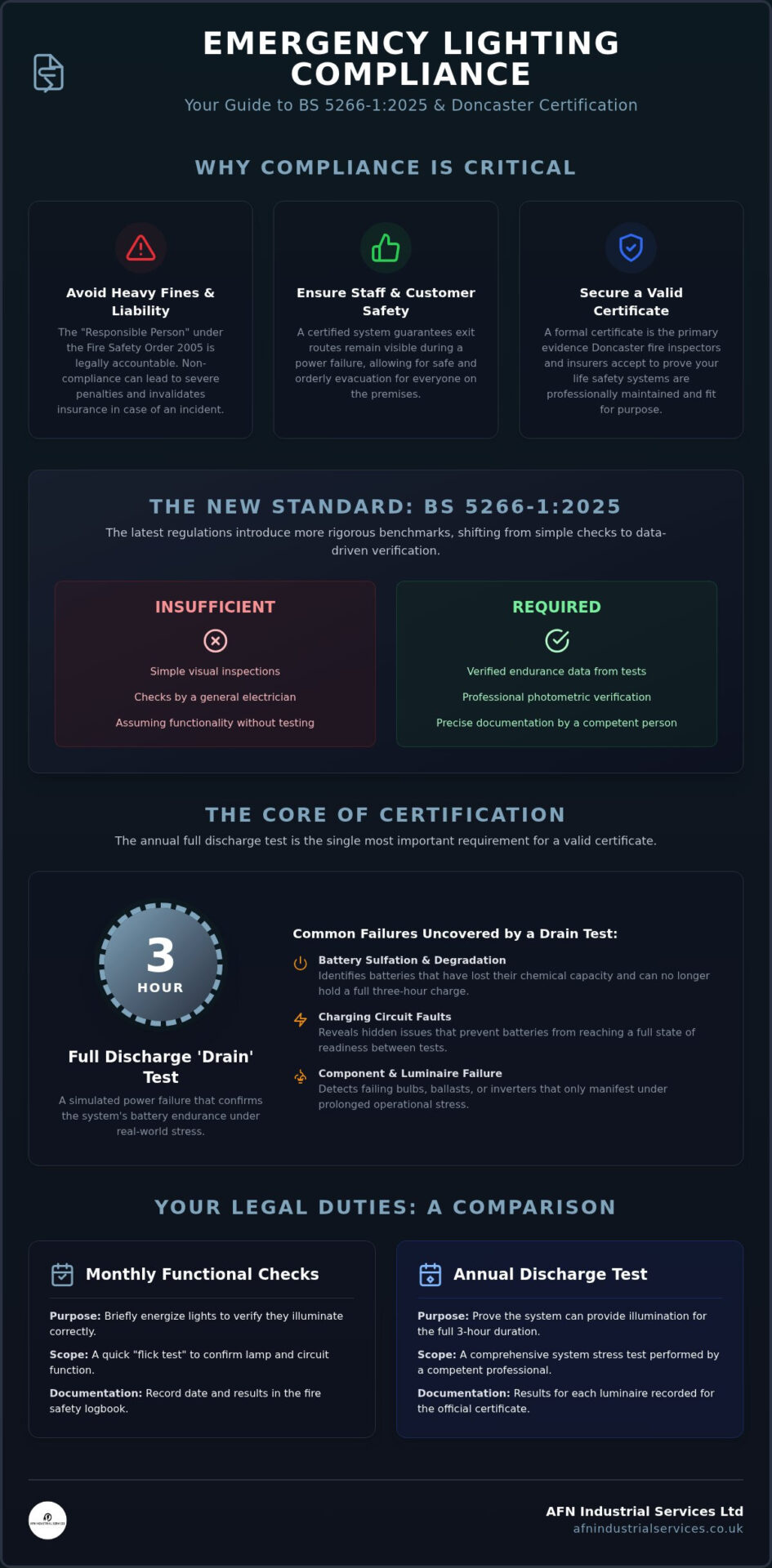
A professional drain test acts as a physical stress test for your building’s safety infrastructure. While the monthly functional check verifies that the lamps ignite, only a full discharge confirms the system’s actual endurance. This technical verification is the primary requirement for an emergency lighting certificate Doncaster operators need to satisfy safety auditors. According to the Regulatory Reform (Fire Safety) Order 2005, the endurance of these systems must be proven through documented evidence rather than theoretical assumptions. A drain test is a simulated power failure duration check that forces the system to rely entirely on its internal battery reserves.
For most commercial premises, a three-hour endurance is the industry benchmark. This specific duration allows for safe evacuation and ensures that emergency services have sufficient visibility if they need to enter the building. Common failure points identified during these tests include battery sulfation, where the chemical capacity of the cell has diminished, and charging circuit faults that prevent the battery from reaching a full state of readiness. Without a professional discharge test, these issues remain hidden until a genuine power failure occurs, potentially leaving your exit routes in total darkness. Securing a valid emergency lighting certificate Doncaster insurers will accept requires documenting that every single luminaire passed this duration check without failing.
Why Annual Full Discharge Testing is Non-Negotiable
Batteries are chemical components that inevitably degrade over time. A unit might show a healthy green charging LED, yet fail within minutes once the mains power is cut. We refer to these as “ghost” lights; they appear functional during a brief “flick test” but lack the capacity for a sustained emergency. A drain test is the only definitive method to identify these hidden failures. It ensures your backup lighting survives the full duration required for commercial compliance, providing a safety margin that protects both lives and your legal standing as a property owner.
How AFN Industrial Services Ltd Conducts Drain Tests
AFN Industrial Services Ltd employs a methodical approach to discharge testing that prioritizes operational stability. We don’t just pull a switch; we systematically monitor every luminaire throughout the discharge window. Our engineers identify components nearing their end-of-life, allowing you to plan repairs before they trigger a certificate failure. This proactive execution is why many South Yorkshire firms trust us for their emergency light drain tests. We provide a comprehensive report for every asset, ensuring your safety logbook remains audit-ready and your premises stay fully protected.
Monthly vs. Annual Inspections: Understanding Your Legal Duties
Compliance with fire safety regulations isn’t a one-off event; it requires a dual-layered approach to maintenance. The 2026 standards, specifically the updated BS 5266-1:2025, distinguish between routine user checks and technical professional assessments. Misunderstanding this difference often leads to failed fire service audits in South Yorkshire. While your internal team handles the basic monthly checks, securing a valid emergency lighting certificate Doncaster inspectors will approve requires a full annual discharge test performed by a competent professional. This ensures that your system doesn’t just turn on, but stays on for the legally required duration.
Your testing regime may differ slightly depending on whether you have maintained or non-maintained systems. Maintained luminaires operate continuously and are common in public spaces like theatres or hospitals. Non-maintained units only activate when the mains power fails, which is the standard setup for most Doncaster warehouses and offices. Both systems require a meticulous logbook history. When a fire inspector visits your site, they’ll prioritize your logbook over the physical equipment, looking for a consistent record of every test performed over the last 12 to 24 months. For a deeper dive into these requirements, see our Emergency Light Testing: The 2026 Compliance Guide.
The Monthly ‘Flick Test’ Checklist
Designated site staff or fire wardens should perform a functional “flick test” every 30 days. This is a brief check to ensure every emergency lamp illuminates when the power is interrupted. During this walk-through, staff should verify that the green charging LED is visible on every unit and that luminaires are clean and unobstructed. If a lamp flickers or the charging light is red, it’s a sign of a failing component. You must record every “pass” or “fail” in your fire safety logbook immediately. If you notice multiple failures, don’t wait for your annual inspection; call a specialist to prevent your entire system from becoming non-compliant.
The Annual 3-Hour Discharge Test
The annual test is a high-stakes technical requirement that only a competent professional can fulfill. It involves a full three-hour discharge of the battery system to verify its endurance under load. Because this test leaves your backup batteries depleted, it’s best to schedule this during low-occupancy hours. This allows the system enough time to recharge fully before staff or customers return to the premises. Following a successful drain test, we provide the formal emergency lighting certificate Doncaster business owners need for their insurance and legal records. This certification acts as a professional seal of approval, confirming your system meets the highest safety benchmarks.
Preparing Your Doncaster Premises for an Emergency Lighting Audit
Effective preparation for a safety audit reduces operational downtime and ensures a smoother path to your emergency lighting certificate Doncaster. Before our engineers arrive at your site, you should locate your existing fire safety logbook and any previous certificates. These documents provide the necessary historical data for a comprehensive audit. Next, conduct a walk-through to identify obvious faults such as red LED indicators on units or flickering tubes. Early identification allows us to bring the correct replacement components, preventing the need for a follow-up visit. Ensuring our engineers have unrestricted access to all areas, including plant rooms and high-level warehouse racking, is vital for a thorough inspection. Finally, coordinate with our team to schedule the three-hour discharge at a time that minimizes disruption to your business flow.
Common Deficiencies in Doncaster Commercial Buildings
We frequently encounter specific issues across South Yorkshire that can delay certification. In large warehouse environments, inadequate signage at change-of-direction points is a common point of failure. Occupants must be able to see the next exit sign clearly from any point on the escape route. External lighting failures are another frequent problem; if the route leads to an outside area that remains pitch black, the system fails the safety check. In busy retail environments like the Doncaster Frenchgate centre, luminaires are often obstructed by temporary stock displays or new signage. These obstructions prevent the light from reaching the floor level required for safe passage.
Combining Your Safety Inspections for Efficiency
Managing multiple compliance dates for different safety assets is an administrative burden. Many facility managers find logic in scheduling their lighting tests alongside Fire Extinguisher Servicing. Bundling these requirements into a single site visit reduces administrative friction and often lowers overall service fees. It ensures that all your fire safety assets are synchronized within one master compliance folder, making it easier to present evidence during a surprise fire service inspection. This integrated strategy is the most efficient way to maintain your emergency lighting certificate Doncaster while managing other fire safety duties. To secure your premises and streamline your compliance, contact AFN Industrial Services to schedule your combined audit.
Why Choose AFN Industrial Services for Your Doncaster Certification?
Selecting a contractor for your safety certification requires more than just a price check; it demands a partner with deep technical expertise. AFN Industrial Services brings 25 years of local experience to every site visit, serving facility managers across South Yorkshire from our Rotherham base. We operate as Reliable Experts, meaning we don’t simply identify faults to leave you with a list of problems. Instead, we provide functional industrial solutions that restore your compliance immediately. You’ll deal directly with seasoned engineers who understand the heavy-duty requirements of your facility, rather than navigating a generic call centre. This direct line of communication ensures that technical queries are handled with precision and speed.
We prioritize commercial clarity through transparent pricing structures. Whether your site requires a per-item breakdown or a comprehensive site-wide quote, we provide the data you need for budget certainty. Our approach integrates your emergency lighting certificate Doncaster requirements with other vital assets, such as fire extinguisher maintenance. This methodology ensures that your safety protocols aren’t fragmented across different providers. By consolidating your compliance tasks, you reduce administrative friction and ensure that every life safety system is handled with the same level of professional thoroughness.
Our Commitment to Doncaster Businesses
Our team is active daily across Doncaster’s key commercial hubs, from the high-capacity iPort logistics park to the Thorne and Hatfield industrial estates. We specialize in complex environments where standard “off-the-shelf” testing procedures often fail to address specific operational risks. Whether you manage a town centre retail unit or a vast distribution warehouse, we tailor our discharge testing to suit your occupancy patterns. Our digital certification process is designed for speed, delivering your emergency lighting certificate Doncaster promptly to satisfy both fire inspectors and insurance auditors.
The AFN Professional Standards
Safety is our baseline. Every engineer is fully insured and safety-vetted to work in high-stakes industrial environments. We strictly adhere to the latest BS 5266-1:2025 protocols, ensuring your systems meet the most current photometric and endurance standards. This commitment to formal validation acts as an anchor for your site’s credibility, proving that you value the safety of your staff and customers above all else. Contact AFN Industrial Services for your Doncaster Emergency Lighting Certificate to secure your premises today.
Secure Your Doncaster Premises for 2026
Maintaining a safe environment for your staff and customers requires proactive asset management. The transition to the BS 5266-1:2025 standards means that simple visual checks are no longer sufficient for legal protection. You must provide evidence of battery endurance through documented annual discharge testing. Securing a professional emergency lighting certificate Doncaster business owners can rely on is the final step in closing your compliance gap and minimizing insurance liability.
AFN Industrial Services offers the stability of 25+ years of industry experience. We are specialists in emergency light drain tests, providing the technical validation required for high-stakes industrial and commercial environments. Our local South Yorkshire support team is ready to help you synchronize your safety audits and streamline your fire safety documentation. Don’t wait for a fire service inspection to uncover faults in your system. Book Your Emergency Lighting Certificate in Doncaster Today and gain the peace of mind that comes with expert certification. We’re here to ensure your exit routes remain safe and your business stays fully protected.
Frequently Asked Questions
Is an emergency lighting certificate a legal requirement in Doncaster?
Yes, it’s a legal requirement under the Regulatory Reform (Fire Safety) Order 2005. This legislation mandates that the “Responsible Person” must ensure all escape routes are adequately illuminated during a power failure. An emergency lighting certificate Doncaster businesses receive acts as the primary evidence of this compliance. Local fire inspectors prioritize this documentation during site audits to verify that life safety systems are being maintained correctly and consistently.
How long does an emergency lighting certificate last for commercial buildings?
A professional emergency lighting certificate is valid for twelve months. While your internal staff must perform monthly functional checks, the British Standard BS 5266-1:2025 requires a full discharge test every year. This annual inspection confirms that the internal batteries can sustain the luminaires for the mandatory three-hour duration. Once the system passes this endurance test and any faults are rectified, a new certificate is issued to cover the next twelve-month period.
Can any electrician issue an emergency lighting certificate?
If any luminaire fails to remain illuminated for the full duration, the engineer records a failure in your safety logbook. You won’t receive a valid emergency lighting certificate Doncaster compliance officers approve until these faults are repaired. Usually, this involves replacing degraded battery cells or faulty charging circuits. After the remedial work is complete, the system is re-tested to confirm it meets the three-hour benchmark before the final compliance certificate is generated and issued.
Does my business need emergency lighting if I only operate during daylight hours?
Most commercial buildings require emergency lighting regardless of their operating hours. Power failures occur without warning, and internal areas like stairwells, basements, or toilets often lack natural light even at midday. If a fire breaks out, smoke can quickly darken a building, making illuminated exit signs vital for safe passage. Your fire risk assessment will identify specific zones where emergency illumination is mandatory to prevent panic and guide occupants to safety during an emergency.
How much does an emergency lighting certificate cost in Doncaster?
The total fee for an emergency lighting certificate Doncaster businesses are quoted depends on the number of luminaires and the complexity of the electrical installation. A vast industrial facility with high-access requirements will differ in scope from a standard retail unit. Professional service providers offer transparent pricing based on a per-item or site-wide assessment. Providing an accurate count of your emergency lamps ensures the quotation covers the full three-hour discharge period required for legal compliance.
What is the difference between an EICR and an emergency lighting certificate?
An EICR evaluates the condition of a building’s fixed electrical wiring and is typically required every five years. An emergency lighting certificate is a separate life safety document that specifically validates battery endurance and luminaire performance. While the EICR ensures the power supply is safe, the lighting certificate proves the backup system will work when that power fails. You must maintain both sets of records, but they involve different testing frequencies and technical standards.
Do I need to test emergency lighting in an HMO property?
Landlords of Houses in Multiple Occupation (HMOs) have a legal duty to maintain emergency lighting in all communal escape routes. These systems must be tested monthly by a designated person and annually by a competent professional. Maintaining these records is often a condition of the HMO license issued by the local council. Regular testing ensures that tenants can navigate hallways and stairs safely during a fire or power cut, reducing the landlord’s legal and insurance liability.