In the 2025/26 period, 126 worker fatalities occurred across Great Britain, a statistic that underscores the critical importance of proactive risk management. For many facility managers in Sheffield and South Yorkshire, the difference between a routine shift and a RIDDOR reportable incident often comes down to how your team handles Near Misses. You likely recognize that high insurance premiums and the persistent fear of a blame culture can prevent staff from speaking up about close calls. It’s frustrating when confusion over what requires formal reporting leads to missed opportunities for improvement.
By identifying these “free lessons” before they escalate into injuries, you can transform your business safety culture and prevent serious workplace accidents. This guide provides a clear reporting framework to help your operation achieve full HSE compliance and reduce workplace accidents. We’ll examine the current 2026 RIDDOR consultation landscape, clarify reporting definitions, and explain how documenting minor electrical or structural slips can inform your professional safety audits. This methodical approach ensures your facility remains a safe, stable environment for every employee.
Key Takeaways
- Learn how to identify Near Misses as critical event-based precursors to serious workplace injuries and fatalities.
- Understand the legal distinction between internal incident tracking and mandatory RIDDOR reporting for specific “Dangerous Occurrences.”
- Discover how to implement a no-blame reporting framework that encourages staff transparency and simplifies documentation processes.
- See how proactive data collection serves as a vital foundation for professional health and safety audits and site-wide compliance.
- Access expert guidance tailored for South Yorkshire businesses to reduce operational risk and stabilize insurance premiums.
What is a Near Miss? Definition and Workplace Significance
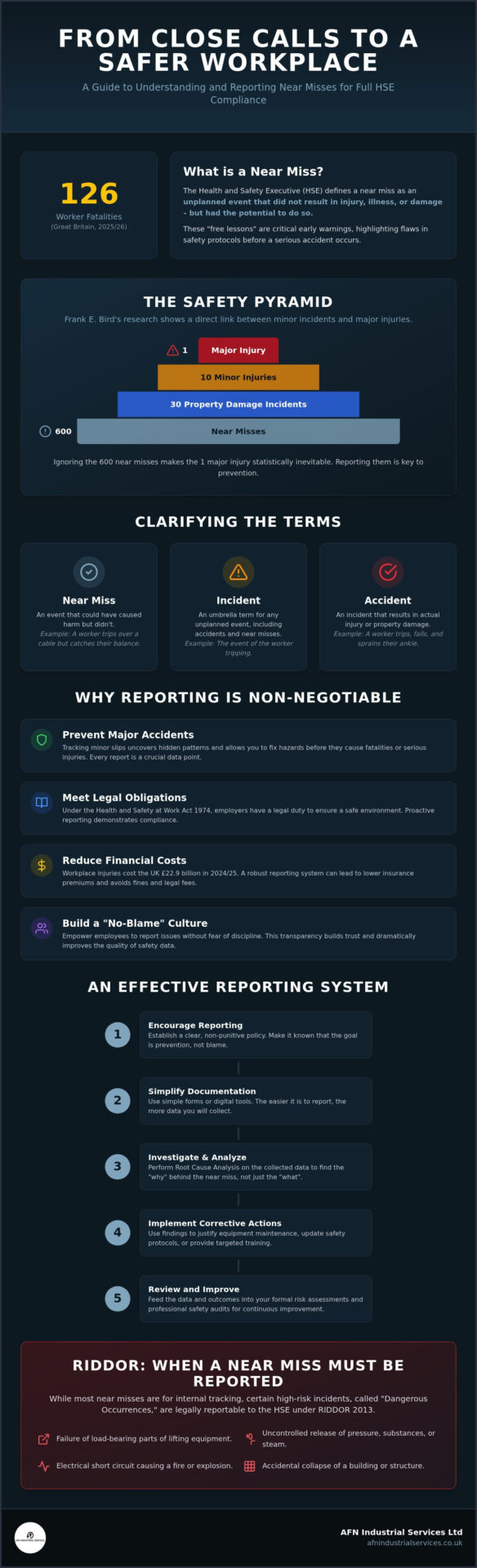
A near miss is an unplanned event that didn’t result in injury, illness, or damage, but had the clear potential to do so. The Health and Safety Executive (HSE) classifies these events as ‘event-based precursors’ to more serious accidents. Identifying What is a Near Miss? allows a business to intervene before a worker is hurt. These incidents act as an early warning system, highlighting flaws in safety protocols or equipment before a catastrophe occurs.
Frank E. Bird’s research into industrial safety led to the ‘Bird’s Pyramid’ theory. This data suggests that for every 600 Near Misses recorded, there is typically one major injury. This ratio demonstrates a clear mathematical link between minor close calls and catastrophic failures. Ignoring these small signals is a high-stakes gamble with your team’s safety. When a worker stumbles but doesn’t fall, it’s a sign that the environment requires immediate attention.
Managing these events is the most cost-effective way to handle workplace safety. It costs nothing to tidy a trailing cable or retrain a forklift driver. Conversely, a single accident can lead to legal fees, lost productivity, and increased insurance premiums. Proactive identification of Near Misses often reveals the need for routine maintenance, such as ladder inspections or portable appliance testing, before equipment fails during use.
Common Examples of Near Misses in Industrial Settings
In industrial environments, these events are often subtle but indicate systemic risks. A worker might trip over a loose floorboard in a Rotherham warehouse but regain their balance. While no harm was done, the hazard remains. In a Sheffield manufacturing plant, a forklift might narrowly miss a pedestrian due to poor visibility at a corner. Similarly, a ladder might slip slightly while an operator is climbing, though they managed to steady themselves. Each of these cases represents a failure in the safety chain that requires documentation.
The Difference Between a Near Miss, an Incident, and an Accident
Clarity in terminology is essential for accurate reporting and compliance. An accident is an event that results in actual physical injury or property damage. An incident is a broader, umbrella term that includes both accidents where harm occurred and close calls where it did not. A Dangerous Occurrence is a specific, high-risk category of near miss that is legally reportable under RIDDOR 2013. These include events like the failure of load-bearing parts on lifting equipment or an electrical short circuit that causes a fire. While most close calls stay within your internal records, these high-potential events require immediate notification to the HSE.
Why Reporting Near Misses is Critical for UK Businesses
Reporting isn’t a bureaucratic exercise. It’s a strategic tool designed to prevent “The Big One.” Understanding What is a Near Miss? helps facility managers build a buffer against disaster. By tracking minor slips, you uncover the hidden patterns that lead to fatalities. Every close call recorded is a data point that could save a life in the future.
Under the Health and Safety at Work Act 1974, employers have a legal duty to ensure a safe environment. Proactive reporting proves you’re meeting this obligation. It also has a direct impact on the bottom line. The economic cost of workplace injury and ill health in Great Britain for 2024/25 was estimated at £22.9 billion. Insurers look favorably on businesses with robust reporting systems, often rewarding lower accident rates with reduced commercial premiums.
A strong reporting culture shifts the focus from blame to prevention. It empowers employees to take ownership of their workspace. When staff feel safe to report errors without fear of discipline, the quality of your safety data improves. This transparency is the foundation of a reliable industrial operation.
Identifying Root Causes Through Near-Miss Data
Near-miss data provides the evidence needed to update Risk Assessments. If three people stumble in the same corridor, the floor surface is the problem, not the staff. Root Cause Analysis allows you to solve the issue once rather than constantly treating symptoms. You can use this data to justify the budget for new safety equipment or specialized training. It moves safety management from a cost center to a value driver.
Linking Near Misses to Equipment Maintenance
Many Near Misses are actually equipment warnings. A slight electrical shock or a visible spark from a machine isn’t just a minor event. It’s a clear signal that the item requires portable appliance testing to prevent a fire or electrocution. Similarly, blocked fire exits or obstructed extinguishers are critical categories that demand attention. Ensuring that fire extinguisher servicing is up to date mitigates these risks before an emergency occurs. If your data reveals recurring equipment issues, our professional health and safety services can help you implement a more robust maintenance schedule.
Legal Requirements and RIDDOR: What You Must Report
While the majority of Near Misses are managed through internal safety protocols, specific high-risk events fall under the Reporting of Injuries, Diseases and Dangerous Occurrences Regulations (RIDDOR) 2013. These are termed “Dangerous Occurrences.” As of August 2026, the Health and Safety Executive (HSE) is reviewing these regulations following a major consultation that concluded in June. Despite potential future changes in 2027 or 2028, current law requires immediate online notification for these events, followed by a full report within 10 days.
Failing to recognize a reportable event can lead to severe penalties. The HSE uses this data to identify trends and target inspections. If an investigation reveals that a Dangerous Occurrence was suppressed, the business faces potential prosecution, heavy fines, and a significant blow to its professional reputation. Precise documentation is the only way to ensure compliance during high-stakes industrial operations.
Common examples of reportable Dangerous Occurrences include:
- The collapse, overturning, or failure of any load-bearing part of lifting equipment or scaffolding.
- Plant or equipment coming into contact with overhead power lines.
- Electrical short circuits or overloads that cause a fire or an explosion.
- Accidental release of any substance which may cause major injury or damage to health, such as a significant gas leak.
Internal Tracking vs. Official HSE Reporting
A robust safety system records 100% of incidents, regardless of their RIDDOR status. Internal tracking provides the data necessary to refine your specific health and safety protocols. Maintaining a GDPR-compliant incident log book is a legal necessity for businesses with 10 or more employees. These records act as a primary defense against personal injury claims. They prove that the company actively monitors hazards and takes reasonable steps to mitigate them before they cause harm.
Is Near-Miss Reporting a Legal Requirement?
The Management of Health and Safety at Work Regulations 1999 doesn’t explicitly name every minor slip, but it mandates that employers assess and control risks. If a serious accident occurs and an investigation finds a history of unaddressed Near Misses, it serves as evidence of negligence. Courts view a lack of reporting as a failure to maintain a safe system of work. In 2026, a documented history of near misses serves as definitive evidence of a business’s foresight and commitment to risk mitigation during HSE inspections.
How to Build an Effective Near-Miss Reporting System
A functional reporting system relies on trust rather than technology. If your staff believes that reporting a close call will result in a formal warning, they’ll remain silent. To capture accurate data on Near Misses, you must first remove the threat of blame. Transitioning to a “just culture” focuses on why a system failed rather than who made the mistake. This shift encourages transparency in high-stakes environments like warehouses and manufacturing plants.
Efficiency is the next priority. Busy site operatives don’t have time for complex paperwork. Simplify the process by using digital apps or concise one-page forms located at key workstations. Once a report is submitted, investigate it promptly. When employees see immediate remedial action, they recognize that their input has practical value. Finally, establish a clear feedback loop. Informing the team about specific safety improvements made as a direct result of their reports reinforces the system’s importance.
Overcoming Barriers to Employee Reporting
In many industrial workplaces, a “snitch” stigma persists that prevents honest reporting. You must reframe these reports as protective measures for the whole team. It isn’t about highlighting a colleague’s error; it’s about identifying a hazard that could hurt them tomorrow. Busy schedules also create a “fear of red tape.” If the reporting process feels like a burden, it’ll be ignored. Training is essential here. Use toolbox talks to teach staff how to recognize Near Misses that might otherwise be dismissed as just part of the job.
Designing a Simple Near-Miss Report Form
A well-designed form captures the necessary data without being intrusive. Essential fields include the date, time, location, and a brief description of the event. Crucially, include a section for “what could have happened.” This allows you to gauge the potential severity of the risk. Providing an option for anonymity is vital in high-pressure environments where workers might still feel vulnerable. Integrating these insights into your wider workplace safety strategy ensures that your documentation remains a living part of your operation. If you need help structuring these processes, our health and safety consultancy services provide the professional framework required for full compliance.
Professional Safety Support in South Yorkshire and the Midlands
AFN Industrial Services supports businesses across Rotherham, Sheffield, and Doncaster with practical, heavy-duty risk management solutions. With over 25 years of industry experience, we understand the specific operational challenges of northern industrial sites. Our team translates raw data from Near Misses into actionable Safe Systems of Work (SSoW). This process ensures that your fire safety and electrical compliance protocols align perfectly with your incident reporting history. We act as a calm, capable partner in complex environments, providing the stability your facility managers require.
We provide thorough Fire Extinguisher Maintenance and Portable Appliance Testing to address equipment-related risks before they escalate into accidents. If your internal reports show recurring electrical sparks or obstructed fire exits, our technicians provide the on-site expertise to rectify these hazards immediately. This integrated approach ensures that your safety documentation isn’t just a static file but a functional tool for daily operations. We focus on execution rather than promotional embellishment, delivering results that keep your facility compliant and your workers protected.
Tailored Safety Solutions for Northern Businesses
Local expertise in Sheffield and Wakefield is vital for maintaining industrial compliance in a demanding regulatory landscape. We offer qualitative face-fit testing and ladder inspections as critical risk mitigators for site-based teams. These services address the physical hazards often identified in close-call reports, such as equipment instability or respiratory risks. By partnering with a local specialist, facility managers maintain a ‘Compliance Ready’ status at all times. Our specialists understand the heavy-duty nature of South Yorkshire’s industrial sector and provide individualized solutions that rigid, national competitors often overlook.
Next Steps: Auditing Your Current Safety Culture
A professional audit is the most effective way to identify hidden trends in your Near Misses. We examine your existing records to find systemic flaws that your team might’ve missed during busy shifts. This includes reviewing your Emergency Light Drain Tests to ensure safe evacuation routes are always functional and documented. AFN provides the robust documentation required for full legal peace of mind, ensuring you meet all current HSE standards. Our methodical auditing process mirrors a well-organized project plan, giving you a clear roadmap for safety improvements. This level of thoroughness helps stabilize insurance premiums by demonstrating a proactive commitment to risk reduction.
Contact AFN Industrial Services today for a professional safety consultation.
Strengthening Your Industrial Safety Foundation
Effective safety management doesn’t just mean reacting to accidents. It’s about building a proactive culture where every close call is treated as a vital data point. By implementing a no-blame reporting system, you empower your team to identify hazards before they escalate into RIDDOR-reportable incidents. Tracking Near Misses provides the specific evidence needed to refine your Risk Assessments and justify essential maintenance, such as Portable Appliance Testing or ladder inspections.
At AFN Industrial Services, we bring over 25 years of industry experience to every site we visit. Based in Rotherham, we serve as a reliable partner for facility managers across South Yorkshire and the Midlands. Our specialists focus on creating HSE-compliant documentation that protects both your business and your workforce. We’ll help you move beyond simple compliance to achieve a truly stable and safe operational environment.
Secure your workplace with professional H&S consultancy from AFN Industrial Services
Prioritizing these early warning signs today ensures a safer, more productive workplace for years to come.
Frequently Asked Questions
What is a near miss example in an office environment?
A common office example is a worker stumbling over a trailing computer cable without sustaining an injury. Another instance involves a heavy box falling from a high shelf but narrowly missing a staff member. While these events don’t result in harm, they indicate failures in cable management or storage protocols. Documenting these Near Misses allows facility managers to implement corrective measures, such as cable tidies, before a serious accident occurs.
How long should we keep near-miss report records?
For businesses with 10 or more employees, maintaining a GDPR-compliant accident book is a legal requirement. Records of reportable incidents must be kept for at least three years from the date of the entry. However, many industrial operators choose to retain internal data for longer periods to identify long-term safety trends. This historical data is essential for professional safety audits and helps demonstrate a consistent commitment to risk mitigation during official HSE inspections.
Do near misses count towards our official accident frequency rate?
Standard Accident Frequency Rate (AFR) calculations typically only include events that resulted in actual injury or lost time. However, many sophisticated safety managers now use a separate “All Incident Rate” that incorporates Near Misses. This broader metric provides a more accurate reflection of the site’s safety culture. By tracking close calls alongside accidents, you gain a clearer understanding of the ratio between minor precursors and serious injuries, allowing for more precise intervention.
What is the difference between a near miss and a hazard?
A hazard is a potential source of harm, such as a frayed electrical wire or a wet floor. A near miss is an actual event where that hazard almost caused an injury. For instance, the frayed wire is the hazard; a worker touching the casing and seeing a spark without getting a shock is the near miss. Hazards require identification and removal, while reporting provides the data needed to understand why the hazard existed.
Can an employee be disciplined for a near miss?
An effective safety culture avoids disciplining staff for honest mistakes that lead to a close call. Punitive measures often discourage reporting, which leaves the business blind to underlying risks. Instead, focus on root cause analysis to determine if the event was caused by poor training, faulty equipment, or inadequate procedures. Encouraging transparency ensures that your safety data remains accurate and that hazards are addressed promptly by facility managers.
How many near misses should a company expect to have?
If your report log is empty, it rarely indicates a perfectly safe environment; instead, it often signals that staff aren’t recognizing or reporting close calls. A healthy safety culture typically generates a high volume of these reports, reflecting an engaged workforce. High reporting numbers are a positive indicator, as they provide facility managers with the data needed to solve minor issues before they escalate into a serious RIDDOR-reportable accident or a workplace fatality.
Is a near miss the same as a ‘close call’?
Yes, ‘close call’ is a common industry term used interchangeably with a near miss. Both describe an unplanned event that had the potential to cause injury or damage but did not. Whether you use formal terminology or colloquial descriptors, the objective remains the same: capture the data and prevent a recurrence. Using clear, accessible language in your reporting forms helps site operatives understand exactly what they need to document during their busy shifts.
Should near-miss reports be anonymous?
Providing an option for anonymity is highly effective in high-pressure industrial environments. It removes the fear of peer judgment or management repercussions, leading to higher reporting rates. While knowing the identity of the reporter can help during a detailed investigation, the priority is identifying the hazard itself. An anonymous reporting channel ensures that critical safety information reaches facility managers, allowing for proactive maintenance like ladder inspections or fire extinguisher servicing without delay.