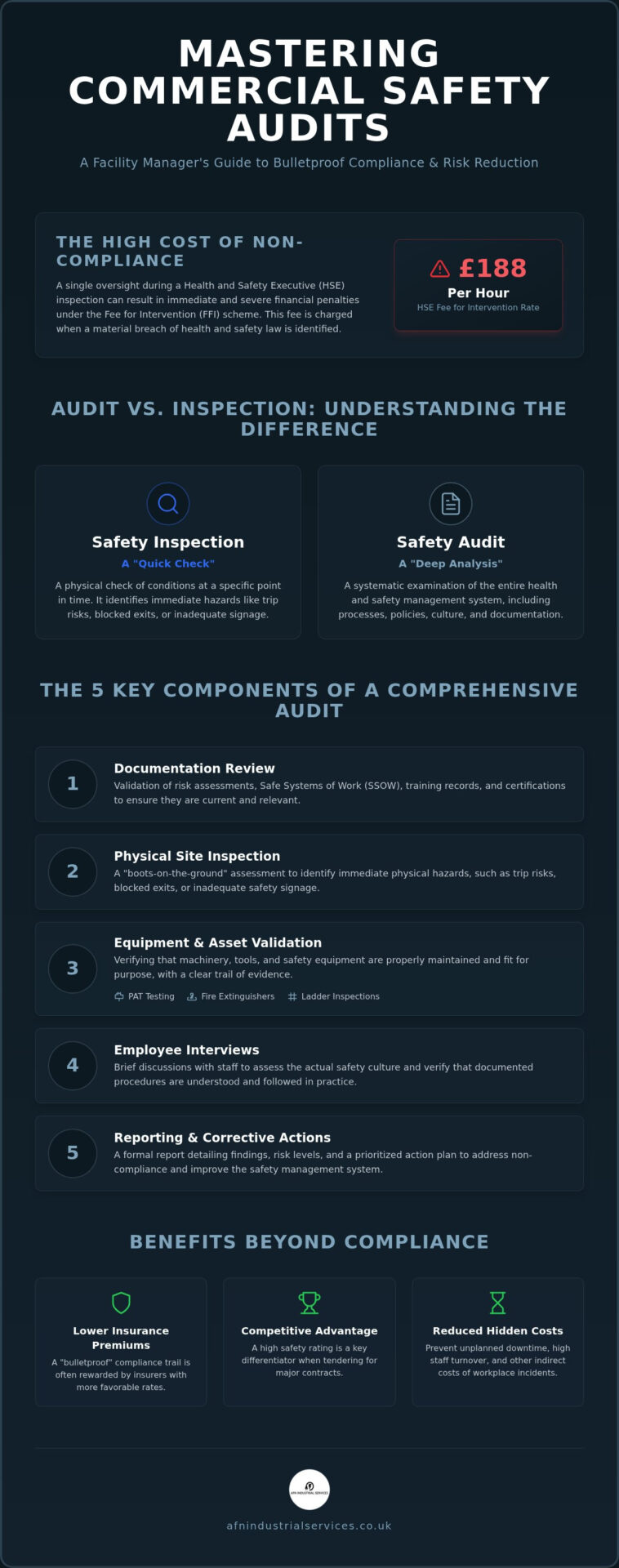
With the Health and Safety Executive (HSE) Fee for Intervention rate now standing at £188 per hour, a single oversight during a routine inspection is no longer just a safety concern; it’s a significant financial liability. For facility managers in Sheffield, the challenge of maintaining operational momentum while navigating complex regulatory demands is a constant reality. You’re likely all too familiar with the stress of coordinating Portable Appliance Testing (PAT) and fire safety schedules while watching insurance premiums rise. It’s a demanding environment where the cost of a mistake can reach millions, making rigorous safety audits a non-negotiable requirement for modern industrial operations.
We recognize that you need a workplace that is both productive and protected. This guide provides a clear roadmap for mastering commercial safety audits to help you safeguard your workforce and ensure total legal compliance. By following this structured approach, you’ll reduce operational risk and build a bulletproof compliance trail for your insurers. We will break down the essential elements of the process, including fire extinguisher maintenance and ladder inspections, to give you the clarity needed to maintain a secure and functional site.
Key Takeaways
- Understand how safety audits function as a proactive mechanism to validate your physical safety barriers against 2026 legal benchmarks.
- Identify the core components of a site inspection, focusing on critical maintenance for fire extinguishers, ladders, and electrical equipment.
- Learn the strategic advantages of third-party audits in eliminating “familiarity blindness” and providing authoritative validation for insurers.
- Access a structured preparation checklist for Sheffield facility managers to streamline documentation and maintenance scheduling.
- Discover how to integrate physical asset testing with documentation reviews to create a robust, compliant safety ecosystem.
What is a Safety Audit and Why is it Critical in 2026?
A safety audit is a systematic and independent examination of an organisation’s entire health and safety management system. It’s the “brain” of your compliance strategy. While a safety inspection is a quick check of physical conditions, Safety audits provide a deep analysis of your processes and culture. They verify that your safety policies aren’t just words on a page but are actively protecting your staff. This process applies foundational Occupational safety and health principles to ensure every risk is accounted for and managed effectively.
The regulatory landscape in 2026 demands more than just a signed policy. The Health and Safety Executive (HSE) has shifted its focus toward proactive physical asset validation. They want proof that your safety equipment, from fire extinguishers to ladders, is fit for purpose. Ignorance is no longer a viable defence. A failed audit often reveals breaches of Section 2 or 3 of the Health and Safety at Work etc. Act 1974. With the HSE Fee for Intervention (FFI) rate currently at £188 per hour, the financial consequences of non-compliance are immediate and severe. You’re paying for the regulator’s time to fix your mistakes.
The Legal Framework for UK Businesses
The Management of Health and Safety at Work Regulations 1999 mandates that employers monitor their safety arrangements. This requires the involvement of “Competent Persons” who possess the technical expertise to identify hidden risks. In 2026, compliance is about evidence, not intentions. You need a documented trail of maintenance and testing to satisfy inspectors. This includes regular Portable Appliance Testing (PAT) and fire equipment servicing. Moving away from “box-ticking” toward rigorous validation is the only way to ensure your business remains on the right side of the law.
Business Benefits Beyond Legal Compliance
Robust audits do more than just keep the HSE away; they directly impact your profitability. Commercial insurers frequently reward businesses that maintain a “bulletproof” compliance trail with lower premiums. In the competitive industrial landscape of Sheffield and South Yorkshire, a high safety rating is a powerful asset. It’s often the deciding factor when tendering for high-stakes contracts with major operators. By identifying risks early, you prevent the “hidden costs” of workplace incidents, such as unplanned downtime and high staff turnover. A well-audited site provides the stability your business needs to grow, and for those looking to enhance their corporate environment with professional fitness facilities, you can learn more about אולימפוס פתרונות בריאות for expert gym design and consultancy.
The 5 Key Components of a Comprehensive Workplace Safety Audit
Safety audits are only as effective as the data they collect. A structured approach ensures that no critical asset or process is overlooked during the evaluation. The first component is a thorough documentation review. This involves validating your risk assessments, Safe Systems of Work (SSOW), and training records. You must prove that your staff are not only trained but that their certifications remain current and relevant to their specific roles on the shop floor.
The second component is the physical site inspection. This is a boots-on-the-ground assessment where auditors look for immediate hazards. Common issues include trip risks, blocked emergency exits, or inadequate safety signage. This leads directly into the third pillar: equipment and asset validation. Auditors require evidence that your machinery and tools are maintained to professional standards. Following this, employee interviews help assess the actual safety culture of the site. These brief discussions reveal whether the protocols documented in the office are truly understood and followed by the workforce in real-world scenarios.
Validating Electrical Safety (PAT)
Portable appliance testing is a preventative maintenance requirement for all movable electrical assets. In a rigorous audit, these records serve as the backbone of your electrical safety evidence. To satisfy HSE inspectors, you should present a clear, chronological log of all portable appliance testing results. This documentation proves you’ve taken active steps to mitigate fire and shock risks across your facility. If you’re unsure about your current testing status, our team provides comprehensive health and safety services to bring your equipment up to standard.
Fire Safety and Emergency Equipment
Fire safety verification is a non-negotiable pillar of any audit. You must confirm that fire extinguisher servicing is up to date and correctly documented. This level of preparation is vital; International Labour Organization statistics indicate that equipment failure and lack of emergency preparation remain leading factors in workplace incidents globally. Beyond extinguishers, auditors will verify emergency light drain tests and ensure fire blankets are accessible and in good condition. Physical audits also extend to height-safety equipment, requiring regular ladder inspections to prevent falls, which remain a primary cause of workplace fatalities.
Internal vs. External Safety Audits: Which Does Your Business Need?
Internal monitoring is a fundamental part of a healthy safety culture. It allows your on-site team to maintain a constant pulse on daily risks and ensures that basic protocols are followed between formal reviews. However, these checks are often limited by the internal team’s proximity to the work. When staff are immersed in the same environment every day, they naturally develop a level of acceptance for minor deviations. This can lead to a gradual erosion of standards that an internal inspector might unintentionally overlook.
Safety audits conducted by an external specialist provide the necessary distance to evaluate your systems objectively. This “Reliable Expert” perspective ensures that your facility is measured against current industry benchmarks rather than just “the way we’ve always done it.” An external auditor brings an authoritative voice that carries significant weight with both the Health and Safety Executive and commercial insurers. They validate that your physical barriers, such as fire blankets and extinguishers, meet the rigorous standards expected in 2026 without the bias of daily operational pressures.
Adopting a hybrid approach often yields the best results for facility managers in Sheffield and Rotherham. You can utilise frequent internal inspections to handle the “muscles” of your safety regime. Then, you schedule a professional annual audit to act as the “brain” of the operation. This combination ensures that your documentation remains robust and your physical assets stay fully compliant. In the event of a serious incident, having a history of external Safety audits provides a much stronger legal defence by proving you sought competent, independent advice to protect your workforce.
Avoiding the ‘Familiarity Blind Spot’
Staff often walk past hazards they see every day without noticing them because the brain eventually filters out repetitive visual information. This psychological desensitisation makes it difficult for internal teams to spot a blocked emergency exit or a missing ladder inspection tag. Consultants from AFN Industrial Services Ltd bring over 25 years of multi-site experience to your facility. They identify the subtle risks your team has stopped seeing, reinforcing a culture of precision and safety across your entire operation.
Preparing Evidence for Insurers and Stakeholders
Many commercial insurance providers now mandate external safety validation as a condition of coverage or to offer competitive premiums. An independent report serves as a “Safety Passport” that validates the integrity of your site to external stakeholders and potential partners. It demonstrates a commitment to professional standards that can be crucial when tendering for large industrial contracts in South Yorkshire. Beyond standard equipment logs, specialised services like qualitative face-fit testing provide concrete evidence that your PPE protocols are both compliant and effective.
Audit Preparation Checklist: Steps for Rotherham & Sheffield Facility Managers
Success in safety audits depends entirely on the quality of your preparation. A methodical approach ensures that when the auditor arrives, you’re presenting a site that is already in a state of high compliance. The first step involves gathering your ‘Compliance Pack’. This central file should contain your current risk assessments, COSHH sheets, and incident logs. Having these documents organised and ready for review demonstrates a professional commitment to safety management that immediately instils confidence in the auditor.
Beyond the paperwork, you must verify your maintenance calendar. Check that your Portable Appliance Testing and fire extinguisher services are current. If any service dates have lapsed, address them before the audit begins. Conducting a ‘pre-audit’ walk-through is an effective way to catch ‘low-hanging fruit’ such as blocked emergency exits, missing signage, or frayed power cables. These are simple fixes that, if left unaddressed, signal a lack of oversight. Finally, ensure all staff training records are accessible. This includes specialised qualitative face-fit testing results for employees using respiratory protective equipment (RPE).
Regional Compliance Focus: South Yorkshire & Midlands
Manufacturing and industrial sectors in Sheffield and Rotherham face unique risks, from heavy machinery operation to the management of hazardous dust. Local facility managers should leverage regional support networks to stay informed about specific HSE focus areas in the Midlands and North East. Maintaining a steady communication rhythm with your staff during the preparation phase ensures everyone understands their role. This structured approach prevents confusion and minimises disruption to your industrial operations during the actual audit process.
The Physical Asset Prep
Your physical assets are the ‘muscles’ that support your safety policy. Use this quick checklist to ensure your equipment is ready for inspection:
- Fire Extinguishers: Verify correct placement, check pressure gauges are in the green zone (high-quality replacements can be sourced from Zenith Sales & Calibrations Pty Ltd), and ensure fire blankets are easily accessible.
- Electrical Safety: Ensure all electrical items have visible and valid PAT labels that match your central log.
- Emergency Lighting: Confirm all units are functioning and that your drain test logbooks are signed and up to date.
- Access Equipment: Check that all ladders have undergone recent inspections and are free from structural damage.
If you need to update your equipment or schedule a maintenance visit before your next inspection, you can book our professional health and safety services to ensure your site is fully prepared.
How AFN Industrial Services Ltd Streamlines Your Safety Compliance
Managing high-stakes industrial environments requires a partner who understands that safety isn’t a static obligation. At AFN Industrial Services Ltd, we move beyond generic checklists to provide a tailored approach to Safety audits. Our methodology integrates high-level strategic oversight with the heavy-duty maintenance required to keep a site operational. Based in Rotherham, we’ve spent over 25 years acting as a calm, capable partner for businesses across Doncaster, Barnsley, and Wakefield. We provide the stability you need to focus on production while we handle the complexities of regulatory standards.
The AFN Audit Ecosystem is designed to eliminate the gaps between policy and practice. We don’t just identify risks; we provide the technical solutions to mitigate them. By combining documentation support with physical maintenance, we ensure your site remains a high-performance environment. Our team delivers results that meet the highest professional benchmarks. This comprehensive oversight offers the “peace of mind” that only comes from knowing your compliance trail is managed by seasoned experts with decades of industry experience.
Integrated Maintenance and Documentation
One of the primary challenges for facility managers is the administrative burden of coordinating multiple contractors. AFN Industrial Services Ltd simplifies this by acting as a single-source provider for your essential safety services. We deliver professional reporting and documentation alongside the physical servicing of your assets. This integrated model ensures your Safe Systems of Work (SSOW) and audit logs are always aligned with the actual condition of your equipment. Our service list includes Portable Appliance Testing, fire extinguisher maintenance, and ladder inspections. By centralising these tasks, you reduce data loss and ensure a consistent standard of safety across your entire facility.
Getting Started with a Professional Audit
Requesting a site visit is the first step toward securing your operational future. During our initial consultation, we customise the audit scope to match your specific industrial or commercial requirements. We don’t believe in rigid frameworks; instead, we adapt our expertise to the unique challenges of your sector. Our methodical process moves from a broad overview of your site to the specific details of your asset maintenance. This logical progression ensures that every potential risk is identified and addressed with precision through professional Safety audits. Contact AFN Industrial Services Ltd today for a comprehensive safety audit and compliance review.
Secure Your Operational Future Through Rigorous Compliance
Mastering the 2026 regulatory environment requires a shift from reactive fixes to proactive validation. You now understand that Safety audits act as the essential brain of your compliance strategy; they verify that your safety policies translate into real-world protection. By combining documentation reviews with physical maintenance like PAT testing and fire equipment servicing, you eliminate the “familiarity blind spot” that often leads to overlooked hazards. This integrated approach doesn’t just satisfy the HSE; it builds a resilient business capable of securing high-stakes industrial contracts.
AFN Industrial Services Ltd provides the stability and expertise needed to navigate these complex requirements. With over 25 years of industrial safety experience, our local experts serve South Yorkshire and the Midlands with precision. We deliver comprehensive maintenance and documentation solutions that reduce your administrative burden and lower operational risk. Secure your business with a professional safety audit from AFN Industrial Services Ltd. Taking these steps today ensures your facility remains a safe, productive, and legally sound environment for years to come.
Frequently Asked Questions
How often should a business conduct a formal safety audit?
Most industrial businesses in Sheffield should conduct a formal audit every twelve months. This annual cycle allows you to account for changes in machinery, personnel, and floor layouts that occur throughout the year. You should also consider an interim review following a significant workplace incident or a major change in legislation. Regular Safety audits ensure your compliance remains current and protects against the gradual erosion of standards.
What is the difference between a safety audit and a risk assessment?
A risk assessment identifies specific hazards for a particular task or piece of equipment and implements controls to mitigate them. In contrast, Safety audits examine your entire health and safety management system to ensure those controls are actually being used. While the assessment is a plan for a single risk, the audit is a systematic verification that your whole safety programme is functioning as intended.
Is a safety audit a legal requirement for UK businesses?
The Management of Health and Safety at Work Regulations 1999 requires all employers to monitor their health and safety arrangements. While the regulations do not always use the specific term “audit” for every industry, conducting a formal audit is the industry-standard method for meeting this legal monitoring duty. It provides the documented evidence needed to satisfy the Health and Safety at Work etc. Act 1974 requirements.
What happens if a business fails a safety audit?
Failing an audit identifies critical gaps that could lead to workplace accidents or HSE enforcement. If the HSE discovers these failures during an inspection, they can issue Improvement or Prohibition Notices and apply Fee for Intervention charges at £188 per hour. Beyond legal costs, a failed audit can lead to higher insurance premiums and disqualification from tendering for industrial contracts in Rotherham and Doncaster.
Can our own staff perform a safety audit, or do we need a consultant?
Internal staff can perform routine inspections, but they are often prone to familiarity blindness. Engaging a professional consultant from AFN Industrial Services Ltd provides an unbiased, authoritative perspective that internal teams might lack. With over 25 years of experience across the Midlands and North East, our team identifies systemic issues that your staff may overlook, ensuring a more robust and legally defensible compliance trail.
How much does a professional safety audit cost for an industrial site?
Costs for professional safety services are typically scalable to match the size and complexity of your facility. At AFN Industrial Services Ltd, we use a transparent fee structure, such as per-item Portable Appliance Testing fees or per-person qualitative face-fit testing charges. This mechanism ensures that commercial clients in Wakefield or Barnsley pay a rate that reflects their specific asset count and workforce size rather than a generic flat fee.
What documents will an auditor ask to see during their visit?
An auditor will typically request your central compliance pack, which includes your health and safety policy and current risk assessments. They will also examine training records, Safe Systems of Work (SSOW), and incident logs. You should also have maintenance records ready for review, such as ladder inspection logs and fire extinguisher servicing certificates. Having these documents organised demonstrates a professional commitment to safety and facilitates a smoother audit process.
How do PAT testing and fire extinguisher maintenance fit into an audit?
These maintenance tasks serve as the physical evidence that your safety policies are being executed on the shop floor. During an audit, your Portable Appliance Testing records prove you are actively managing electrical risks for all movable assets. Similarly, fire extinguisher maintenance logs provide the validation that your emergency equipment is fit for purpose. These services act as the “muscles” that support the “brain” of your safety management system.