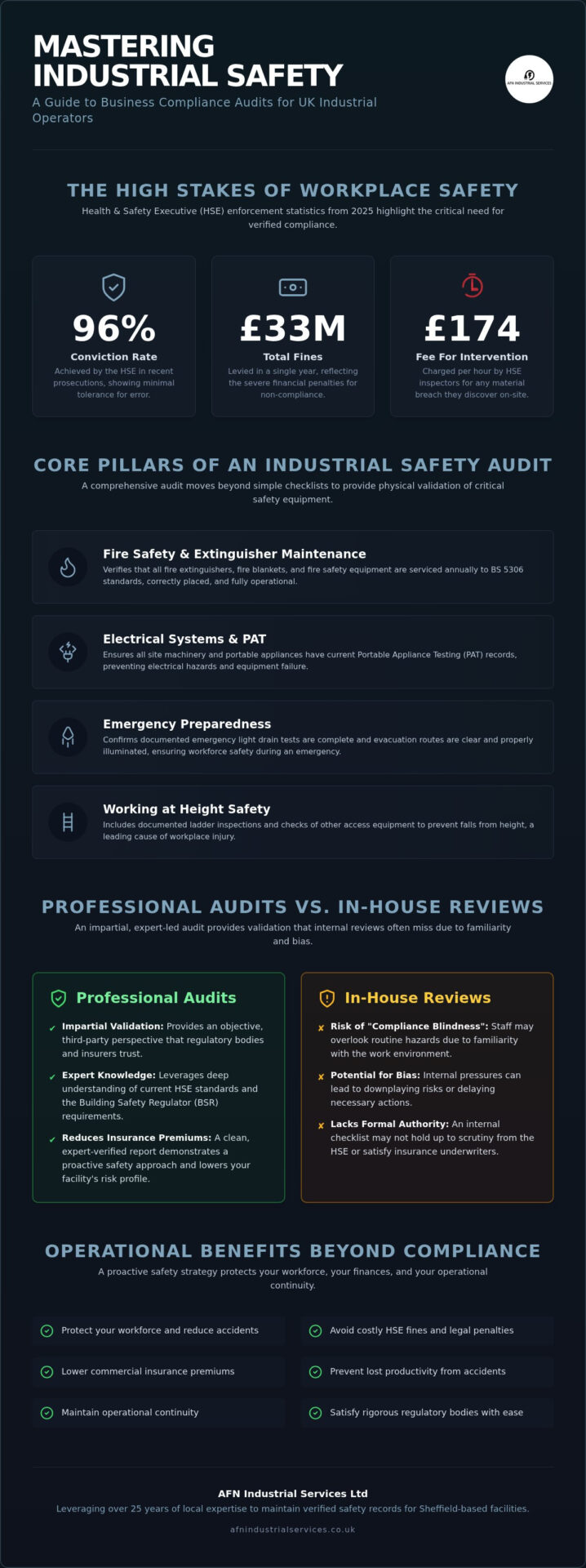
Did you know that the Health and Safety Executive (HSE) secured a 96% conviction rate in 2025, resulting in over £33 million in total fines? For industrial operators and facility managers in Sheffield, these figures represent more than just data; they’re a stark reminder of the high stakes involved in workplace safety. You’re likely familiar with the anxiety that comes from overlapping regulations or the dread of an inspector charging the £174 per hour “Fee for Intervention” because of a simple oversight. It’s frustrating to manage rising insurance premiums while trying to decipher which safety protocols take priority.
Conducting regular business compliance audits is the most effective way to replace that uncertainty with professional validation. This guide will show you how to master the essentials of health, safety, and environmental audits to protect your workforce and ensure total legal compliance. We’ll provide a structured roadmap for your facility, covering everything from fire extinguisher maintenance to portable appliance testing. By the end of this article, you’ll have a clear strategy to reduce workplace accidents and satisfy even the most rigorous regulatory bodies with ease.
Key Takeaways
- Understand the critical role of the Health and Safety Executive (HSE) in setting industrial standards to avoid costly enforcement actions and legal penalties.
- Use systematic Business compliance audits to proactively identify risks in high-stakes areas like electrical systems, respiratory safety, and fire equipment.
- Learn why impartial third-party validation is essential for maintaining insurance coverage and eliminating the “compliance blindness” common in internal reviews.
- Implement a structured 2026 safety roadmap that streamlines everything from documentation gathering to physical testing of fire extinguishers and ladders.
- Leverage over 25 years of local expertise to reduce workplace accidents and maintain a verified safety record for your Sheffield-based facility.
What is a Business Compliance Audit & Why is it Essential?
A business compliance audit is a systematic and objective review of a company’s adherence to specific regulatory guidelines and safety standards. To gain a comprehensive overview of auditing, it helps to understand that these evaluations verify whether your daily operations match your legal obligations. In heavy-duty industries, these checks aren’t mere formalities; they’re critical diagnostic tools that identify gaps in your safety infrastructure before they lead to accidents or legal action. They provide a clear baseline for your current safety performance.
The Legal Framework for UK Businesses
The foundation of workplace safety rests on the Health and Safety at Work etc. Act 1974. This legislation requires every employer in South Yorkshire and the Midlands to provide a safe working environment. Alongside this, the Regulatory Reform (Fire Safety) Order 2005 places strict duties on business owners regarding fire safety equipment. In South Yorkshire and the Midlands, business compliance audits act as a shield against the legal repercussions of these acts. For industrial sites in Sheffield and Rotherham, this means maintaining equipment like fire blankets and extinguishers to a verified standard. Current 2026 regulations have also seen the Building Safety Regulator (BSR) take a more active role in high-risk environments, making detailed documentation a mandatory requirement rather than an optional safeguard.
Operational Benefits Beyond Legal Requirements
Beyond avoiding the £174 per hour “Fee for Intervention,” a professional audit protects your bottom line. It identifies the hidden costs of workplace accidents, such as lost productivity and equipment damage, which can be far more expensive than the audit itself. Insurers increasingly demand proof of professional testing to justify lower commercial premiums. A thorough audit typically verifies:
- The service history of all fire extinguishers and fire blankets.
- Current Portable Appliance Testing (PAT) records for all site machinery.
- Documented ladder inspections to prevent falls from height.
- Emergency light drain test results for safe evacuation routes.
Core Pillars of an Industrial Safety Compliance Audit
Industrial environments present unique challenges that standard retail or office checks simply don’t address. A one-size-fits-all approach fails because it ignores the heavy-duty nature of manufacturing and warehousing. Effective business compliance audits must focus on high-risk sectors: electrical systems, fire hazards, and respiratory risks. While many firms use software to track dates, these tools can’t inspect a damaged extinguisher or a frayed cable. Understanding broader business compliance requirements is a start, but local industrial sites need physical validation. Integrating these checks into a single cycle ensures your facility remains operational without the disruption of multiple visits. For a detailed look at regional standards, see our guide on Workplace Safety in Rotherham & Sheffield.
Fire Safety and Extinguisher Maintenance
Fire extinguishers aren’t just wall ornaments; they’re critical life-saving tools. Auditing their placement and condition is mandatory under current safety protocols. Annual servicing to BS 5306 standards ensures that when a fire occurs, the equipment actually works. We verify the integrity of every unit, including fire blankets, to ensure they’re ready for immediate use. Our specialized Fire Extinguisher Servicing in Rotherham, Sheffield & Doncaster helps businesses maintain these benchmarks with seasoned expertise.
Electrical Compliance: PAT and Emergency Lighting
Portable Appliance Testing (PAT) remains a primary defense against electrical fires in workshops and factories. Auditing these devices alongside emergency lighting drain tests provides a clear picture of your site’s safety. These tests ensure that evacuation routes remain illuminated during power failures, preventing panic and injury. Explore our Portable Appliance Testing (PAT) for South Yorkshire Businesses to see how we handle high-volume industrial environments with precision.
Respiratory Protection: Qualitative Face-Fit Testing
For employees working with hazardous particulates, qualitative face-fit testing is non-negotiable. It’s a critical compliance component that ensures an airtight seal for industrial PPE. Documenting these fit-test results is essential for HSE inspection readiness. Without a verified seal, your workforce is exposed to long-term health risks, and your business remains liable for non-compliance. Our approach focuses on the safety of the individual, ensuring every mask provides the intended protection level.
Maintaining these pillars requires a partner who understands the grit of industrial work. You can secure your facility by booking a consultation for Health and Safety Services tailored to your specific site needs.
Professional Compliance Audits vs. In-House Reviews
Many facility managers initially rely on internal teams to monitor safety standards. While industrial safety self-inspection checklists are effective for day-to-day checks, they lack the formal weight of professional business compliance audits. Internal reviews frequently fall victim to “compliance blindness,” where staff become accustomed to hazards that have existed for months. A frayed cable or a missing safety pin on an extinguisher may be overlooked because it has become part of the daily scenery. A professional auditor provides a detached, expert perspective that is essential for identifying these critical oversights.
Third-party validation is often a strict requirement for maintaining commercial insurance coverage. If a workplace incident occurs, an internal checklist is rarely sufficient to prove due diligence in a court of law. The cost-benefit analysis favors professional intervention; while there is an upfront fee, it is a managed operational cost compared to the unpredictable financial damage of a legal claim. AFN Industrial Services Ltd utilizes over 25 years of experience to identify these subtle risks, providing the formal certification that insurers and regulatory bodies demand.
When to Choose a Professional Consultancy
High-risk environments such as chemical processing, metal fabrication, and heavy warehousing require a level of scrutiny that goes beyond basic housekeeping. You should engage a professional consultancy when preparing for an insurance renewal or if you are scaling operations across multiple sites in the North East. For businesses operating across Sheffield and the wider region, AFN Industrial Services Ltd ensures a uniform safety standard. This removes the risk of inconsistent safety protocols between different shifts or departments, establishing a single, high-performance safety culture.
The Value of Expert Safety Documentation
Professional auditing delivers more than a list of failures; it provides the technical foundation for your Safe Systems of Work (SSoW). These reports are not generic templates but are customized to the specific site layouts of your facility in Sheffield or Doncaster. In the event of a regulatory visit, these expert-verified documents serve as your primary evidence of compliance. They demonstrate that the business has sought professional validation and taken every reasonable step to protect its workforce, meeting the highest professional benchmarks expected in the industrial sector.
Step-by-Step Checklist for Your 2026 Compliance Audit
Generic checklists designed for small retail shops often fail to address the complexities of a Sheffield manufacturing plant or a South Yorkshire warehouse. A professional safety audit requires a methodical, five-phase approach to ensure every hazard is accounted for. By following this structured roadmap, you can transform business compliance audits from a stressful obligation into a strategic asset for your facility. This process identifies risks before they result in HSE fines or industrial accidents. The five essential phases include:
- Phase 1: Pre-audit preparation and documentation gathering.
- Phase 2: Physical site inspection and equipment testing.
- Phase 3: Employee competency and PPE assessment.
- Phase 4: Gap analysis and remedial action planning.
- Phase 5: Final reporting and certification.
Gathering Essential Safety Records
Phase 1 focuses on building a solid administrative foundation. You must compile all historical safety data, including previous PAT records and fire extinguisher service logs. It’s essential to review your current ladder inspection results and verify that your emergency light test logs are up to date. For specific details on local requirements, see our Emergency Light Testing: 2026 Compliance Guide. This stage reveals whether your administrative safety trail will stand up to an official inspection or an insurance review.
Executing the Physical Site Inspection
Phase 2 involves a comprehensive walkthrough of your facility. We identify new or evolving hazards, such as damaged machinery cables or blocked fire exits. During this inspection, we test portable appliances and fire blankets for immediate readiness, ensuring that equipment hasn’t been tampered with or degraded. We also verify that all safety signage is visible, legible, and compliant with current UK standards. This physical validation is the most effective way to prevent workplace injuries.
Following the inspection, Phase 3 moves to employee competency. We verify that your workforce is trained to use safety equipment and that their personal protective equipment has passed qualitative face-fit testing. Phase 4 involves a detailed gap analysis where we compare our findings against current 2026 regulations. We then create a remedial action plan to address any deficiencies. Finally, Phase 5 delivers the formal reporting and certification you need to satisfy regulatory bodies. You can secure your facility and meet every 2026 benchmark by booking our professional Health and Safety Services today.
Tailored Compliance Solutions with AFN Industrial Services Ltd
Local expertise is the final piece of the safety puzzle. While global software platforms like eFACiLiTY® offer robust tracking and asset management tools, they lack the physical presence to inspect a workshop in Rotherham or a warehouse in Barnsley. Business compliance audits require a hands-on approach that only an experienced local partner can provide. At AFN Industrial Services Ltd, we don’t offer generic templates; we deliver no-nonsense, professional safety solutions rooted in over 25 years of industry experience. Our team understands the specific operational challenges faced by facility managers in Wakefield and the surrounding regions, allowing us to customize audit cycles that mirror your specific site requirements.
Specialist Maintenance and Testing
Our service delivery focuses on the high-stakes areas where failure isn’t an option. We provide expert fire extinguisher maintenance and thorough fire blanket inspections to ensure your first line of defense is always operational. For high-volume commercial clients, we offer scalable PAT testing fees that allow you to maintain electrical safety across hundreds of appliances without compromising your budget. Additionally, our professional qualitative face-fit testing ensures your respiratory protection programs meet the highest benchmarks for employee safety. These services provide the formal validation needed to satisfy both HSE inspectors and insurance providers.
Serving the Midlands and North East
We’ve built our reputation on a commitment to constant availability and rapid response times. Our base in Rotherham allows us to provide seamless support to businesses in Worksop, Mansfield, and Scunthorpe. We understand that industrial environments are dynamic, and safety needs can change overnight. By choosing a partner with deep roots in the North East, you ensure that expert help is always within reach. Whether you’re managing a single site or a multi-facility operation, AFN Industrial Services Ltd provides the stability and precision required to maintain total legal compliance through rigorous business compliance audits.
Getting started is a straightforward process. We’ll review your current safety documentation and equipment status to identify any immediate gaps. From there, we develop a recurring audit schedule that keeps your facility safe and your business protected. Contact AFN Industrial Services Ltd for a tailored compliance quote today.
Securing Your Industrial Future Through Proactive Compliance
Adopting a structured approach to safety is a strategic investment in your facility’s operational continuity. By implementing regular business compliance audits, you move beyond basic tick-box exercises to establish a verifiable culture of safety that satisfies both the HSE and commercial insurers. We have outlined how professional equipment testing, such as PAT and extinguisher maintenance, provides the physical evidence of safety required in high-stakes industrial environments. This proactive strategy ensures that your documentation remains robust and your site stays operational without the fear of sudden regulatory intervention.
Relying on seasoned expertise is the most reliable way to navigate the complexities of 2026 safety regulations. With over 25 years of industry experience, our Rotherham-based team delivers the precision and reliability that South Yorkshire’s industrial sector demands. We provide the formal validation necessary to protect your workforce and your bottom line from the consequences of non-compliance. Our focus remains on providing stable, safe, and highly individualized solutions for every client we serve across the Midlands and North East.
Prepare your facility for the challenges ahead by securing a professional review. Book Your Comprehensive Business Compliance Audit with AFN Industrial Services Ltd to ensure your site meets every legal benchmark with confidence. We are ready to act as your steadfast partner in maintaining a safe, productive workplace.
Frequently Asked Questions
How often should a business conduct a compliance audit?
Most industrial operators should schedule a comprehensive audit at least once every twelve months. High-risk facilities in Sheffield or those with high equipment turnover often benefit from more frequent quarterly reviews. Regular business compliance audits ensure that maintenance cycles for fire extinguishers and PAT testing remain current. This prevents gaps in safety records that insurers frequently scrutinize during policy renewal periods or following a reported workplace incident.
Is a business compliance audit a legal requirement in the UK?
The Health and Safety at Work etc. Act 1974 requires all employers to ensure a safe working environment, making systematic reviews a practical necessity. While the specific term audit may not appear in every regulation, it’s the primary method used to prove legal adherence. For businesses in Rotherham and Sheffield, failing to demonstrate these safety standards can lead to HSE Fee for Intervention charges of £174 per hour.
What happens if a business fails a health and safety audit?
Identifying safety gaps during an audit allows you to implement remedial actions before an accident occurs. If these failures are discovered by the HSE instead, the business faces potential prosecutions, which maintained a 96% conviction rate in 2025. Beyond legal penalties, failing to rectify audit findings can result in significantly higher insurance premiums or the total withdrawal of commercial coverage, as insurers view unaddressed hazards as an unacceptable risk.
What is the difference between a risk assessment and a compliance audit?
A risk assessment identifies potential workplace hazards and implements controls to mitigate them. In contrast, business compliance audits verify whether those controls are functioning and if equipment meets specific standards. For instance, a risk assessment might highlight a fire hazard in a Sheffield warehouse, while an audit confirms that the fire extinguishers are maintained to BS 5306 standards and that all service logs are documented correctly for inspection readiness.
How long does a professional site compliance audit typically take?
The time required depends on the scale of your facility and the total volume of equipment requiring inspection. A compact workshop in Doncaster may only take half a day, while a sprawling manufacturing plant in Sheffield could require several days for a full review. The process involves a methodical documentation check followed by physical testing of ladders, fire blankets, and electrical appliances to ensure every safety benchmark is met.
Can I perform my own business compliance audit?
You can conduct internal reviews, but they often lack the impartial validation required by insurers and regulatory bodies. Internal teams may develop compliance blindness, overlooking routine hazards that have become familiar. Professional consultants bring over 25 years of experience and specialized testing equipment to the site. This results in a verified report that acts as a robust legal defense during an HSE inspection or in the event of a workplace injury claim.
What specific documentation do I need for an HSE inspection?
You need to present up-to-date PAT records, fire extinguisher service logs, and emergency light drain test results. Inspectors also require documented ladder inspections and proof of qualitative face-fit testing for any employees using respiratory PPE. Maintaining these records in a centralized safety file demonstrates a proactive management approach. This organization is essential for avoiding the £174 per hour HSE intervention fees and ensuring your facility remains fully compliant with 2026 standards.
How much does a professional business compliance audit cost?
Audit costs are calculated based on the complexity of your site and the volume of items requiring specialized testing. Fees for PAT testing are typically scalable for high-volume commercial clients, while face-fit testing is charged per candidate tested. Investing in a professional audit is a predictable operational expense. It remains far more cost-effective than facing HSE intervention fees or the devastating financial and reputational impact of a serious workplace accident in your facility.