What if the emergency lights in your Sheffield premises failed just when people needed to leave safely? An installed system is not necessarily a dependable one. What are the Benefits of Emergency Light Testing? Regular checks help confirm that lights operate during a power failure, uncover faults and give you time to arrange follow-up work before the system is needed.
Testing can feel like another task on a busy maintenance schedule, particularly when access, records and repairs are difficult to coordinate. A clear process makes it easier to know which fittings were checked, what the results showed and whether any action remains outstanding. That turns emergency lighting from equipment on a wall into a system your team actively monitors.
This article explains how testing supports evacuation, helps organise compliance evidence and reduces the chance of discovering a fault during an outage. You’ll find practical points for planning checks, recording results and following up defects. AFN Industrial Services Ltd provides emergency light drain tests for businesses in Sheffield and nearby areas, with more than 25 years of team experience.
Key Takeaways
- What are the Benefits of Emergency Light Testing? It helps you check whether lighting can support people finding escape routes during a mains failure.
- Planned checks can uncover faults in lamps, batteries or indicators, giving you time to assess them and arrange follow-up work.
- Keep test results and remedial actions together so records show what was checked and how identified issues were handled.
- Build a workable testing plan by identifying equipment, planning access around business operations and tracking results and outstanding actions.
- For organised testing support in Sheffield and nearby areas, consider AFN Industrial Services Ltd’s emergency light drain testing service.
What Are the Benefits of Emergency Light Testing in a Workplace?
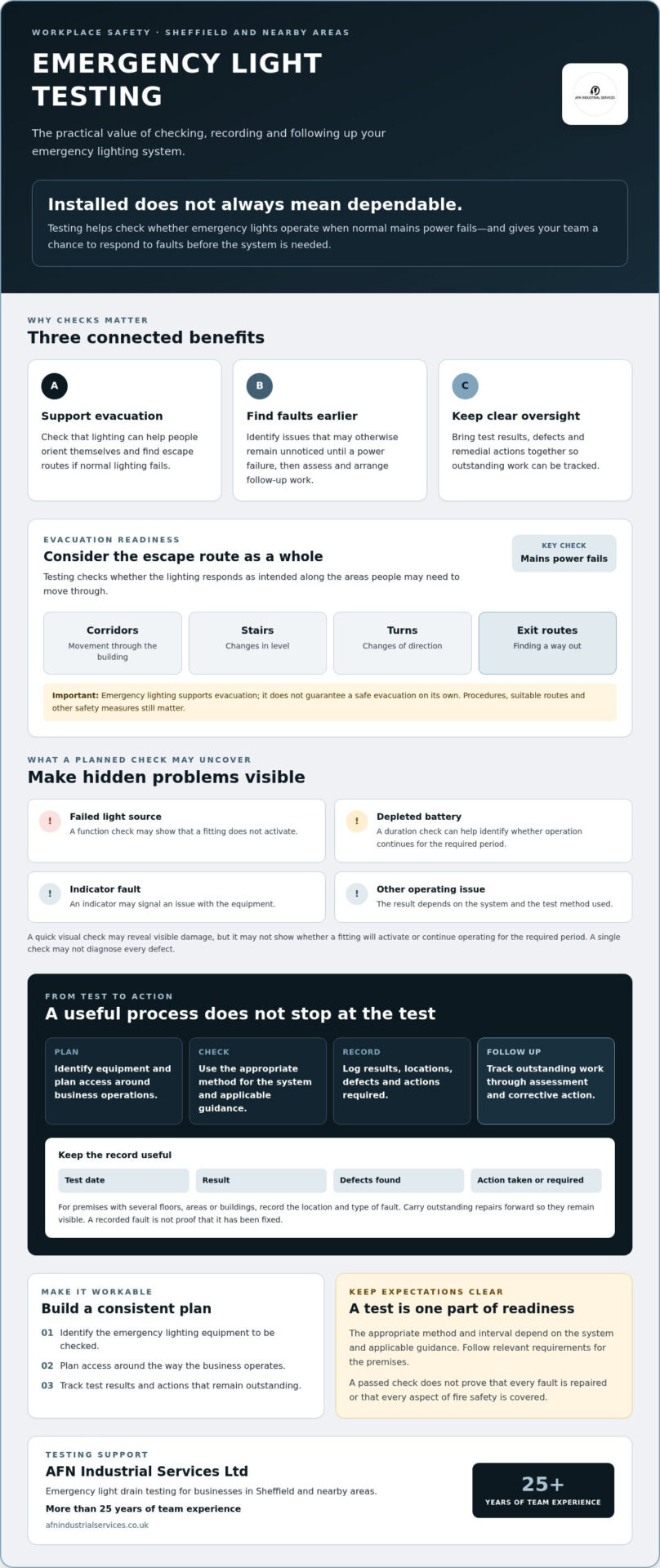
Emergency light testing checks whether the system operates as intended, including whether lights activate when normal mains power fails. It helps businesses assess whether this equipment can provide illumination when occupants need to move through the building or find an exit.
Testing helps verify that emergency lighting is ready to support evacuation, rather than simply present on the premises. That is the central answer to “What are the Benefits of Emergency Light Testing?” The immediate benefit relates to life safety. Maintenance and compliance records matter too, but a completed check does not, by itself, show that every fault has been repaired.
How emergency lighting supports evacuation
If normal lighting fails, illuminated escape routes can help people orient themselves and make their way towards an exit. This may include stairs, corridors, changes of direction and exit routes, where darkness or uncertainty could make movement more difficult. Testing checks whether the lighting responds as intended. It does not mean lights alone guarantee a safe evacuation. Clear procedures, suitable routes and other safety measures still matter.
For a general background on how emergency lighting works, Wikipedia provides an overview of the equipment and its operation. For workplace decisions, use applicable UK guidance and advice relevant to the specific premises.
Why a visual check alone may not be enough
A quick look can reveal visible damage, but it may not show whether a fitting will activate during a power failure or continue operating for the required period. A lamp or indicator can appear intact during normal building use while an underlying defect remains undetected.
Testing provides a more practical check of operation and, where the method requires it, duration. The appropriate method and interval depend on the system and applicable guidance. Follow those requirements and make sure the planned check covers the relevant equipment, rather than relying on appearance alone.
Testing also supports building maintenance by bringing defects to attention so they can be assessed and remedial work arranged. The maintenance benefit is distinct from the evacuation benefit: repairing faults helps maintain the system, while records help responsible people track what was tested and what happened next. Together, checks and follow-up give workplace teams a clearer basis for judging readiness and prioritising work. A passed check does not prove that every aspect of fire safety is covered.
How Emergency Light Testing Finds Faults Before an Emergency
A planned test can reveal problems that might otherwise remain unnoticed until normal power fails. Depending on the lighting system and test method, checks may expose a failed light source, a depleted battery, an indicator fault or another issue affecting operation. The findings give responsible people time to assess the problem and arrange suitable remedial work before an emergency puts the equipment to use.
What faults can an emergency light test reveal?
Results depend on the equipment and the check carried out. A function test may show that a fitting does not activate, while a duration test can help identify whether it continues operating for the required period. An indicator may also show a fault, but not every defect will be visible or diagnosed by a single check. Follow the method and intervals set out in applicable guidance for the system.
For a business with several floors, areas or buildings, recorded findings help teams see where attention is needed. Note the location and type of fault so it is easier to distinguish an isolated fitting issue from a problem affecting multiple areas. The responsible people can then assess priority, arrange corrective work and monitor outstanding items instead of relying on memory or informal handovers.
Why records and follow-up matter
A useful log should make the outcome clear. Record the test date, the result, any defects found and the action taken or still required. If a repair remains outstanding, carry it forward so it does not disappear between checks. A clear record supports oversight and helps demonstrate planned management, but it is not proof that a fault has been fixed.
A recorded fault only improves readiness when it leads to timely assessment, corrective action and confirmation that the issue has been addressed. Completing a test is one step. Managing the findings through to resolution is what helps maintain confidence in the system.
The responsible person retains responsibility for fire safety arrangements, even when others help carry out checks. GOV.UK explains legal duties for fire safety in workplaces. Clear records can support that oversight, but they do not replace action on defects or compliance with applicable requirements.
If coordinating checks and follow-up across your premises is difficult, professional support may help make the process more organised. AFN Industrial Services Ltd lists emergency light drain tests among its services.
What Emergency Light Testing Proves About Compliance and Readiness
For Sheffield firms, a test record can help show that emergency lighting checks form part of planned fire safety management. Its value has limits: a completed test entry does not prove that every fitting worked correctly or that faults found were repaired. Readiness depends on recording results and tracking follow-up through to completion.
The Regulatory Reform (Fire Safety) Order 2005 sets the fire safety framework for non-domestic premises in England and Wales. BS 5266-1:2025 is the current code of practice identified for emergency lighting, but check which guidance and edition apply to the premises and system. The Health and Safety Executive guidance on workplace lighting offers further context. Testing records support oversight; they do not replace the responsible person’s wider fire safety arrangements.
Who is responsible for emergency lighting checks?
The responsible person has a general role in managing workplace fire precautions, which may include ensuring suitable arrangements are in place for emergency lighting. Who holds that role and how responsibilities are organised depend on the premises and its circumstances. A contractor may carry out checks, but businesses should confirm current official guidance for their specific duties and retain oversight of any required actions.
What should an emergency lighting test record include?
Make each entry clear enough for someone else to understand what was checked and what remains outstanding. Record the date, locations or fittings covered, test results and any defects identified. Add corrective actions, their completion status and relevant sign-off where applicable. Check the suitable record format and retention expectations against current guidance and your organisation’s procedures.
| Test activity | Evidence created | Follow-up needed |
|---|---|---|
| Planned check of identified fittings or areas | Date, locations checked and results | Assess any failed or incomplete result |
| Defect noted during a check | Fault description and affected location | Assign corrective action and track it to completion |
| Remedial work completed | Action taken, completion status and relevant sign-off | Update the record and confirm any further check required |
These distinctions clarify What are the Benefits of Emergency Light Testing? Testing provides structured evidence of checks and helps responsible people see whether faults remain unresolved. A log is most useful when it captures the full sequence: test, finding, action and closure. Keep the process aligned with the building’s arrangements, and verify recordkeeping requirements rather than assuming one format suits every workplace.
How to Make Emergency Light Testing Practical and Consistent
A workable testing plan makes checks easier to schedule, complete and review. Start by identifying the emergency lighting equipment, planning checks, recording results and tracking remedial work. Set the method, intervals and test duration against current guidance and the system’s requirements, rather than relying on a generic schedule.
Build a usable test plan for your premises
Create an inventory or site plan showing where fittings are located, including less obvious areas such as stairwells, corridors and shared spaces. Assign responsibility for arranging checks, recording results and reviewing outstanding actions. Before testing, consider access requirements and how the work may affect staff, visitors or building operations. Planning these details helps reduce avoidable disruption and makes it less likely that areas will be missed.
For premises with several floors or buildings, organise the schedule by location and make sure the person carrying out checks can identify each fitting. Keep the plan accessible to the people coordinating access and follow-up. For more detail on routine checks, refer to the existing guide titled Why Monthly Emergency Light Testing Is So Important, and verify the applicable interval for your system and premises.
Turn test results into completed actions
Record each defect clearly, note its location and assign an owner for the next step. A useful action record shows whether work is pending, underway or complete. Keep unresolved faults visible between checks, and update the log once action has been taken. Marking an issue as “noted” is not the same as confirming it has been corrected.
The existing guide titled A Checklist for Your Annual Emergency Lighting Test may help your team prepare for an annual check. Confirm the test method and duration against current guidance and the system’s requirements before using any checklist as a working procedure.
Consistency is what turns a schedule into a useful control. If your team lacks the time or capacity to coordinate checks and follow-up, professional testing may provide a practical option. Arrange emergency light drain testing with AFN Industrial Services Ltd, which serves Sheffield and nearby areas including Rotherham, Doncaster and Worksop.
Organised checks and clear follow-through are central to answering What are the Benefits of Emergency Light Testing? They help businesses keep track of what has been checked, what needs attention and whether actions have been completed.
Arrange Emergency Light Testing for Your Business in South Yorkshire
Regular testing gives businesses a clearer view of evacuation readiness, helps bring equipment faults to light before an emergency and supports organised records of checks and follow-up. The value comes from understanding what has been tested and addressing issues found, not simply completing a scheduled visit.
AFN Industrial Services Ltd provides emergency light drain tests for commercial and industrial clients. Based in Rotherham, the company’s stated regional coverage includes Sheffield, Doncaster, Worksop and other nearby towns. Confirm coverage for your premises directly, as arrangements may depend on the location and agreed scope.
What to ask before arranging a testing visit
Before agreeing a visit, clarify what the testing will cover and how the work will fit your site’s needs. These questions can help set clear expectations:
- Which areas, fittings and equipment are included in the agreed scope?
- How will test results, identified defects and recommended follow-up be documented?
- What access is needed, and how can testing be planned around staff, visitors and building operations?
- Who will receive the findings and coordinate any outstanding actions?
Also confirm which test method is appropriate for your system and what records will be provided. A clear agreement helps your team prepare access, understand the results and keep responsibility for follow-up visible.
How AFN can support local businesses
AFN’s stated coverage includes businesses in Rotherham, Sheffield, Doncaster, Worksop and nearby locations across its wider operating region. Check whether your specific premises can be covered and confirm the proposed scope before arranging testing. The company states that its team has more than 25 years of experience, which you can discuss in relation to the practical requirements of your commercial or industrial site.
If you’re considering support, discuss the premises, areas to be tested, access arrangements and the records your team needs. Ask how findings and recommended follow-up will be communicated, then confirm how your staff will track any work through to completion. This helps keep testing aligned with your operations and safety management arrangements.
To discuss your requirements, contact AFN about emergency light testing. A clear conversation about scope and recordkeeping can help you decide on a practical next step for your South Yorkshire premises.
Make Emergency Lighting Checks Part of Your Safety Plan
What are the Benefits of Emergency Light Testing? Regular checks help you assess whether lighting is ready to support evacuation, identify faults that need attention and keep test results and follow-up actions organised. A recorded test is a useful part of safety management, but defects found still need to be assessed and addressed.
AFN Industrial Services Ltd provides emergency light drain tests for businesses in South Yorkshire and nearby areas, including Rotherham, Sheffield and Doncaster. The company’s team has more than 25 years of experience. Before arranging testing, discuss the areas and equipment to be covered, access arrangements, and the records and findings your team needs.
If your business needs support with organised checks, discuss emergency light testing for your premises with AFN. Confirm the proposed scope and local coverage for your site, then agree a practical next step. A clear process helps keep checks, records and remedial actions on track.
Frequently Asked Questions
What are the main benefits of emergency light testing?
Emergency light testing helps check that fittings activate during a mains failure and can support people using escape routes. It can reveal faults, such as a failed light source or battery issue, while records help teams track findings and remedial actions. The practical benefit is clearer oversight of system readiness, not a guarantee of safe evacuation. Lighting works alongside suitable escape routes, procedures and wider fire safety arrangements.
Is emergency light testing a legal requirement in the UK?
The Regulatory Reform (Fire Safety) Order 2005 requires the responsible person to manage fire safety in relevant non-domestic premises. Whether emergency lighting is needed depends on the premises and its fire safety arrangements. Where it is provided, it should be kept in working order and checked in line with applicable guidance and system requirements. Confirm premises-specific duties using current official guidance; do not treat a test record alone as proof of compliance.
How often should emergency lights be tested?
Common guidance calls for a brief functional check each month and a full-duration test annually. Confirm the appropriate arrangements against current emergency lighting guidance, the system design and the premises. Record checks and follow up any faults. If you are unsure which fittings are covered or what method applies, ask a competent person to review the system and testing plan.
What happens if an emergency light fails a test?
Record the failed fitting, its location, the test result and any other relevant finding. Arrange for the issue to be assessed and remedial work to be completed, then update the record to show the action and its completion status. Keep unresolved defects visible rather than marking them as dealt with simply because they have been noted. If a fault could affect safe evacuation, assess it promptly within your fire safety arrangements.
Do emergency lights need a full-duration test?
Yes, an annual full-duration discharge test is part of commonly cited emergency lighting guidance. It checks whether the system remains illuminated for its rated duration, which is typically three hours in commercial premises. Confirm the required duration and method for your particular system against current guidance and design information. Plan the test carefully, as equipment may need time to recharge afterwards.
Who can carry out emergency light testing?
A competent person within the business may be able to carry out routine functional checks, while a full-duration test should be undertaken by a qualified technician. Confirm the tester’s competence for the method and system involved. AFN Industrial Services Ltd lists emergency light drain tests among its services. Its stated local coverage includes Bawtry, Sheffield, Rotherham, Doncaster, Worksop, Retford, Wakefield, Barnsley, Mansfield, Scunthorpe and Pontefract; confirm arrangements for your premises.
What should be included in an emergency lighting test log?
Record the date, locations or fittings checked, test method and result. Note defects clearly, along with corrective actions, who is responsible for follow-up and whether the work is complete. Add relevant sign-off where applicable. A log should make outstanding issues easy to identify between checks. Confirm the suitable format and record-retention expectations against current guidance and your organisation’s procedures, as these may depend on the premises and arrangements.
Can emergency light testing disrupt normal business operations?
Testing may require access to fittings and affect building users, particularly during a full-duration test. Plan the work around site access, occupancy and operational needs, and tell relevant staff which areas may be affected. Consider how to manage movement through those areas during testing. Discuss the proposed scope, duration and arrangements with the person carrying out the check so the work can be organised safely and disruption kept manageable.
