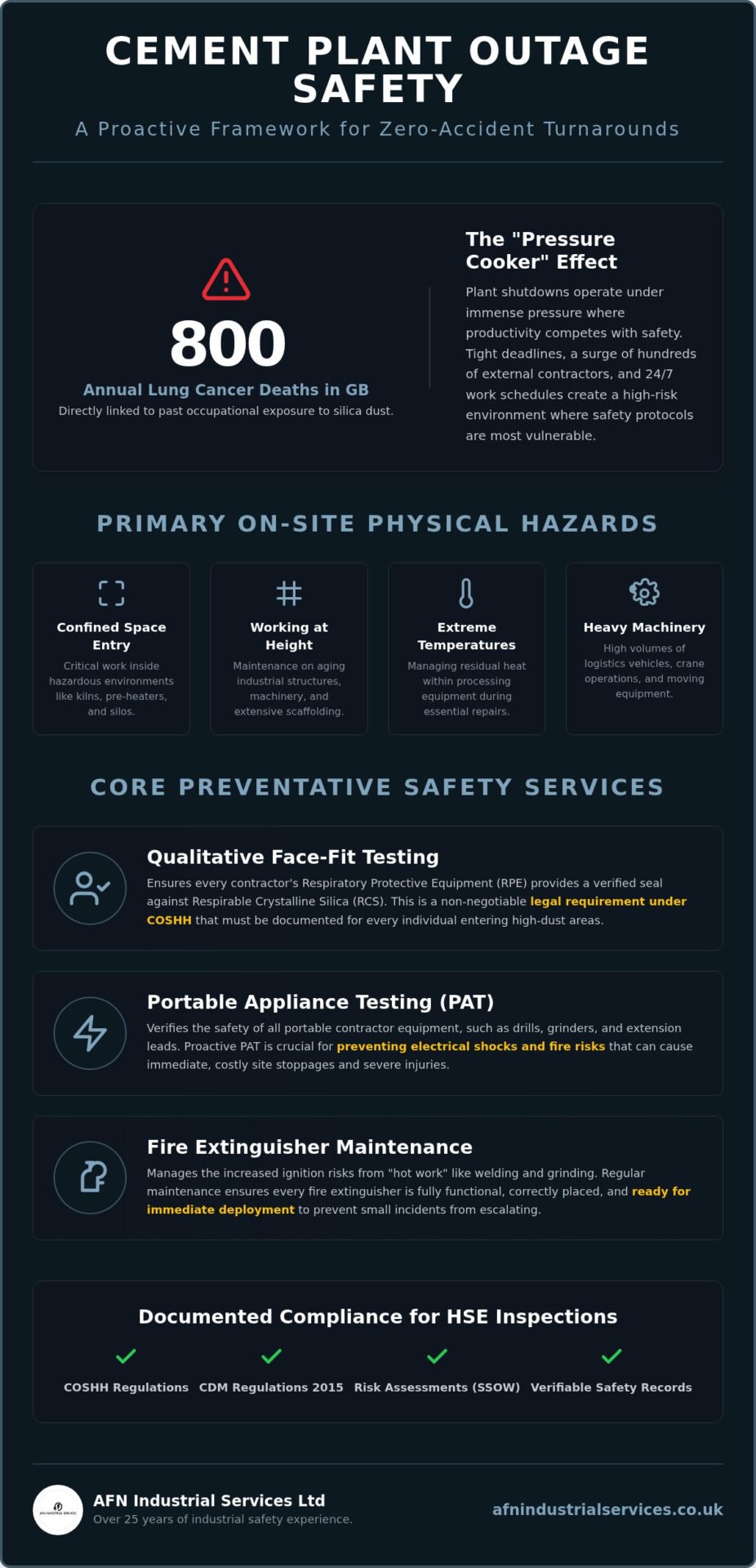
With approximately 800 lung cancer deaths annually in Great Britain linked to past silica exposure, the pressure to protect your workforce during a shutdown is immense. Managing hundreds of external contractors under tight deadlines often forces safety to compete with productivity. Professional Cement Outage Safety Support Services in Sheffield provide the necessary framework to ensure that shortcuts aren’t taken when risks are at their peak.
It’s a reality every facility manager understands; the chaotic nature of a turnaround can easily lead to documented compliance gaps or, worse, on-site accidents. You need a partner who treats regulatory standards with the same urgency as your production timeline. This article outlines how to manage high-risk requirements through expert support designed for full HSE compliance. We will examine the critical role of qualitative face-fit testing for silica dust protection, the importance of fire safety during hot work, and how methodical equipment inspections prevent costly downtime. By the end, you’ll have a clear strategy for achieving a zero-accident turnaround while maintaining the steady, methodical rhythm your industrial processes require.
Key Takeaways
- Learn why qualitative face-fit testing is a legal necessity for protecting hundreds of contractors from the long-term health risks of respirable crystalline silica (RCS).
- Understand how scalable Portable Appliance Testing (PAT) prevents electrical hazards and fire risks without compromising tight maintenance deadlines.
- Discover how professional Cement Outage Safety Support Services provide the documented compliance needed to satisfy HSE inspections during high-pressure shutdowns.
- Identify the critical importance of proactive fire extinguisher maintenance and strategic placement to manage the increased risks associated with industrial hot work.
- Leverage over 25 years of industrial safety experience to ensure a zero-accident turnaround through tailored health and safety support for South Yorkshire facilities.
Understanding the Safety Complexity of Cement Plant Outages
A cement outage is a planned, large-scale shutdown where production stops to allow for critical maintenance, equipment upgrades, and repairs. These events often bring hundreds of external contractors onto a single site, creating a high-density work environment. Because production downtime costs thousands per hour, these turnarounds operate under a “pressure cooker” effect. In 2026, this pressure is intensified by tighter regulatory deadlines and a shrinking window for maintenance, often leading to increased safety risks if not managed by dedicated Cement Outage Safety Support Services.
The environment is inherently dangerous. Beyond the mechanical risks, workers face significant health and safety hazards of Portland cement, including caustic dust exposure and acute respiratory risks. Primary physical hazards during these periods typically include:
- Confined space entry: Critical work inside kilns, pre-heaters, and silos.
- Working at height: Maintenance on aging industrial structures and scaffolding.
- Extreme temperatures: Managing residual heat within processing equipment.
- Heavy machinery: High volumes of logistics vehicles and crane operations.
Why Cement Outages Require Specialized Support
General health and safety advice often fails to address the specific “contractor surge” seen during a kiln turnaround. When hundreds of temporary workers arrive simultaneously, site-specific safety standards can easily be diluted. Specialized support services bridge this gap by providing consistent monitoring and equipment verification. The shift to 24/7 working schedules further complicates safety; fatigue management becomes a critical factor that standard safety officers might overlook. You need a partner who understands the heavy industrial nature of the cement industry, ensuring every contractor adheres to your site’s rigorous safety culture.
Regulatory Compliance and the HSE in 2026
Compliance isn’t optional, and the HSE has increased its focus on industrial shutdowns. Key legislation, such as the Construction (Design and Management) Regulations 2015 (CDM) and the Control of Substances Hazardous to Health (COSHH), requires meticulous documentation. This includes detailed Risk Assessments and Safe Systems of Work (SSOW) for every high-risk task. Incorporating advanced aerial data from Aeroshot into these assessments can provide a clearer picture of structural hazards before any work begins. Using professional Cement Outage Safety Support Services ensures that all safety protocols are documented and verifiable. Site managers hold a non-delegable legal duty of care to ensure the health and safety of every individual on the premises, regardless of their employment status or the urgency of the maintenance schedule.
Core Safety Support Services for Industrial Turnarounds
While emergency rescue teams are often the primary focus of high-risk planning, preventative compliance is what keeps an outage on track. Effective Cement Outage Safety Support Services focus on the technical details of equipment and personnel protection to eliminate hazards before they escalate. This proactive approach ensures that every contractor on site is both protected and compliant with current regulations.
Every individual entering a high-dust area must have a verified seal on their respiratory protective equipment (RPE). Qualitative face-fit testing is the only way to ensure that masks actually protect workers against respirable crystalline silica dust. This testing isn’t just a best-practice; it’s a legal requirement under COSHH that must be documented for every worker. Similarly, contractor tools represent a significant variable. Portable Appliance Testing (PAT) ensures that every drill, grinder, and extension lead brought onto the site is safe for use, preventing electrical shocks or fires that cause immediate site stoppages.
Maintenance during an outage involves extensive welding and grinding, which increases the risk of ignition. Regular fire extinguisher maintenance ensures that every unit in a “hot work” zone is fully functional and ready for immediate deployment. Combined with real-time safety audits and site monitoring, these services provide documented proof of compliance throughout the entire turnaround period.
The Integrated Safety Support Model
Safety teams shouldn’t work in isolation. They must integrate seamlessly with permit controllers and site management to streamline the workflow. Having a single point of contact for all safety equipment compliance simplifies the process for facility managers and reduces administrative friction. This documented, third-party verification—offered by professional safety firms like Vita Secure—is a key factor in demonstrating a proactive safety culture. It provides the formal validation required by insurers and regulatory bodies, often helping to manage insurance premiums through proven risk mitigation.
Scalable Safety Solutions for Large Sites
Managing safety for hundreds of contractors requires a scalable, transparent approach. We utilize per-item and per-person fee structures, allowing you to budget accurately for high-volume testing without hidden costs. Mobile safety support is essential for cement works, as testing needs to happen where the workers are located to minimize downtime. With over 25 years of experience, we understand how to navigate complex industrial environments without disrupting the critical maintenance schedule. If you require reliable on-site expertise, you can explore our Health and Safety Services for your next planned outage.
Managing Respiratory Risks: Face-Fit Testing and RCS Compliance
Respirable Crystalline Silica (RCS) remains one of the most significant health hazards in the cement and limestone industry. Unlike immediate safety risks like falls or electrical shocks, the damage caused by RCS is often cumulative and irreversible. Effective Cement Outage Safety Support Services focus on this “silent threat” of microscopic dust particles that bypass the body’s natural defenses to settle deep within the lung tissue. During an outage, when cleaning and maintenance activities agitate settled dust, the concentration of these particles often spikes well beyond safe limits.
Legal requirements for tight-fitting respiratory protective equipment (RPE) are absolute. A common misconception in industrial environments is that a high-quality mask provides universal protection. In reality, a “one size fits all” approach fails because individual facial structures vary significantly. If the seal between the mask and the wearer’s face isn’t airtight, the RPE is essentially useless. This is why qualitative face-fit testing is a mandatory component of COSHH compliance for any worker using disposable or half-mask respirators.
The Dangers of Silica Dust in Cement Works
The COSHH hierarchy of control prioritizes the elimination of hazards, yet in cement production, dust is an inherent byproduct of the process. When engineering controls like local exhaust ventilation are insufficient or undergoing maintenance themselves, RPE becomes the final line of defense. Prolonged exposure to respirable crystalline silica in the cement industry can cause life-changing conditions such as silicosis, lung cancer, and chronic obstructive pulmonary disease. Because of these severe outcomes, the HSE has increased its focus on RPE compliance, making documented fit-testing a non-negotiable requirement for site entry.
Professional Face-Fit Testing Protocols
We utilize the qualitative face-fit testing method, which is the industry standard for half-masks and filtering facepieces. This process involves two distinct stages: a sensitivity test and the actual fit test. Using Bitrix (bitter) or Saccharin (sweet) solutions, our specialists verify if the wearer can detect the aerosol while performing a series of movements designed to simulate real-world work activities. If the wearer tastes the solution, the seal is compromised and the mask must be adjusted or replaced for a different size or model.
Scheduling these sessions on-site is essential for maintaining the momentum of a turnaround. We provide mobile testing that integrates with your contractor induction process, ensuring every individual has a valid fit-test certificate before they step onto the plant floor. This methodical approach provides the documented compliance your facility requires while protecting the long-term health of your workforce. By utilizing expert Cement Outage Safety Support Services, you ensure that respiratory safety is handled with the precision required by modern industrial standards.
Fire Safety and Electrical Compliance During Shutdowns
Hot work operations like welding, cutting, and grinding are necessary during a kiln turnaround. These activities introduce significant fire risks into an environment that may already contain combustible materials or settled dust. Managing these risks requires more than just a permit system. It demands the physical presence of functional, verified safety equipment in every temporary work zone. Comprehensive Cement Outage Safety Support Services provide the technical oversight to ensure that fire suppression tools are ready for immediate use.
Ensuring Fire Readiness in High-Risk Zones
Temporary work areas often lack the permanent fire infrastructure found in other parts of the plant. We manage the strategic placement of fire extinguishers and fire blankets to create a safety perimeter around every welding station. This isn’t a generic service. It involves assessing the specific hazards of each work zone to ensure the correct extinguisher type is available. Regular fire extinguisher servicing ensures that every unit is pressurized, tagged, and compliant before the outage begins. This proactive maintenance prevents the catastrophic delays that a small, uncontrolled fire would cause.
Rigorous PAT Testing for Contractor Equipment
The influx of contractors brings thousands of power tools onto the site, each representing a potential electrical hazard. Under the Electricity at Work Regulations 1989, site managers have a legal obligation to ensure this equipment is safe for use. Professional portable appliance testing (PAT) is the primary method for verifying tool safety. We manage the high-volume testing of drills, grinders, and extension leads, using a scalable per-item fee structure. Our team labels each item clearly, providing the documented proof required for HSE audits. This methodical approach ensures that contractor tools don’t cause fire or shock, keeping your project on its critical path.
Visibility is another critical safety factor during an outage. Deep silos and underground galleries often lose their primary lighting during maintenance or power isolations. Emergency Light Drain Tests ensure that backup systems will function correctly if a primary power failure occurs. Maintaining these systems is vital for safe egress during an emergency. We provide the technical validation needed to confirm that your facility remains safe for workers even in windowless or subterranean work zones. Every piece of safety equipment, from ladders to emergency lights, must be inspected to ensure it meets the heavy-duty requirements of the industry.
For a reliable partner to manage your electrical and fire compliance, contact us for our Health and Safety Services.
Partnering with AFN Industrial Services Ltd for Local Outage Support
Managing the safety requirements of a large-scale shutdown requires more than just technical knowledge; it requires a partner who understands the heavy-duty nature of the cement industry. AFN Industrial Services Ltd provides dedicated Cement Outage Safety Support Services that prioritize operational continuity alongside strict regulatory adherence. We act as a steadfast extension of your site management team, ensuring that every safety protocol is executed with the precision your facility demands.
Our approach is built on over 25 years of industrial safety experience. We don’t offer generic solutions. Instead, we provide bespoke safety packages tailored to the specific scale and complexity of your plant. Whether you are managing a minor maintenance window or a total kiln turnaround, our team delivers the specialized support needed to bridge the gap between your permanent staff and a large influx of temporary contractors. This commitment to reliability ensures that safety remains a constant, even when production schedules are at their most intense.
A Local Partner for the South Yorkshire Industrial Belt
Proximity is a critical factor during an outage. AFN Industrial Services Ltd provides a rapid response and a consistent on-site presence for cement works and industrial sites across Rotherham, Sheffield, Doncaster, and Scunthorpe. Our familiarity with the regional industrial landscape allows us to meet the specific safety expectations of facility managers in Mansfield, Wakefield, and Barnsley. We understand the local challenges of maintaining a high-risk site in these areas, from environmental dust controls to complex logistics management.
By choosing a local expert, you benefit from a partner who can integrate seamlessly into your existing workflows. Our team is well-versed in the regional standards for workplace safety in Rotherham & Sheffield, providing the documented compliance necessary to satisfy both internal audits and HSE inspections. This local expertise ensures that your safety infrastructure is robust, verifiable, and tailored to the unique demands of South Yorkshire’s heavy industry.
Contact AFN Industrial Services Ltd for Your 2026 Outage Planning
Effective safety management begins long before the first contractor arrives on site. We recommend integrating our team into your pre-outage planning meetings to identify potential compliance gaps early. This proactive collaboration allows us to design a scalable support plan that accounts for your expected contractor volume and the specific hazards of your maintenance schedule. You can request a transparent quote based on your site complexity, ensuring that your safety budget is both accurate and effective.
Our goal is to provide the stability and steadfast professionalism your facility requires to achieve a zero-accident turnaround. We focus on the technical details of equipment maintenance and personnel protection so that your site managers can focus on the engineering challenges of the outage. When the stakes are high, you need a partner with a history of navigating diverse industrial challenges with expertise. Contact AFN Industrial Services Ltd today to secure reliable Cement Outage Safety Support Services for your 2026 project.
Securing Your Next Industrial Turnaround
A successful cement plant outage is defined by technical precision and the absence of safety-related delays. By employing dedicated Cement Outage Safety Support Services, you move beyond reactive measures to a preventative framework that safeguards every contractor. This methodical oversight ensures that high-risk requirements, such as documented RPE seals and verified tool safety, are managed as integral parts of the project plan rather than last-minute hurdles. It provides the documented validation necessary to satisfy both internal stakeholders and regulatory bodies.
AFN Industrial Services Ltd brings over 25 years of industrial safety experience to your facility, offering the stability required during high-stakes shutdowns. Our specialists provide the local expertise across South Yorkshire and the Midlands necessary to satisfy rigorous HSE standards and documented compliance. We focus on the intricate details of PAT compliance and qualitative face-fit testing so your site managers can concentrate on restoring production capacity. Choosing a seasoned partner ensures that your safety commitments are met with the same level of expertise as your engineering goals.
Contact AFN Industrial Services Ltd for specialized cement outage support to ensure your 2026 turnaround is defined by steadfast professionalism and a zero-accident result. We remain a calm, capable partner ready to support your most complex industrial challenges.
Frequently Asked Questions
What are the primary safety risks during a cement plant outage?
Primary safety risks involve the intersection of high-risk tasks and extreme environmental conditions. During a turnaround, the combination of confined space entry in kilns and the “contractor surge” creates a complex hazard profile. Workers also face significant thermal risks and potential falls from height on temporary scaffolding. Managing these overlapping dangers requires a structured safety framework that addresses both mechanical hazards and the long-term health risks associated with industrial dust exposure.
Is face-fit testing a legal requirement for all cement plant contractors?
Face-fit testing is a mandatory legal requirement under the COSHH Regulations for any contractor wearing tight-fitting respiratory protective equipment (RPE). This includes disposable masks and half-masks commonly used for dust protection. Site inductions alone are insufficient; every individual must have a documented fit-test certificate for the specific make and model of mask they are using. This ensures the seal is airtight, protecting the wearer from inhaling hazardous respirable crystalline silica particles.
How often should portable appliances (PAT) be tested on an industrial site?
On heavy industrial sites like cement works, electrical equipment is subject to significant wear and tear. While the Electricity at Work Regulations 1989 do not specify a fixed interval, industry best practice for 110v and 240v power tools used in these environments is testing every 3 to 6 months. Frequent inspections are vital because the presence of conductive dust and moisture can quickly degrade the safety of electrical components, leading to shocks or fires.
What fire safety equipment is essential for hot work during a shutdown?
Essential fire safety equipment for hot work includes serviced fire extinguishers, fire blankets, and spark-resistant screens. Because welding and grinding in a cement plant often occur near residual combustible materials, having the correct class of extinguisher, such as Dry Powder or CO2, is critical. Every piece of equipment must be professionally maintained and correctly tagged. This ensures that fire suppression tools are fully functional and ready for immediate deployment in temporary work zones.
Can AFN Industrial Services Ltd provide on-site safety support in Scunthorpe or Doncaster?
AFN Industrial Services Ltd provides comprehensive on-site safety support throughout the South Yorkshire and Midlands industrial belt, including Scunthorpe and Doncaster. Our mobile specialists visit your facility to perform qualitative face-fit testing and PAT inspections during the pre-outage or active shutdown phases. This local presence ensures that sites in Bawtry, Worksop, and Barnsley receive rapid, professional support tailored to the specific regulatory demands of the cement and limestone industries.
How do I ensure my business remains compliant with HSE silica dust regulations?
To ensure your business remains compliant with HSE silica dust regulations, you must implement a robust monitoring and protection strategy. This involves maintaining the legal Workplace Exposure Limit (WEL) of 0.1 mg/m³ through engineering controls and verified RPE. Utilizing professional Cement Outage Safety Support Services ensures that all respiratory equipment is fit-tested and documented, providing the audit trail required by the HSE during their 2026 industrial inspection campaigns.
What is the difference between qualitative and quantitative face-fit testing?
Qualitative face-fit testing is a pass/fail method that relies on the wearer’s sense of taste using Bitrix or Saccharin solutions. It is the industry standard for half-masks and filtering facepieces used in cement works. Quantitative testing uses a particle counting machine to measure the exact fit factor. We specialize in the qualitative method as it provides a reliable, efficient, and cost-effective way to verify airtight seals for large groups of contractors on-site.
How can external safety support help reduce my insurance costs?
External safety support helps reduce insurance costs by providing documented, third-party validation of your risk management activities. When you utilize AFN Industrial Services Ltd for equipment testing and personnel protection, you create a professional audit trail that demonstrates a proactive safety culture. Insurers often recognize this formal verification of safety protocols, such as PAT and face-fit testing, as evidence of a lower risk profile, which can lead to more favorable premium rates.
