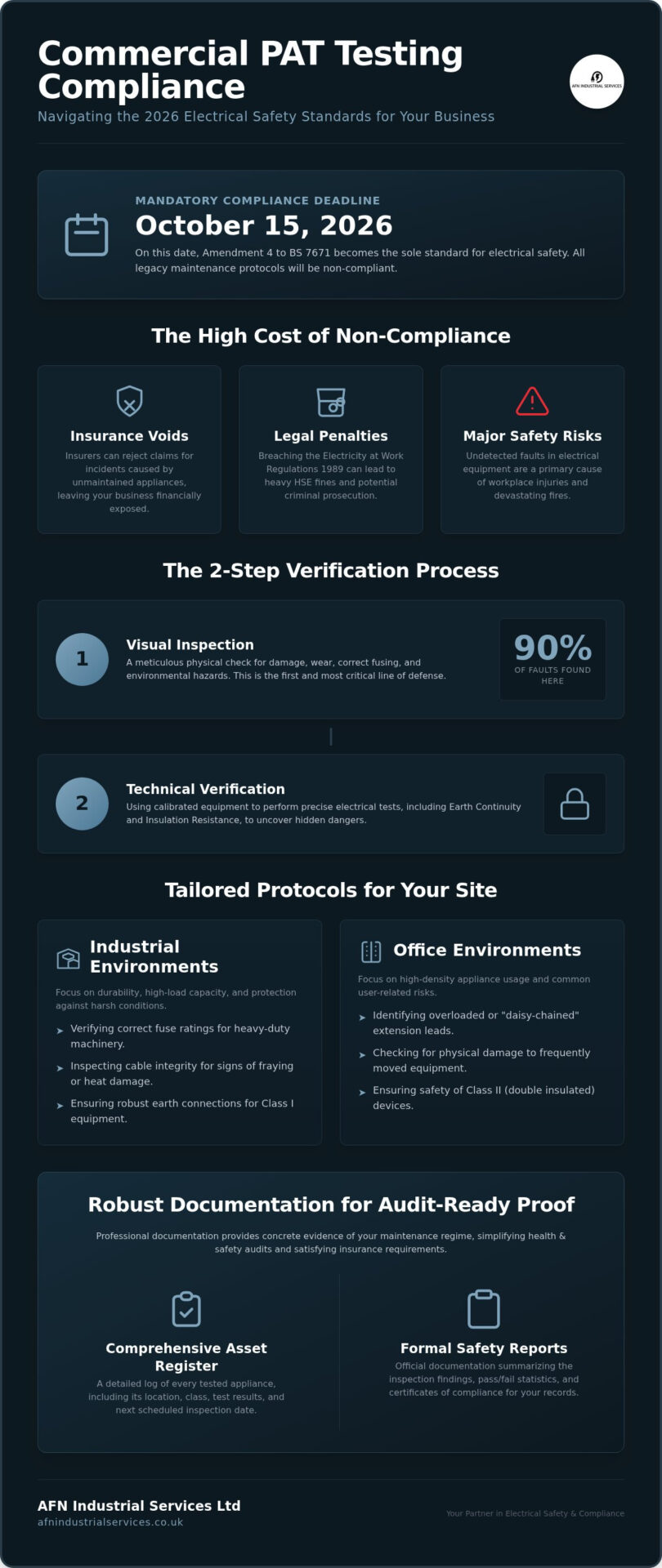
By October 15, 2026, Amendment 4 to BS 7671 becomes the sole standard for electrical safety, leaving no room for outdated maintenance routines. If your facility is still operating on legacy protocols, you’re likely facing more than just a safety risk; you’re looking at potential insurance voids and heavy non-compliance fines. Managing commercial PAT testing Sheffield shouldn’t feel like a choice between legal safety and operational efficiency.
You likely agree that the biggest headache isn’t the testing itself, but the disruption it causes to your team and the lack of clarity regarding high-volume pricing. It’s frustrating when safety protocols feel like they’re working against your productivity. This guide provides a clear roadmap to achieving full compliance with the Electricity at Work Regulations 1989 without the typical downtime. We’ll show you how a structured approach to asset registers and professional safety reports can streamline your 2026 compliance strategy. By the end, you’ll know exactly how to keep your business running while ensuring your site remains fully protected and insurance-ready.
Key Takeaways
- Understand how the Electricity at Work Regulations 1989 apply to your site to avoid legal penalties and ensure insurance validity.
- Learn the technical steps involved in commercial PAT testing Sheffield to verify appliance safety through visual checks and earth continuity tests.
- Discover how to tailor testing protocols for different environments, from heavy-duty manufacturing plants to high-density office spaces.
- Determine the optimal testing intervals for your facility using a risk-based approach aligned with the IET Code of Practice.
- Establish a robust asset register and safety report to streamline your health and safety audits and simplify future inspections.
Understanding PAT Testing Regulations for Sheffield Businesses in 2026
Portable appliance testing (PAT) is the routine inspection of electrical equipment to ensure it’s safe for continued use. In a commercial context, this covers any device that connects to a power supply with a flexible cable and plug. For those managing commercial PAT testing Sheffield, it’s vital to recognize that this process is the primary method for meeting statutory obligations across diverse sites, from small offices to heavy industrial plants. It isn’t just about sticking a green label on a kettle; it’s a systematic verification of electrical integrity.
The legal framework is built on the Electricity at Work Regulations 1989 and the Health and Safety at Work Act 1974. While the phrase “legal requirement” is often used loosely, the law is nuanced. The regulations don’t explicitly mandate PAT testing by name, but they do mandate that all electrical equipment is maintained in a safe condition. This creates a “duty to maintain” that is absolute. If an accident occurs and you can’t provide evidence of a structured maintenance regime, you’re in breach of the law. Non-compliance often results in heavy HSE fines, criminal prosecution, and, in the worst cases, avoidable workplace injuries.
The Legal Duty of Care for Employers
Employers hold the ultimate responsibility for the safety of their workforce and any visitors to their premises. Simply providing equipment is only the first step; you must actively prove that the equipment remains safe over time. Professional testing acts as a formal asset register and vital evidence of maintenance for local authorities and health and safety inspectors. Under the Electricity at Work Regulations 1989, employers are legally required to ensure that any electrical equipment that has the potential to cause injury is maintained in a safe condition. A regular schedule for commercial PAT testing Sheffield ensures this duty is met with precision and documented proof.
Insurance Requirements and PAT Testing
Beyond the legalities, your business insurance policy likely dictates your testing schedule. Insurers frequently use missing or outdated safety records as a primary reason to reject claims following a fire or electrical incident. If an investigation reveals that a fire originated in an unmaintained appliance, you’re essentially operating without a safety net. We advise Sheffield businesses to scrutinize their specific policy wording, as many providers now include clauses that make professional testing a prerequisite for liability coverage. Relying on outdated labels or ignoring “low-risk” items puts your entire operation at financial risk. Professional documentation ensures that if the worst happens, your business remains protected and insurance-ready.
The Commercial PAT Testing Process: From Visual Inspection to Technical Verification
A professional inspection follows a rigid, technical sequence designed to identify hazards that aren’t visible to the untrained eye. It isn’t a guessing game. Every technician uses calibrated testing equipment to ensure that readings for earth continuity and insulation resistance are accurate to the milliohm. For those overseeing commercial PAT testing Sheffield, this precision is the difference between a safe workplace and a potential fire hazard. The process moves methodically from a physical assessment to deep technical verification, ensuring every asset is fit for purpose.
The Critical Role of the Visual Inspection
According to HSE guidance on PAT, approximately 90% of electrical faults are identified during a thorough visual check. This phase requires a meticulous eye for detail. In Sheffield offices, we frequently encounter “daisy-chaining,” where extension leads are overloaded by being plugged into one another, creating a significant fire risk. In industrial environments, we focus on checking for correct fuse ratings in high-duty machinery and inspecting cable integrity for signs of fraying or heat damage. A plug that looks fine on the surface may have loose internal connections or an incorrect fuse that bypasses safety protocols.
Technical Testing and Pass/Fail Criteria
Once the visual check is complete, we move to technical verification. This requires distinguishing between Class I appliances, which rely on an earth connection for safety, and Class II appliances, which use double insulation. We perform earth continuity tests to ensure a path exists for fault current to reach the ground safely, preventing electric shocks. Insulation resistance testing then detects internal faults that could lead to short circuits. Earth leakage testing in modern electronics ensures that any residual current escaping from the circuit remains within safe parameters, preventing damage to sensitive components and ensuring operator safety.
If an item fails any part of this process, it’s immediately failed and labeled. We implement a strict quarantine and repair process to ensure that dangerous equipment isn’t accidentally returned to service. Facility managers often find that outsourcing to a reliable PAT testing partner simplifies this technical phase, as it provides a clear, documented path from fault detection to resolution. Every device also undergoes a functional check to ensure it operates safely under its normal working load. This methodical progression ensures that every asset on your site is verified against the highest safety benchmarks, leaving you with a complete, audit-ready asset register.
Industrial vs. Office PAT Testing: Tailoring Safety to Your Sheffield Site
Sheffield’s business landscape is exceptionally diverse. A standard office setup presents entirely different electrical risks compared to a steel fabrication workshop or a busy distribution center. Under The Electricity at Work Regulations 1989, the obligation to maintain safe equipment remains constant, yet the methods must change. For commercial PAT testing Sheffield, we customize our inspection protocols to match the specific demands of your site. Office environments typically involve high volumes of sensitive IT equipment, kitchen appliances, and desktop peripherals. These require delicate handling and low-current testing to prevent damage to internal motherboards.
Industrial environments demand a significantly more aggressive approach. We focus on 110V site tools, 415V machinery, and heavy-duty extension leads that endure constant physical strain. Environmental factors like dust, moisture, and extreme temperatures in a warehouse environment accelerate the degradation of insulation and connectors. A cable used in a damp or dusty workshop requires more frequent verification than one used in a temperature-controlled server room. We evaluate these variables to ensure your maintenance schedule reflects the actual risk profile of your equipment.
Managing High-Volume Commercial Sites
Large retail venues and hospitality businesses often struggle with the logistics of site-wide testing. You don’t have to close your doors to stay compliant. We coordinate out-of-hours testing schedules that allow your business to remain operational while we work through your asset register. Utilizing a per-item fee structure provides your management team with predictable budgeting. This transparency is vital for large facilities where asset counts can fluctuate, ensuring you only pay for the work performed without hidden call-out surprises.
Safety for Industrial Workshops and Warehouses
In industrial settings, we prioritize the safety of workshop tools and mobile plant equipment. These high-usage items often feature specialized industrial connectors that require expert verification. We understand the mechanical stress these tools undergo and perform rigorous checks to prevent operator injury. Our deep roots in the region help us provide targeted advice, which you can explore further in our guide to Workplace Safety in Rotherham & Sheffield. By integrating testing into your broader safety framework, we help you maintain a secure, productive environment across all your South Yorkshire locations.
Frequency and Documentation: Maintaining Your Electrical Safety Register
Establishing a maintenance schedule requires more than just picking a date on the calendar. The IET Code of Practice serves as the definitive industry standard, providing a framework for determining how often equipment should be checked. While many believe testing must happen annually, the reality is more complex. For commercial PAT testing Sheffield, we help you move away from arbitrary timelines toward a structured, defensible strategy. This ensures you’re not over-testing low-risk items or neglecting high-risk machinery that undergoes daily strain.
The goal of professional documentation is to create a transparent audit trail. When an inspector or insurance adjuster asks for proof of maintenance, a stack of loose papers isn’t enough. You need a methodical system that proves every asset has been accounted for and verified. Transitioning to digital records ensures that your data is accessible, searchable, and secure, allowing you to present compliance evidence at a moment’s notice.
Risk-Based Testing Intervals
A formal risk assessment should dictate your PAT schedule to ensure compliance while optimizing maintenance costs. High-risk items, such as handheld power tools used in a workshop or industrial cleaners, require frequent inspection due to constant vibration and physical handling. Conversely, stationary items like PC monitors or desktop printers in a stable office environment present a much lower risk and can often go longer between technical verifications. We evaluate the equipment type, the environment it operates in, and the frequency of use to set these intervals accurately.
The Asset Register and Compliance Reporting
Effective documentation is the cornerstone of your health and safety audit trail. A professional report must include a unique identification number for every electrical item, the test results, and the date of the next scheduled inspection. This asset register allows you to track safety trends and the remaining lifespan of your equipment. If a specific model of tool or appliance consistently fails, your records will highlight the pattern, allowing for proactive replacement before a failure occurs. This level of detail is essential for high-volume sites where manual tracking is impossible.
For a deeper look at these requirements, read our Portable Appliance Testing (PAT): The Complete Guide for South Yorkshire Businesses. Maintaining an accurate register is a proactive step in protecting your workforce and your liability. If you need assistance setting up a compliant safety register for your site, contact our expert team today to schedule a professional assessment.
Professional PAT Testing Services in Sheffield: The AFN Industrial Advantage
Choosing a compliance partner requires more than just finding a technician with a tester. With over 25 years of industry experience across South Yorkshire, AFN Industrial Services Ltd operates as a Reliable Expert for facility managers who cannot afford downtime or safety lapses. We combine technical precision with a consultancy-led approach, ensuring your site meets the highest professional benchmarks. For businesses requiring commercial PAT testing Sheffield, we provide a proactive service that identifies potential hazards before they escalate into operational failures. Our history of navigating diverse industrial challenges in the region allows us to deliver results where standard providers often fall short.
Transparency is the foundation of our service delivery. We utilize a scalable per-item pricing model, which we’ve found to be the most honest and predictable method for commercial clients. This approach eliminates the ambiguity often associated with high-volume sites. You only pay for the assets tested, providing your finance team with clear, actionable data for budgeting. Beyond electrical safety, we offer a consolidated maintenance framework. By integrating PAT testing with fire extinguisher maintenance and emergency light drain tests, we help you maintain a safe, insurance-ready environment through a single, dependable partner. For organizations seeking to manage broader regulatory risks, a managed security service provider UK can provide the necessary strategic oversight for 2026 compliance across all operational areas.
Why a Local Rotherham-Based Partner Matters
Our base in Rotherham ensures rapid response times for businesses in Sheffield, Doncaster, and Barnsley. We aren’t a faceless national franchise; we’re a local team that understands the specific industrial heritage and modern commercial requirements of the Sheffield City Region. This local expertise allows us to provide a personalized service that respects your operational schedule. Whether you’re managing a heavy-duty manufacturing plant or a high-density office, we bring a seasoned perspective to every inspection. Our approach to commercial PAT testing Sheffield ensures that we know the local landscape and the importance of keeping our region’s economy moving safely.
Comprehensive Safety Solutions
Managing multiple safety compliance streams is a significant administrative burden. AFN Industrial Services Ltd streamlines this process by acting as a single point of contact for your essential health and safety services. This holistic approach ensures that no part of your safety infrastructure is overlooked during busy operational periods. For instance, you can easily coordinate your electrical checks alongside your Fire Extinguisher Servicing in Rotherham, Sheffield & Doncaster. This integration reduces site visits and simplifies your documentation management, leaving you with a robust, audit-ready safety register.
Reliability is non-negotiable when it’s a matter of workplace safety. Our team is ready to provide the steadfast professionalism your facility requires to remain compliant through 2026 and beyond. We prioritize your results and your safety above all else, maintaining clear communication from the initial assessment to the final report. Contact AFN Industrial Services Ltd for a tailored PAT testing quote and secure a partnership with a team that values precision as much as you do.
Securing Your Site’s Electrical Future
Transitioning from a basic maintenance routine to a comprehensive electrical safety strategy is a critical move for any facility manager. As we’ve explored, successful compliance in 2026 relies on a nuanced, risk-based approach that prioritizes the most active equipment on your site. By moving away from arbitrary testing cycles and utilizing detailed asset registers, you protect your operation from unforeseen failures and legal liabilities. Implementing a structured plan for commercial PAT testing Sheffield ensures that your business remains both productive and fully aligned with modern safety standards.
AFN Industrial Services Ltd brings over 25 years of specialized experience to the Sheffield City Region, offering the technical depth required for complex commercial and industrial environments. Based in Rotherham, our team delivers the personalized safety consultancy and thorough documentation needed to keep your business insurance-ready and audit-compliant. Get a scalable per-item PAT testing quote for your Sheffield business to secure a partnership built on steadfast reliability and technical precision. Let us help you maintain a workplace where safety and operational efficiency work in perfect tandem.
Frequently Asked Questions
Is PAT testing a legal requirement for businesses in Sheffield?
PAT testing isn’t explicitly named in legislation, but maintaining safe electrical equipment is a strict legal requirement under the Electricity at Work Regulations 1989. Professional commercial PAT testing Sheffield serves as your primary evidence that you’ve met this duty of care. Without documented proof of maintenance, businesses face severe penalties if an accident occurs. It’s the most recognized method to ensure your site remains compliant and insurance-ready.
How much does commercial PAT testing cost in South Yorkshire?
Costs for electrical safety inspections are typically structured around the volume of assets and the specific environment of your site. We utilize a scalable per-item pricing model to ensure full transparency for our commercial clients. This approach allows facility managers to budget accurately without hidden call-out fees. For a precise figure tailored to your South Yorkshire premises, we recommend a site-specific assessment to account for your unique equipment count.
What items are included in a commercial PAT test?
Any appliance that connects to the mains power supply via a flexible cable and plug requires inspection. This includes stationary office equipment like printers, kitchen appliances such as kettles, and heavy-duty workshop tools. Extension leads and multi-way adapters are also critical items often overlooked. While PAT testing covers portable heating units, for those needing comprehensive boiler and system work, you can discover SRH Heating & Homes Ltd. Our technicians verify the integrity of the plug, fuse, and cable for every asset on your register to ensure comprehensive site safety.
How often should my office equipment be PAT tested?
The frequency of testing depends on the risk profile of the equipment and its environment rather than a fixed annual rule. Stationary office monitors in a clean environment might only require technical verification every few years, whereas handheld tools in a workshop need much more frequent checks. We help you establish a risk-based schedule aligned with the IET Code of Practice to optimize your maintenance costs while maintaining safety.
Can my own staff perform PAT testing if they are competent?
Legislation allows a competent person with the necessary knowledge and equipment to perform tests. However, most businesses prefer professional commercial PAT testing Sheffield to ensure high-level accuracy and independent validation. Our team provides comprehensive asset registers and safety reports that internal staff often lack the specialized software to produce. Professional testing also removes the internal liability of certifying your own equipment’s safety.
What happens if an appliance fails its PAT test?
Failed appliances must be withdrawn from use immediately to prevent potential injury or fire. We label these items clearly and provide a detailed report explaining the specific reason for the failure, such as insulation breakdown or incorrect fuse ratings. The equipment should be quarantined in a secure area until it’s professionally repaired or safely decommissioned. This proactive approach prevents accidental use of dangerous machinery.
Does new electrical equipment need to be PAT tested before use?
New equipment usually doesn’t require a full technical PAT test before its first use, as manufacturers are responsible for initial safety. A simple visual inspection to check for transit damage is generally sufficient for the first year. You should add the new item to your asset register immediately so it’s included in the next scheduled testing cycle. This ensures your safety records remain accurate and up to date as your inventory grows.
Will PAT testing cause a power outage or disrupt my computers?
Each appliance must be briefly unplugged during the technical verification phase, which causes a momentary power loss for that specific device. We work closely with site managers to coordinate testing around critical IT systems and server uptimes to prevent data loss. Our methodical process ensures that disruption to your daily operations is kept to an absolute minimum while we verify the integrity of your electrical infrastructure.