A single lapse in confined space protocol during a high-pressure maintenance window can derail an entire Sheffield plant’s operational schedule and safety record. Managing hundreds of contractors while maintaining strict HSE compliance is arguably the most demanding phase of Energy-from-Waste operations. You understand that when high-risk activities in boilers and silos meet unforgiving deadlines, the margin for error disappears. It’s a period where complex documentation and contractor non-compliance can quickly become significant operational liabilities.
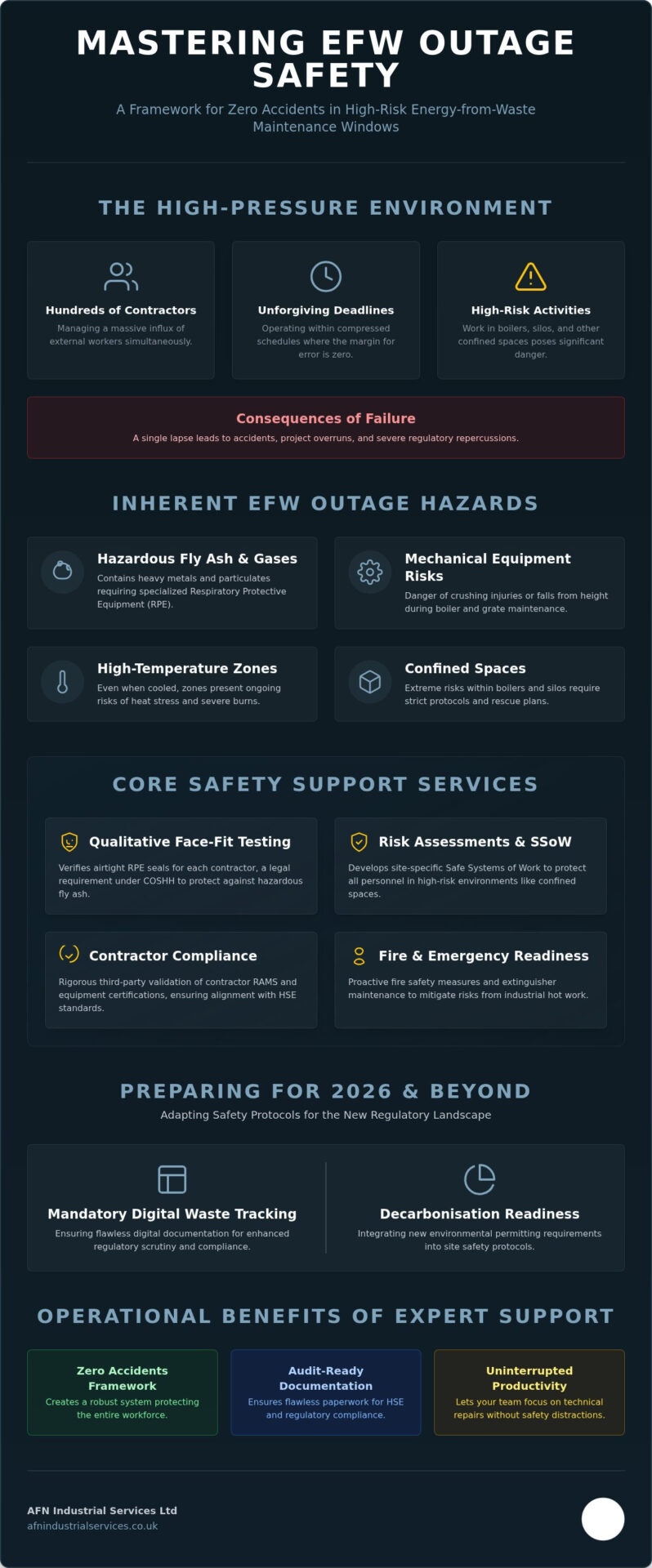
Securing professional EfW Outage Safety Support Services ensures your site remains protected, compliant, and productive throughout the entire maintenance window. This guide demonstrates how expert safety oversight, from qualitative face-fit testing to fire safety coordination, creates a robust framework for zero accidents and audit-ready documentation. We’ll examine the specific strategies needed to navigate the 2026 regulatory landscape, including new Decarbonisation Readiness requirements and mandatory Digital Waste Tracking, while maintaining the steadfast safety standards your facility demands. Our focus remains on practical, reliable execution that lets your team concentrate on technical repairs without compromising on personnel welfare or regulatory standing.
Key Takeaways
- Understand how to adapt your safety protocols for the 2026 regulatory landscape, including new Digital Waste Tracking and Decarbonisation Readiness requirements.
- Discover how professional EfW Outage Safety Support Services manage contractor compliance through specialist qualitative face-fit testing and rigorous equipment testing.
- Learn the essential components of a site-specific Safe System of Work (SSoW) designed to protect personnel in high-risk confined spaces like boilers and silos.
- Identify proactive fire safety measures and extinguisher maintenance schedules that mitigate the increased risks associated with industrial hot work.
- Recognise the operational benefits of utilizing a local South Yorkshire safety partner for rapid response and audit-ready documentation during tight maintenance windows.
The Critical Role of EfW Outage Safety Support Services
Energy-from-Waste (EfW) outages are high-pressure events where complex mechanical maintenance, industrial cleaning, and structural inspections occur simultaneously. Unlike routine factory maintenance, these shutdowns involve a massive influx of external contractors, often numbering in the hundreds, all operating within compressed deadlines. Standard workplace safety protocols often fall short because they don’t account for the unique thermal, chemical, and structural risks inherent to Energy-from-Waste (EfW) plants. Relying on generic safety measures during these windows creates dangerous gaps. These gaps lead to accidents, project overruns, and severe legal repercussions for facility managers.
Utilising dedicated EfW Outage Safety Support Services provides a structured layer of protection that standard site management cannot provide alone. These services focus on the proactive identification of hazards before the first contractor sets foot on site. The financial implications of a safety failure are staggering. Beyond potential HSE fines, a single serious incident can halt production for weeks, leading to significant revenue loss and increased insurance premiums. Professional safety support acts as a safeguard. It ensures that every activity is performed under a verified Safe System of Work (SSoW), protecting both the workforce and the operator’s bottom line.
Understanding the Hazards of EfW Maintenance
The environment inside an EfW facility during an outage is unforgiving. Personnel must manage exposure to hazardous fly ash and flue gases, which require specialized respiratory protective equipment (RPE). Mechanical failures during boiler inspections or grate maintenance can result in crushing injuries or falls from height in confined spaces. To mitigate these risks, many facilities are adopting remote inspection technologies; for expert support and specialized equipment, check out Caswell Aviation Ltd. High-temperature zones, even when cooled, present ongoing risks of heat stress and burns. Expert safety partners understand these specific variables. They implement controls that address the actual conditions on the ground, rather than relying on theoretical risk models.
HSE Compliance and Industry Standards
Regulatory scrutiny is intensifying across the sector. With the 2026 shift toward stricter environmental permitting and decarbonisation readiness, site operators must ensure their safety documentation is flawless. Professional safety consultants provide an objective audit layer. They review contractor RAMS and equipment certifications with a level of detail that internal teams may miss due to time constraints. This third-party validation ensures that all outage activities align with current HSE standards. It makes the facility audit-ready at every stage of the maintenance cycle, providing peace of mind for site leadership.
Specialised Safety Services for EfW Shutdowns
Executing a successful maintenance window requires more than just high-level oversight. It demands specific technical validations that ensure every individual and piece of equipment on site meets rigorous standards. Implementing Specialised Safety Services for EfW Shutdowns ensures that your facility remains compliant with HSE guidance while protecting personnel from the unique hazards of energy recovery environments. These services bridge the gap between general site rules and the practical realities of high-risk maintenance tasks.
Qualitative Face-Fit Testing for RPE
In Energy-from-Waste plants, respiratory protection is a critical line of defence. Fly ash, which can account for up to 20% of the total ash produced during combustion, contains concentrated heavy metals and hazardous particulates. Standard masks only work if they create a perfect, airtight seal against the wearer’s face. EfW Outage Safety Support Services include qualitative face-fit testing to verify this seal using specialized sensitivity solutions. Each contractor must undergo an individual assessment to ensure their specific mask provides the required protection factor. This process isn’t just about safety; it’s a legal requirement under COSHH regulations that must be documented before any worker enters a hazardous zone like a boiler or flue gas treatment area.
PAT Testing for Industrial Site Safety
Outages involve a massive influx of portable electrical tools brought on-site by various contractors. Faulty equipment is a primary cause of electrical fires and shocks in industrial settings. Scalable Portable Appliance Testing (PAT) is essential for managing this volume of equipment efficiently. Every drill, grinder, and lead must be inspected and tagged to prove it’s safe for use in a heavy-duty environment. This systematic approach prevents project delays caused by equipment failure and significantly reduces the risk of ignition during sensitive maintenance phases. Maintaining a high standard of health and safety services through rigorous equipment testing is essential for a smooth maintenance window.
Fire safety and access equipment also require professional attention before hot work begins. Hot work, such as welding or grinding, increases the risk of fire in areas where residual dust may be present. Fire extinguisher maintenance must be completed to ensure every unit is fully operational and correctly positioned for the duration of the shutdown. Similarly, ladder inspections for temporary access structures ensure that workers aren’t using damaged or non-compliant equipment. These localized, technical checks form the backbone of a reliable safety strategy, ensuring that the integrity of the process is maintained from the first day of the outage to the final restart.
Developing Risk Assessments and Safe Systems of Work (SSoW)
Effective safety management during an outage starts with rigorous, pre-emptive planning. A Safe System of Work (SSoW) is more than a simple checklist; it’s a dynamic framework designed to mitigate the specific hazards found within an Energy-from-Waste environment. For Sheffield plant operators, this means moving beyond generic templates. Generic assessments often miss the nuances of high-temperature residue or the structural instability of fly ash buildup in silos. Professional EfW Outage Safety Support Services bridge this gap by conducting site-specific evaluations that reflect the actual physical conditions of your facility during the maintenance window.
Documentation must be accessible and clearly understood by every contractor on site. If safety protocols are buried in complex manuals, they won’t be followed under the pressure of a deadline. We ensure that all Safe Systems of Work are distilled into actionable instructions that align with site-wide permits. This clarity is especially vital for confined space entry in boilers and flue gas treatment areas, where the margin for error is non-existent. By integrating these systems into the daily workflow, you maintain the steady rhythm of industrial processes without compromising personnel welfare.
Customised Risk Assessments for High-Risk Tasks
Identifying hazards in ash handling and turbine maintenance requires technical expertise. Fly ash, which can make up 10% to 20% of total ash, poses respiratory and chemical risks that demand specific extraction protocols and RPE. A Safe System of Work is a formal procedure resulting from systematic examination of a task. Implementing these systems ensures that control measures, such as forced ventilation or specialized lighting, are integrated into the workflow. This methodical approach is critical when adhering to the Risk Assessments and Safe Systems of Work (SSoW) required under the Confined Spaces Regulations 1997. With over 25 years of industry experience, we understand how to implement these controls without causing unnecessary delays to your outage timeline.
Audit Trails and Legal Protection
Safety documentation must be more than compliant; it must be defensible. Creating a robust audit trail is essential for protecting facility managers from liability and ensuring you’re ready for any HSE inspection. Professional EfW Outage Safety Support Services ensure that every permit-to-work and risk assessment is logged, signed, and archived correctly. This transparency prevents the “compliance gap” where site rules exist on paper but aren’t followed on the floor. These documented audits also serve as a blueprint for continuous improvement, allowing you to refine safety protocols for future shutdowns based on verified data and observations from the current project.
Fire Safety and Emergency Equipment Readiness
Hot work is a necessity during Energy-from-Waste shutdowns, but it introduces significant ignition risks in environments where combustible dust and residual waste are present. Welding, grinding, and cutting activities must be strictly controlled under a permit-to-work system, yet the presence of the hardware itself is equally vital. Our EfW Outage Safety Support Services provide a proactive approach to fire prevention by ensuring all suppression and emergency systems are fully operational before high-risk maintenance begins. This preparation mitigates the dangers identified under the Dangerous Substances and Explosive Atmospheres Regulations (DSEAR), which are strictly enforced in EfW facilities. We focus on the functional readiness of every safety asset, ensuring that the integrity of your fire protection remains uncompromised during intensive maintenance phases.
Industrial Fire Extinguisher Maintenance
Having the correct fire extinguisher is only effective if the unit is properly maintained and accessible. During an outage, temporary fire points must be established near hot work zones, often requiring a mix of CO2, foam, and dry powder extinguishers to address electrical and chemical hazards. We provide comprehensive fire extinguisher servicing to ensure every canister is pressurized, undamaged, and ready for immediate deployment. Annual maintenance shouldn’t be left until the outage begins; it’s a prerequisite for site safety. We also deploy heavy-duty fire blankets to shield sensitive equipment and prevent sparks from igniting nearby materials, providing a physical barrier against accidental combustion. This methodical equipment oversight is a core part of our commitment to zero-accident outcomes.
Emergency Lighting and Drain Tests
Total plant power-downs are common during major maintenance windows, turning vast, complex industrial structures into pitch-black environments. In these conditions, the reliability of your emergency lighting system is the difference between a safe evacuation and a serious accident. We conduct rigorous emergency light testing, including full three-hour drain tests, to verify that battery backups will hold under pressure. This ensures that escape routes remain illuminated even when the main grid is disconnected. These tests are a critical component of EfW Outage Safety Support Services, providing the technical assurance that your facility remains a safe workplace during its most vulnerable operational phases.
Don’t leave your site’s fire readiness to chance during your next scheduled shutdown. Contact us today for professional fire safety maintenance and ensure your equipment meets every regulatory benchmark. For international operators looking for similar specialized site protection, you can check out Fire Watch Service for expert support.
National providers often promise comprehensive coverage but struggle to deliver the immediate, on-site responsiveness that a high-stakes Energy-from-Waste outage requires. When a critical safety query arises during a night shift in Sheffield or Rotherham, you need an expert who’s minutes away, not hours. Our EfW Outage Safety Support Services are built on a foundation of local presence and rapid deployment. We provide a steadfast level of reliability that national firms simply can’t match. By focusing our expertise on the Midlands and North East, we ensure that every facility manager receives the direct, authoritative support needed to maintain a zero-accident site.
Serving the industrial heartlands of South Yorkshire, we’ve spent over 25 years refining our approach to heavy-duty safety. This tenure has given us a sophisticated understanding of the regional industrial landscape and the specific operational requirements of local EfW plants. We don’t just act as a third-party consultant; we function as a calm, capable partner that integrates into your existing management structure. Our service area includes:
- Sheffield: Supporting major energy recovery facilities within the city’s district heating network.
- Rotherham: Providing local expertise from our regional base for rapid outage response.
- Doncaster: Delivering specialized safety audits and equipment testing for large-scale industrial sites.
- Barnsley: Ensuring full HSE compliance for waste management and processing facilities.
Coordinating safety support across these regions requires methodical planning and a proactive approach. We ensure that your 2026 maintenance schedule remains uncompromised by safety delays or compliance gaps, providing the stability your team needs during high-pressure windows.
Tailored Solutions for Regional Industrial Clients
Regional proximity offers tangible financial and operational benefits. Utilizing a local safety partner significantly reduces travel-related costs and ensures that response times for urgent site visits are kept to an absolute minimum. This is particularly crucial during the pre-outage phase, where detailed risk assessments and Safe Systems of Work (SSoW) require frequent on-site validation. We understand the specific challenges of the North of England, from local labor dynamics to regional environmental permitting nuances. This local intelligence allows us to provide a 2026 approach to workplace safety that’s both practical and fully compliant with current HSE standards.
Partnering with AFN Industrial Services Ltd
The AFN approach is defined by a no-nonsense, hardworking ethos that prioritizes execution over promotional flourish. We specialize in highly individualized EfW Outage Safety Support Services that address the specific risks of your facility, whether you’re managing complex boiler repairs or turbine maintenance. Integrating our team into your 2026 outage planning schedule early allows for a seamless transition into the shutdown phase. By contacting our Rotherham-based team for a site-specific safety consultation, you gain access to a seasoned partner dedicated to protecting your personnel and your reputation. We ensure that every safety protocol is an anchor for credibility, providing the order and predictability your project needs to succeed.
Ensuring Operational Continuity Through Professional Safety Oversight
Managing a successful shutdown requires more than just technical precision; it demands a proactive approach to personnel protection and regulatory compliance. We’ve explored how site-specific Safe Systems of Work and technical validations like qualitative face-fit testing form the backbone of a zero-accident culture. With over 25 years of industrial experience, AFN Industrial Services Ltd provides the stability and expertise needed to navigate the complex hazards of Energy-from-Waste environments. Our team acts as a calm, capable partner, ensuring that every safety protocol is an anchor for site credibility.
By choosing a local partner based in Rotherham, Sheffield plants benefit from rapid response times and deep regional knowledge. Our specialist team ensures that every piece of contractor equipment and every respiratory mask meets the highest professional benchmarks. Integrating professional EfW Outage Safety Support Services into your planning phase transforms safety from a logistical hurdle into a documented operational success. This methodical oversight protects your workforce, your reputation, and your bottom line.
Secure your EfW outage safety support with AFN Industrial Services Ltd today to ensure your next maintenance window is fully compliant and audit-ready. We’re ready to support your safety goals across the Midlands and North East.
Frequently Asked Questions
What are the primary safety risks during an EfW outage?
Primary risks include exposure to hazardous fly ash and flue gases, which contain heavy metals and particulates. Mechanical hazards such as crushing injuries during boiler inspections and falls from height in confined spaces are also prevalent. High-temperature zones and hot work activities significantly increase fire risks. Professional EfW Outage Safety Support Services help mitigate these dangers by identifying specific site hazards and implementing rigorous control measures before maintenance begins.
Why is qualitative face-fit testing required for EfW workers?
Qualitative face-fit testing ensures that respiratory protective equipment (RPE) forms an airtight seal against the wearer’s face. In Energy-from-Waste environments, workers encounter fine particulates and hazardous fly ash that can bypass poorly fitted masks. This testing is a legal requirement under COSHH regulations. It provides documented proof that every individual is protected against site-specific respiratory hazards before they enter high-risk zones like flue gas treatment areas.
How often should fire extinguishers be serviced on an industrial site?
Industrial fire extinguishers must undergo full professional servicing at least once every twelve months to remain compliant with UK safety standards. For Energy-from-Waste plants, it’s essential to complete this maintenance before an outage window begins. This ensures that all units, including CO2 and powder extinguishers required for hot work zones, are fully pressurized and operational. Regular checks prevent equipment failure during high-risk maintenance phases and ensure site-wide fire readiness.
What documentation is legally required for an EfW maintenance shutdown?
Legal compliance during a shutdown requires site-specific Risk Assessments and Method Statements (RAMS), Safe Systems of Work (SSoW), and a robust Permit-to-Work system. You must also maintain valid certification for equipment, such as PAT testing records and ladder inspection logs. Professional EfW Outage Safety Support Services ensure this documentation is audit-ready. This protects facility managers from liability while ensuring that all contractors adhere to established site safety protocols throughout the outage.
Can PAT testing be carried out on-site during an outage?
Yes, on-site Portable Appliance Testing (PAT) is a standard component of outage safety management. We often test high volumes of electrical equipment as contractors arrive at the facility. This proactive approach identifies faulty drills, grinders, or leads before they’re used in sensitive areas. Scalable testing ensures that all portable tools meet industrial safety standards, significantly reducing the risk of electrical fires or shocks during the intensive maintenance window.
What is the difference between a risk assessment and a Safe System of Work?
A risk assessment is the process of identifying potential hazards and evaluating the level of risk they pose to workers. In contrast, a Safe System of Work (SSoW) is a formal, step-by-step procedure resulting from that systematic examination. While the assessment highlights what could go wrong, the SSoW defines exactly how to perform the task safely. Both are essential for managing complex activities like boiler cleaning and turbine maintenance safely.
How does local safety support improve outage efficiency?
Local safety support provides immediate responsiveness that national providers often fail to match. Being based in Rotherham allows our team to reach Sheffield or Doncaster sites within minutes to resolve urgent safety queries or equipment failures. This proximity reduces travel costs and ensures that safety audits don’t delay technical repairs. Our 25 years of local industrial experience also means we understand the specific operational challenges of North of England plants.
What happens if a contractor fails a face-fit test during a shutdown?
If a candidate fails a qualitative face-fit test, they’re legally prohibited from entering hazardous zones requiring that RPE. The failure usually indicates an inadequate seal, often caused by facial hair, mask sizing, or incorrect donning. In these cases, we attempt to adjust the mask or provide a different model or size for re-testing. Only when a candidate achieves a verified seal can they be cleared for high-risk maintenance tasks on the site.
