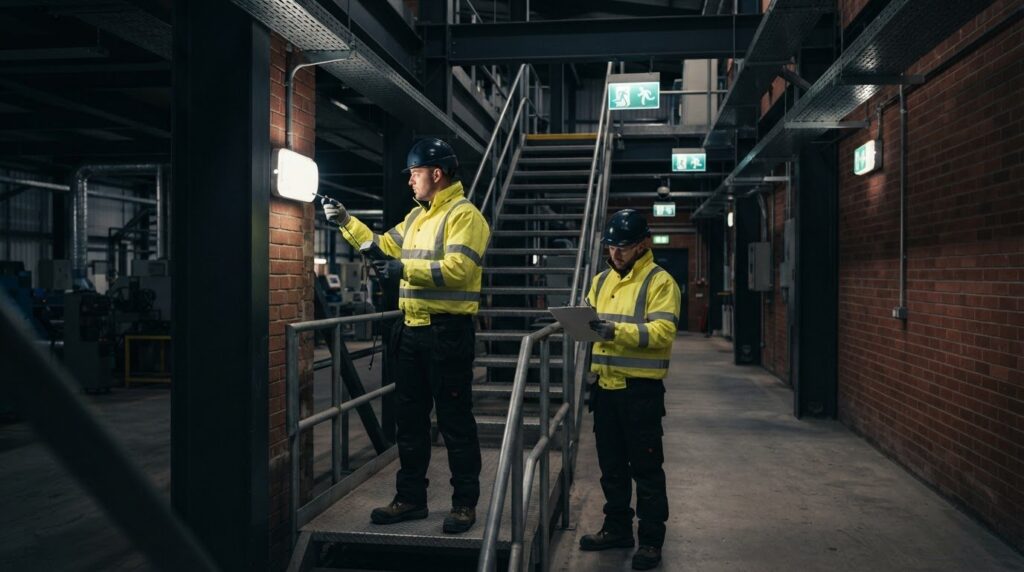
Emergency light testing in Rotherham means carrying out monthly functionality checks and a full three-hour duration test each year. The responsible person holds the fire-safety duty under the Fire Safety Order 2005, according to The National Archives.
Keeping emergency light checks on schedule can be challenging when a building has multiple escape routes, different types of fittings and records to maintain. A clear testing routine helps identify faults and provides a reliable record of system performance.
This guide explains which premises need emergency lighting checks, what happens during the annual duration test, and how monthly results, faults and exit lighting fit into the process. You’ll also learn what to consider when arranging emergency light testing in Rotherham, so you can plan the work around your building and its safety needs.
Key Takeaways
- Identify who is responsible for fire safety in your premises and how that duty relates to emergency lighting.
- Understand what a full-duration test checks and how faults can be recorded for follow-up.
- Keep test records clear, including the log book entries and documentation produced after the annual test.
- Review whether escape routes and exit signs remain visible and illuminated when normal lighting fails.
- See how regular testing can fit into a practical safety routine for your Rotherham premises.
Who Needs Emergency Light Testing in Rotherham?
Premises with emergency lighting need a routine that checks whether lights operate during a power failure. This can include workplaces, shared buildings and public premises where people rely on marked escape routes. The Fire Safety Order 2005 places the duty concerning fire safety on the responsible person, according to The National Archives. That person should ensure the building’s fire-safety arrangements are managed, including checks relevant to its emergency lighting.
Who is qualified to inspect and test emergency lighting in Rotherham? Staff can carry out the monthly function check in-house using the key switch. A more thorough inspection and duration test should be handled by someone with suitable knowledge of the system and its testing process. The responsible person remains accountable for ensuring checks take place and faults are addressed.
What are the monthly functional test and annual duration test for emergency lighting? The monthly functional test briefly switches the system to emergency mode, usually using the key switch, to confirm that each fitting operates. The annual duration test runs the lights for three hours to check whether they remain illuminated for the required period.
Follow a consistent route through the building rather than checking only the most visible fittings. Include escape corridors, stairways, final exits and areas where emergency lighting supports safe movement. During visual inspections, look for damage, obstructions, loose covers or signs that a fitting has been altered. Operate the test switch and confirm the light activates. Record any fitting that fails, flickers or appears unusually dim so it can be investigated.
- Check that the key switch activates the emergency-light function.
- Walk the route and confirm each fitting illuminates.
- Look for visible damage to batteries, bulbs, covers and wiring.
- Note failed fittings and their locations for follow-up.
What are common emergency lighting test failures and risks? A failed battery, bulb or wiring fault can stop a fitting working or shorten its operating time. Damage or an obstruction can also leave part of an escape route poorly lit. During monthly checks, record the location and observed fault, then arrange investigation and any necessary repair or replacement. For emergency light testing in Rotherham, a consistent inspection route and clear records help the responsible person track faults across the premises.
Monthly function checks do not replace the annual three-hour test. A short check confirms that lights switch on; the duration test assesses whether they continue operating for the full period. Keep the test switch accessible, make sure staff know which fittings it controls, and include less-used rooms and secondary routes in the inspection. These steps help prevent overlooked fittings from weakening the building’s emergency arrangements.
Annual three-hour duration testing
BS 5266-1 expects one full three-hour duration test each year. Unlike a brief function check, this test assesses whether each emergency light stays illuminated throughout the required period. It helps reveal problems that a quick switch-on cannot show, including a battery that operates initially but cannot sustain the fitting under emergency load.
Before testing, the tester identifies the fittings and confirms the method for the building’s system. The test simulates a mains supply failure, then checks that emergency lights activate and remain lit. Every fitting matters: a working light near the entrance cannot compensate for a failed fitting along an internal corridor or stairway.
Battery duration is central to the assessment. During the three-hour test, the tester checks whether fittings continue operating and notes any that go out early, flicker or show reduced output. A battery may appear serviceable during a short monthly check yet fail during this longer test. The duration test assesses performance under sustained demand, rather than simply confirming that a lamp turns on.
- Confirm the fittings and areas included in the annual test.
- Simulate a mains failure using the system’s appropriate test method.
- Monitor each emergency light throughout the three-hour duration.
- Record fittings that fail, dim, flicker, or stop operating early.
Plan the annual test around the building’s use. Battery capacity may be reduced temporarily while units recharge, so consider how staff and occupants will move through the premises during and immediately after testing. For a Yorkshire workplace, record the test date, duration, areas covered and faults found. Keep the results with the premises’ emergency-lighting records and use them to plan corrective work and the next annual test.
A three-hour test is more than an extended monthly check. It provides evidence of sustained operation throughout the test period and can reveal weaknesses that a brief activation may miss. Using the same method each year also makes results easier to compare. If a corridor fitting that passed previously now fails before the test ends, the recorded finding gives the responsible person a clear basis for follow-up.
Testing records and compliance certificates
Accurate records link each inspection to the fittings and areas checked. Keep monthly entries and annual test documents together for the premises.
Test Records and Log Book Entries
Record each monthly functional test in the premises’ Emergency Lighting Log Book. Include the test date, the area or fittings checked, and any failure observed. For example, note that a corridor fitting did not illuminate rather than writing only “fault found”. Record monthly emergency lighting functional test results in the log book.
When a fault occurs, add its location and a clear description, such as “stairwell landing light failed to activate”. Record the follow-up action and the outcome after the fitting has been checked again. This creates a traceable account, rather than leaving the next person to guess whether the issue was resolved. Keep entries legible and in date order.
Certificates and Testing Requirements
The Regulatory Reform (Fire Safety) Order 2005 is cited as requiring emergency light testing in the UK, according to The National Archives. The responsible person’s fire-safety duty makes clear records useful for showing how testing is managed. The annual emergency-light duration test produces a certificate and a log book entry. Keep both with the premises’ other fire-safety records.
What are the UK legal requirements for emergency lighting testing? The Regulatory Reform (Fire Safety) Order 2005 is cited as requiring emergency light testing in the UK, according to The National Archives. Monthly functional test results should be entered in the log book, and the annual duration test should have its certificate and corresponding entry retained.
When reviewing a certificate, match it to the correct premises and test date. Check that it identifies the test performed, records the outcome and describes any faults or deficiencies. If repairs or replacements are recommended, use the details to track the work and update the record when it is complete. A certificate documents the test; it does not resolve a recorded fault.
Use one record-keeping process across the building. A simple check can help responsible staff review the file:
- Are monthly test dates and results entered in the log book?
- Is the annual duration-test certificate filed with its matching entry?
- Are failed fittings and recommended corrective actions recorded clearly?
- Does each follow-up entry show what happened to the reported fault?
For premises with several escape routes, record locations consistently, such as “ground-floor rear corridor” or “north stairwell”. This helps staff match a log entry to the right fitting during follow-up. Review the latest entries before the next inspection so unresolved faults remain visible and completed actions are not mistaken for outstanding work.

Escape route and exit sign lighting
Emergency lighting should make escape routes and exits visible when normal lighting fails. Walk each route from occupied areas to final exits, including corridors, stairs and changes of direction. Check that emergency fittings illuminate the route and that exit signs are visible from the approach. A lit sign is less useful if a door, partition or stored item blocks the view.
Start with the building’s actual layout, not just the main entrance. For example, check the route from a rear workshop through its corridor and stairway to the nearest final exit. Include less-used passages, changes in floor level and doors that may be difficult to identify in darkness. If a room layout or partition changes, review whether the fittings and signs still guide people along a clear route.
During a test, assess the lighting from the places occupants would use it. Confirm that each fitting switches on, then check whether the route and exit sign are visible from the relevant approach. Look for damaged covers, loose fittings, dim output or signs facing away from approaching occupants. Record the precise location and fault, such as “exit sign above rear door not illuminated”, so follow-up can target the right point.
- Trace each route from occupied spaces to a final exit.
- Check stairways, junctions, changes in level and rear corridors.
- View exit signs from the direction people would approach.
- Move obstructions, such as a trolley or appliance, from routes and signs.
- Record failed fittings and signs by their location.
Exit signs and emergency lights do related but different jobs. A sign identifies an exit or direction to follow; route lighting helps people see the path, steps and obstacles. Check both together. A visible sign above a doorway does not resolve a dark stair landing just before it. Likewise, a lit corridor needs clear direction at a junction where routes divide.
Building use also affects what needs attention during inspections. Stock, temporary equipment and furniture can shift and obscure a fitting or sign after an earlier check. Include these changes in routine visual inspections, especially in storage areas and busy workspaces. A trolley beneath an exit sign, or an appliance narrowing a passage, can interfere with movement even when the lights work correctly.
Use the same practical approach throughout the premises: inspect the route, test the fittings, view signs from likely approaches and record deficiencies. The results should show which areas were checked and what needs corrective action. Clear findings help the responsible person distinguish a lamp fault from an obstructed sign or a route that needs its layout reviewed.
Emergency lighting testing in Rotherham
Rotherham premises need a testing routine that fits their building layout and emergency-lighting system. The Regulatory Reform (Fire Safety) Order 2005 is cited as requiring emergency light testing in the UK, according to The National Archives. Regular testing helps the responsible person track whether escape-route lighting works and identify faults needing attention.
Which companies provide emergency lighting testing in Rotherham? Specialist fire-safety maintenance companies serving the area test commercial and industrial premises. When choosing a service, look for clear coverage of the monthly functional checks, annual duration test, written findings and fault reporting. AFN Industrial Services Ltd provides Emergency Light Drain Tests for workplace premises.
To arrange testing for a business in Rotherham, prepare the premises’ layout, the locations of emergency fittings and any existing test records. Explain whether you need the annual duration test or help establishing a regular testing schedule. Local postcode districts include S60, S61, S62, S63 and S65.
For routine management, an authorised member of staff can carry out the monthly function test using the key switch. Record the result in the Emergency Lighting Log Book, including any fitting that fails to illuminate. A full three-hour duration test is expected each year under BS 5266-1. Annual inspections can identify problems that a brief activation will not reveal.
Make the testing visit practical by planning access to each fitting and escape route. Share the building’s opening arrangements, identify restricted areas and show where the test switches are located. In a workplace with separate floors, note the stairways, corridors and final exits so testing can cover the complete route. Flag changes such as new partitions or relocated work areas, which may affect how people find an exit.
After testing, review the results against the building’s log book. Check that the record identifies the date, affected locations and any faults or deficiencies. Recommendations for repairs or replacements should be clear enough to assign follow-up work. Once corrective work is complete, update the records so outstanding defects remain distinct from resolved issues.
For Rotherham premises, the practical takeaway is to plan monthly checks, schedule the annual duration test, and retain each result with the relevant records. Arrange a testing visit that covers the building’s actual fittings and routes, then use the findings to manage corrective work. Arrange emergency lighting testing for your premises.
A thorough inspection should take place annually. Testing activates the lights to simulate an emergency and checks that they remain illuminated for the required duration. The inspection also checks the condition of batteries, bulbs and wiring, helping identify issues that may not be apparent during a brief function check. The monthly emergency-light function test can be carried out in-house using the key switch, while a thorough inspection provides a broader system review.
Document testing faults or deficiencies and provide recommendations for repairs or replacements. This gives the responsible person a clear basis for arranging follow-up and tracking issues found during the inspection. Emergency light testing costs in Rotherham vary according to property size, number of lights and testing frequency. When requesting a quote from AFN Industrial Services Ltd, provide details about the premises and the work required so the proposed service can be matched to the building’s fittings and testing arrangements.
AFN Industrial Services Ltd: Fire Extinguisher Maintenance
AFN Industrial Services Ltd provides Emergency Light Drain Tests to support workplace emergency-light testing and maintenance planning. Its Fire Extinguisher Maintenance service can help businesses manage extinguisher upkeep alongside wider fire-safety arrangements. Portable Appliance Testing is also available where workplace electrical equipment needs attention.
Consider arranging support when you need emergency-light drain testing, fire-extinguisher maintenance or help addressing several safety tasks across commercial or industrial premises. AFN Industrial Services Ltd also provides Health and Safety Services for workplace safety needs. Choose the service that matches the task your premises requires.
For help with your premises’ safety requirements, contact AFN Industrial Services Ltd.
Make your next safety task easier to manage
Use your next maintenance review to assign clear responsibility for safety checks. Decide who records faults, follows up corrective work and keeps documentation accessible. A named owner helps prevent actions being lost when responsibilities or building use change.
If your premises need support with several maintenance tasks, AFN Industrial Services Ltd provides Emergency Light Drain Tests, Fire Extinguisher Maintenance and Portable Appliance Testing. These services address distinct equipment and safety needs within your wider maintenance planning.
Planning emergency light testing in Rotherham is a practical opportunity to bring outstanding checks into a manageable routine. List the areas that need attention and the records your team needs to maintain, then arrange Emergency Light Drain Tests with AFN Industrial Services Ltd.
Contact AFN Industrial Services Ltd to discuss the safety support your premises needs. A structured plan can help your team move forward with confidence.
Frequently Asked Questions
How often must emergency lights be tested in commercial buildings in the UK?
Plan monthly functional checks and one full three-hour duration test annually. BS 5266-1 expects the annual duration test; monthly checks confirm that fittings activate between those tests. The Fire Safety Order 2005 places fire-safety duties on the responsible person, according to The National Archives. Set reminders against your premises’ maintenance calendar, and assign someone to record completed checks and report faults promptly.
How much does emergency lighting testing cost in Rotherham?
The price depends on the premises and the testing required, and is provided after a quote request. Key cost factors include the property’s size, the number of emergency lights and how often testing is needed. A site with several separate areas, for example, may take longer to test than a small, simple layout. Sharing an accurate fitting list and building layout helps define the work.
What records and certificates are required after an emergency lighting test?
Keep monthly functional-test results in the premises’ Emergency Lighting Log Book, and retain the certificate and log book entry from the annual duration test. Make records easy to match to the correct building and system. If the premises have several blocks or separately managed areas, identify the relevant location on each entry. Keep fault findings alongside follow-up actions so outstanding issues remain clear.
What should be checked during an emergency lighting inspection?
Check that each fitting activates and inspect visible batteries, bulbs and wiring for damage or deterioration. Look for blocked or obscured lights and signs, then confirm that fittings illuminate the relevant escape routes. Inspect a stair landing as well as the corridor leading to it, for example. Record the precise location of any failure or deficiency, along with recommended repair or replacement action.