A brief functional test can show that emergency lights switch on, but it won’t show how long they can stay illuminated. In Sheffield, an emergency lighting 3-hour discharge test is typically carried out annually to assess whether the lights remain on for their rated duration. The result should be recorded in the emergency lighting logbook, with a certificate produced for the annual duration test.
Keeping checks and records up to date helps facility managers confirm that the system works and identify faults requiring attention. It also makes the maintenance history easier to review.
This article explains the monthly and annual checks, how to assess illumination and battery performance during a discharge test, and which records to retain. You’ll also learn what to include in a test record so it provides clear, useful evidence.
Key Takeaways
- Understand how monthly functional checks differ from an annual full-duration discharge test, and why both belong in a planned maintenance routine.
- Learn which test results and maintenance details help create a clear, useful emergency lighting record.
- See how illumination, operation and battery charging are assessed during and after a discharge test.
- Understand the Responsible Person’s emergency lighting duty under the Regulatory Reform (Fire Safety) Order 2005.
- Find out what information an emergency lighting test certificate should capture and how it supports compliance records.
Emergency lighting compliance checks: what must you do?
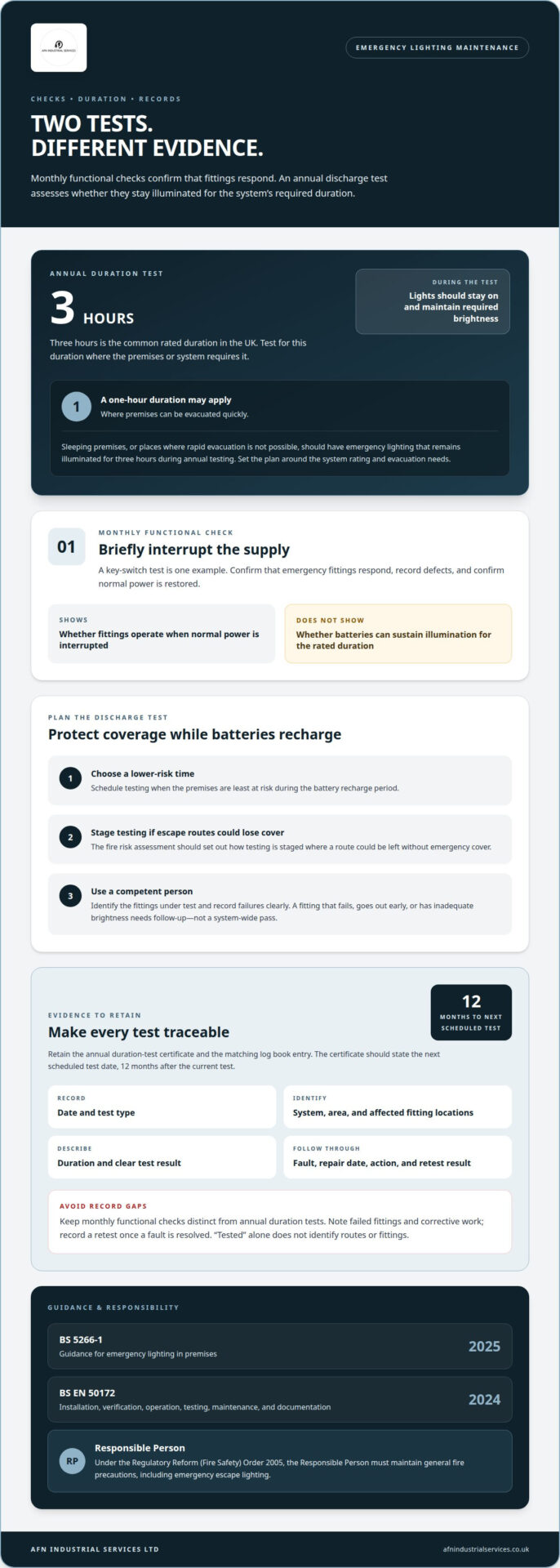
Emergency lighting maintenance combines regular functional checks with an annual full-duration discharge test. Monthly checks show whether fittings operate when normal power is interrupted. The annual test assesses whether each light stays illuminated for its rated period. These checks provide different evidence, so one does not replace the other.
For an emergency lighting 3 hour discharge test Sheffield premises may require, the normal supply to the emergency lighting is interrupted. The fittings then run on their batteries for the required duration. Three hours is the common rated duration in the UK, and a three-hour test is used where the premises or system requires that duration. Emergency lights should remain illuminated and maintain the required brightness throughout the test.
The appropriate duration depends on how the premises are used and how quickly people can evacuate. Premises where people sleep, or where rapid evacuation is not possible, should have emergency lighting that remains illuminated for three hours during annual testing. A one-hour duration may apply where premises can be evacuated quickly. Set the test plan according to the system’s rating and the building’s evacuation needs, rather than applying one duration automatically.
Planning an emergency lighting 3 hour discharge test Sheffield sites need means accounting for the batteries’ recharge period. Schedule the test for a time when the premises are least at risk during recharge. Where an escape route could be left without emergency cover, the fire risk assessment should set out how testing is staged. This helps avoid leaving a route inadequately lit while the system recovers.
A competent person should conduct the duration test, identify the fittings being tested and record failures clearly. They need to observe whether lights operate, stay on for the required duration and show any fault before or during testing. A failed fitting, early loss of illumination or inadequate brightness needs follow-up, not a pass recorded against the whole system. The current guidance standard identified for emergency lighting in premises is BS 5266-1:2025.
Monthly functional testing remains part of the routine. It typically involves briefly interrupting the supply, such as with a key-switch test, to confirm that emergency fittings respond. Record the date, test type and any defects, then confirm that normal power is restored. A brief monthly check can reveal a failed lamp or fitting, but it cannot demonstrate battery endurance. A full-duration test helps show whether the system maintains illumination for its required duration.
What Records Must Be Kept to Prove Compliance?
BS 5266 covers emergency lighting design, installation and maintenance, while fire safety regulations set duties for keeping escape lighting effective. Under the Regulatory Reform (Fire Safety) Order 2005, the Responsible Person must maintain general fire precautions, including emergency escape lighting, according to UK Government.
Testing Records and Log Books
A testing log book records emergency lighting checks, results and remedial work over time. It shows when monthly and annual duration tests took place, which fittings were included and whether faults were addressed. Record the test date, type, outcome, affected locations and follow-up actions. A note that says only “tested” gives little detail about routes or individual fittings.
Keep entries in date order and make each result clear. For example, record a failed fitting by location, then add the repair date and retest result once resolved. Missing entries, unclear locations and faults marked as fixed without a recorded retest leave gaps in the maintenance history. Store the log book where the responsible people can retrieve it for a compliance review.
Certificates and Compliance Records
A test certificate documents the outcome of an emergency lighting duration test, while the log book preserves the wider testing history. BS 5266-1:2025 provides guidance on emergency lighting in premises; BS EN 50172:2024 covers installation, verification, operation, testing, maintenance and documentation of emergency escape lighting systems.
For an annual duration test, retain both the certificate and the corresponding log book entry. The certificate should state the date of the next scheduled test, 12 months after the current test. Check that the date and result align across both records. A certificate without a matching entry, or a log book entry without a certificate, can make the evidence harder to interpret.
Common record-keeping mistakes include combining monthly functional checks with annual duration tests, omitting failed fittings and leaving corrective work without a completion date. Keep each test type distinct. A short monthly check and a full-duration test provide different evidence, so label them accurately rather than using a generic “pass” entry.
Record the system or area tested, the test duration, the result and any action required. For example, distinguish a fitting that operated during a monthly check from one that remained illuminated throughout the annual duration test. This detail helps track recurring faults and confirm that repairs were completed.
BS EN 50172:2024 includes documentation within its scope, so organised records matter alongside the physical checks. Keep certificates, log book entries and repair records together or cross-reference their locations. This creates a traceable history for each test and helps demonstrate how emergency lighting testing has been managed across the premises.
Checking illumination and battery performance
Assess each emergency luminaire for operation, light output and battery performance. A monthly test confirms brief operation, while a full discharge test shows whether the battery sustains illumination for the required duration.
Battery Recharge and Test Scheduling
Recharge time is the period a battery needs to recover after a full discharge. A healthy emergency lighting battery typically needs 24 hours to recharge after a full discharge test. Schedule the test when the premises are least at risk during this period, especially if routes could have reduced emergency cover.
During a duration test, check luminaires at 30 minutes, one hour, two hours and three hours. After a monthly test, confirm the lights charge correctly when normal power returns. Daily visual checks of battery indicators can also reveal a charging issue before the next test.
Common Luminaire and Battery Failures
A luminaire may fail to activate, go out early or provide insufficient illumination. A battery may not hold enough charge to keep the fitting lit for its rated duration. Check the indicator and charging status, then compare each fitting’s operation with the test record.
Illumination matters as well as whether a light switches on. Escape-route lighting should provide at least 1 lux along the floor centre line, and should activate within one second of a power failure. Record the affected location and observed fault, so remedial work can target the right fitting or battery.
Responding to Failed Discharge Tests
If a fitting fails a three-hour test, record its location and when it stopped illuminating, then arrange investigation and corrective work. Keep the failed result visible in the test record until the repair and retest are documented.
Depending on the fault, a fitting may need a battery replacement, repair or further investigation. After the work, test the affected light again and record the outcome. Do not record a pass based only on completion of a repair; the retest confirms whether the fitting operates as required.
For a three-hour duration test, assess whether each relevant fitting remains illuminated throughout and maintains the required brightness. Use consistent location and identification details in observations and records so faults can be traced accurately. If several fittings fail in one area, note the pattern; it may help distinguish individual battery faults from a wider charging or supply issue.
Battery performance also depends on restoring normal supply after testing. Confirm charging indicators return to their normal state, and plan the discharge test so recharge does not leave occupied routes without suitable emergency lighting. The Fire Safety Order 2005 makes maintaining general fire precautions important; test scheduling should account for the temporary loss of battery reserve.
Emergency lighting legal duties in the UK
In England, fire safety duties apply to workplace premises and their escape arrangements. The Responsible Person must maintain general fire precautions, including emergency escape lighting, under the Regulatory Reform (Fire Safety) Order 2005, according to UK Government.
The practical focus of the Order is whether people can leave safely if normal lighting fails. Escape routes should be lit when the normal electricity supply fails. Emergency lighting is part of the premises’ fire precautions; a fitting or test record is not a substitute for effective arrangements.
The Responsible Person is accountable for managing fire safety on the premises. This includes ensuring that fire precautions are maintained and relevant information is available. For emergency lighting, arrange checks, respond to faults and keep records showing what was tested and what happened. A failed light on an escape route needs attention because it may affect evacuation if normal power is lost.
BS 5266 provides guidance on emergency lighting design, installation and maintenance. The current standard identified for premises is BS 5266-1:2025. Its guidance helps structure maintenance, while the Fire Safety Order 2005 establishes the Responsible Person’s general fire-safety duty. Keeping these roles clear helps avoid treating a standard reference or certificate as the duty itself.
Testing is part of maintaining the system. Emergency lighting should receive a monthly functional test and an annual full-duration test. Each has a different purpose: monthly checks assess whether fittings respond, while the annual test assesses whether illumination continues for the required duration. A schedule should identify test dates, locations and the person responsible for arranging and recording each check.
Plan carefully if a test could leave an escape route without emergency cover. The fire risk assessment should set out how testing is staged in that situation. For example, checks may need to be sequenced so that routes are not all left without cover at once. The assessment should reflect the building’s layout, occupancy and evacuation arrangements.
A competent person can carry out testing and identify faults, but the Responsible Person remains accountable for managing fire precautions. Record defects, remedial work and retest outcomes, then keep these with the premises’ fire safety records. This creates a clear trail from the original test to the action taken.
For a Sheffield workplace, apply the same England-wide duties to the site’s actual layout and use. Identify the Responsible Person, include emergency lighting in maintenance arrangements, and consider escape routes during testing and any recharge period. If a fault affects safe evacuation, address it through the site’s fire safety arrangements, not paperwork alone.
Emergency lighting test certificates
An emergency lighting test certificate records the outcome of a duration test, while the log book tracks the broader testing history. Together, they help the Responsible Person follow what was tested, what failed and what action followed. Keep the certificate with the relevant log book entry so the evidence forms a clear maintenance record.
For an annual duration test, the certificate should state the date of the next scheduled test, 12 months after the current test. That date gives the Responsible Person a clear point for planning the next assessment. Record the actual test date as well, so any change to the schedule remains visible in the maintenance history.
A useful certificate identifies the premises or system tested and describes the test carried out. It should make the result clear, including whether the emergency lights remained illuminated for the required duration. Records from an emergency lighting 3 hour discharge test Sheffield businesses have carried out should identify any fitting that failed, its location and the observed issue. This helps distinguish a system that passed from one with outstanding faults.
Keep monthly functional checks separate from the annual full-duration result. A brief switch test shows whether fittings activate when normal power is interrupted; it does not demonstrate battery endurance. Label each entry by test type and date. A monthly check and an annual discharge test should not appear as interchangeable “pass” records.
When a failure occurs, link the certificate or test record to the follow-up evidence. Record the affected fitting, any repair and the retest result. If the fault remains unresolved, make its status clear rather than presenting the system as fully passed. This gives the Responsible Person a reliable view of defects affecting escape lighting.
Store certificates alongside supporting records, including test observations and remedial work. A consistent filing method by premises, system or test date makes it easier to trace an individual fitting. BS EN 50172:2024 covers documentation for emergency escape lighting systems, including testing and maintenance records. Clear documentation supports continuity when the person managing fire safety changes.
Before filing a certificate, check that its premises details, test date and result match the corresponding log book entry. Confirm that any listed failure has a recorded action or remains marked as unresolved. These simple record checks can expose missing evidence, such as a repair noted without a retest outcome. For an emergency lighting 3 hour discharge test Sheffield premises have arranged, matching records help keep the evidence clear.
For a planned duration test, arrange an emergency lighting drain test and retain its certificate with the site’s testing records. This keeps the test outcome connected to the maintenance history and the next scheduled assessment.
AFN Industrial Services: Portable Appliance Testing
AFN Industrial Services Ltd carries out the emergency lighting 3 hour discharge test Sheffield businesses rely on to assess whether emergency fittings maintain illumination during a discharge test. This is the practical next step when a Sheffield site needs emergency lighting tested and the results recorded. The findings help identify fittings requiring attention and support a clear maintenance history.
AFN Industrial Services Ltd also provides Portable Appliance Testing for businesses managing electrical equipment alongside wider safety checks. Its Health and Safety Services can support related workplace safety needs, while Fire Extinguisher Maintenance covers separate fire protection equipment.
Keep Your Safety Records Moving Forward
Use your emergency lighting records as a working tool, not simply an archive. A clear history helps the responsible person spot recurring faults, plan maintenance and keep actions visible as site arrangements change. For an emergency lighting 3-hour discharge test in Sheffield, a planned test can give your team a defined starting point for maintaining that record.
AFN Industrial Services carries out Emergency Light Drain Tests, as well as Portable Appliance Testing and Fire Extinguisher Maintenance. These services support businesses managing practical safety requirements, with each task focused on its own equipment and records.
Contact AFN Industrial Services to discuss an emergency lighting drain test or related safety support for your premises. A clear next step can help keep your site’s maintenance programme organised and your safety responsibilities in view.
Frequently Asked Questions
What is the British standard for emergency lighting testing?
BS 5266-1:2025 is the current British Standard providing guidance on emergency lighting in premises. BS EN 50172:2024 covers installation, verification, operation, testing, maintenance and documentation of emergency escape lighting systems. BS EN 1838:2024 sets out lighting performance requirements. Together, these standards address different parts of the system, from the light levels required to the way installations are tested and recorded.
How should emergency light tests be documented?
Document each test with its date, type, locations covered, result and any faults identified. Keep monthly functional-check entries distinct from annual duration-test records so a brief activation test is not mistaken for a full battery-duration assessment. Identify any failed fitting or area, note the remedial action and record the retest outcome. This creates a traceable record rather than an unexplained pass or failure.
What does the testing schedule look like?
The usual schedule combines monthly functional checks with an annual full-duration test. A monthly check briefly interrupts normal power to confirm that the relevant emergency fittings operate. The annual test assesses whether the lighting maintains its required duration. Plan tests around occupancy and evacuation arrangements, and allow time for batteries to recharge. Record dates and outcomes to help plan the next scheduled tests.
What are the UK requirements for a 3-hour emergency lighting discharge test?
Three hours is a common rated emergency lighting duration in the UK, but it is not automatically required for every premises. The test duration should match the system’s rating and the building’s needs. Premises where people sleep, or where rapid evacuation is not possible, should maintain illumination for three hours during annual testing. The Responsible Person should ensure tests reflect the site’s evacuation arrangements.
How often should emergency lighting be tested in commercial premises in the UK?
Emergency lighting should receive a monthly functional test and an annual full-duration test. The monthly check confirms that fittings respond when normal power is interrupted; it does not establish how long batteries will sustain them. The annual test assesses duration. For commercial premises, keep a schedule showing when each test is due, and record faults or follow-up work against the relevant entry.
What does a 3-hour emergency lighting discharge test involve?
A three-hour discharge test interrupts the normal supply so emergency fittings run on their batteries for three hours. The tester observes whether each relevant light operates, remains illuminated and maintains the required brightness throughout. Record a fitting that goes out early or appears too dim as a fault. After the test, restore normal power and check battery charging.
Who is qualified to carry out emergency lighting testing in Sheffield?
A competent person should carry out emergency lighting tests. They need to understand the system, identify the relevant fittings and recognise failures in operation or duration. Their findings should distinguish a fitting that activates during a brief check from one that sustains illumination during a duration test. The Responsible Person remains accountable for arranging appropriate checks and acting on recorded defects at the Sheffield premises.
What records and certificates are required after an emergency lighting test?
Keep a log book entry showing the test date, type, locations, result and any faults or remedial work. An annual duration test should also produce a certificate, which should state the date of the next scheduled test, 12 months after the current test. Keep the certificate with its related log book entry and repair records. Matching dates and outcomes make it easier to follow the system’s test history.