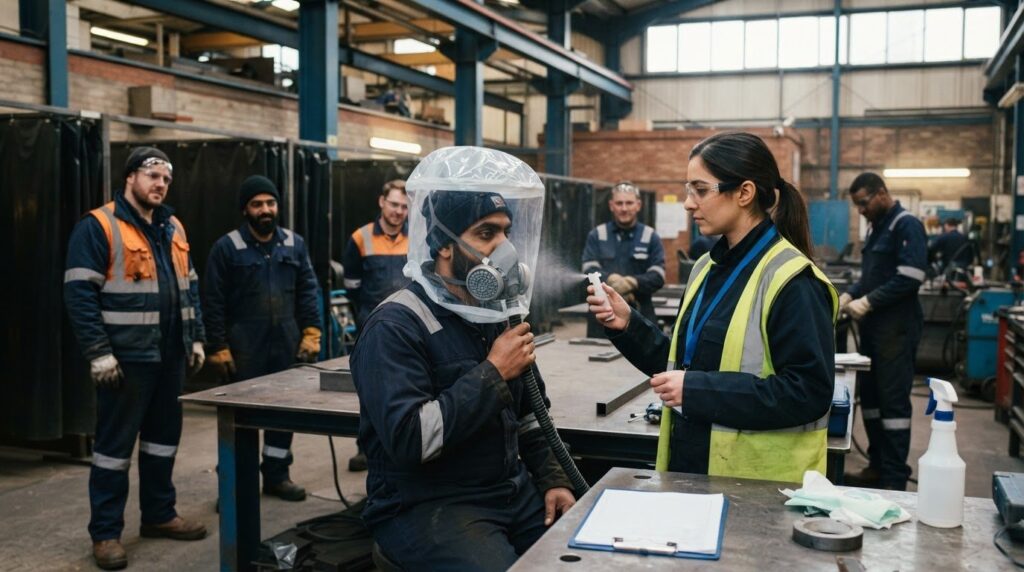
What if a respirator looks suitable but does not seal properly on the person wearing it? For face fit testing for welders Doncaster employers need to consider three things together: the worker, the respirator and the welding task. A comfortable mask alone does not show that it forms an effective seal.
Employers often need to know which welders require testing, what a qualitative test involves and how to fit it around production. Tight-fitting masks need to be fit tested on each individual wearer. Qualitative testing gives a pass or fail result based on whether the wearer detects a test agent. The result applies to that person and the specific facepiece make, model and size tested.
This guide explains how fit testing fits into a wider respiratory protection programme, what workers should know before their appointment and how to prepare the workplace. AFN Industrial Services Ltd provides qualitative testing for respiratory equipment through on-site visits in Doncaster. Individual sessions at your workplace can be planned around shift schedules and welding operations.
Key Takeaways
- Understand what a face fit test checks, and how it differs from selecting, maintaining or training workers to use RPE.
- Follow the qualitative test process and learn how a wearer’s response to a taste or smell test agent determines the outcome.
- Use the welding task and exposure assessment to guide RPE selection, including whether a tight-fitting or loose-fitting facepiece is appropriate.
- Prepare candidate lists, work areas and time slots, and have each welder identify the exact tight-fitting facepiece they use.
- Arrange face fit testing for welders Doncaster teams can coordinate through AFN’s per-person, on-site qualitative testing service.
What face fit testing for welders in Doncaster checks
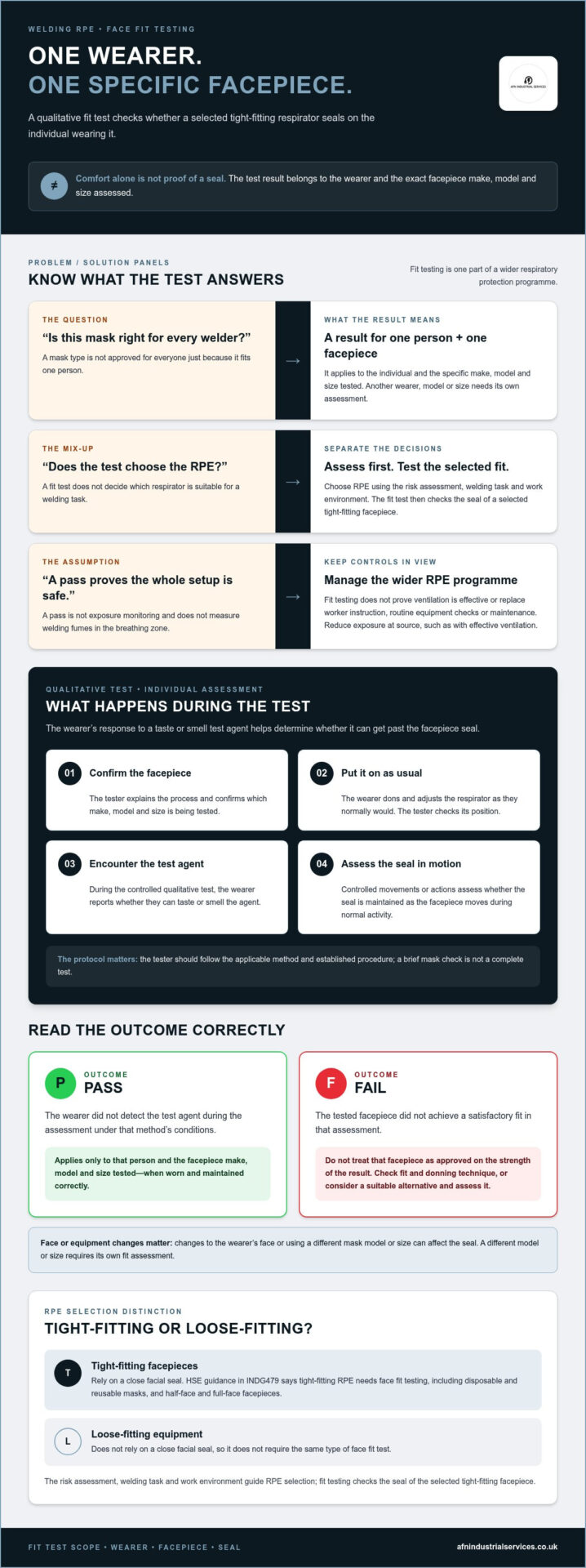
A face fit test checks whether a tight-fitting respirator forms an effective seal against an individual wearer’s face. It is not a general approval of a mask type, nor does it show that a respirator suits every welder or welding task. The result relates to one person wearing one specific make, model and size of facepiece.
This distinction matters in welding environments, where fumes and other airborne hazards must be assessed and controlled. Under the Control of Substances Hazardous to Health Regulations 2002 (COSHH), employers must prevent exposure to hazardous substances or, where that is not reasonably practicable, adequately control it. Respiratory protective equipment (RPE) may form part of those controls, but it does not replace steps to reduce exposure at source, such as effective ventilation. AFN’s UK workplace safety guidance covers the broader compliance context.
When welders may need a tight-fitting respirator test
HSE guidance in INDG479 explains that tight-fitting RPE needs face fit testing to check its seal on the wearer. This applies to tight-fitting disposable and reusable masks, including half-face and full-face facepieces. Loose-fitting equipment does not rely on a close facial seal, so it does not require the same type of face fit test.
Employers should base RPE selection on the risk assessment, the welding task and the work environment. The duration and location of work, exposure controls and the respirator’s design all matter. A fit test checks the seal after a tight-fitting facepiece has been selected. It does not decide which RPE is suitable in the first place.
What a fit test can, and cannot, tell an employer
A qualitative test gives a pass or fail outcome based on whether the wearer can detect a test agent through taste or smell. A pass supports use of that specific facepiece by that person, provided it is worn and maintained correctly. Changes to the wearer’s face or use of a different mask model or size can affect the seal, so the original result should not be treated as a universal approval.
A face fit test checks whether a specific tight-fitting facepiece seals on a specific wearer; its result applies only to that individual and the make, model and size tested.
Fit testing is not exposure monitoring. It cannot measure the concentration of welding fumes in the breathing zone, prove that ventilation is effective or establish that the selected RPE provides adequate protection for a particular exposure. It also does not replace worker instruction, routine equipment checks or maintenance. Employers need to manage these elements as part of a wider RPE programme, following HSE guidance such as INDG479 and HSG53. For a general overview of test purpose and methods, see Understanding Respirator Fit Testing.
How qualitative face fit testing works for Doncaster welding teams
Qualitative face fit testing follows a controlled sequence. The wearer’s responses help determine whether the test agent can get past the seal of the specific tight-fitting facepiece being assessed. It is an individual process, and a pass cannot be assumed in advance: the outcome depends on the wearer, the facepiece and the conditions during the test.
For employers arranging face fit testing for welders Doncaster teams can complete at the workplace, explaining the stages beforehand helps candidates know what to expect and managers plan around production. HSE guidance in INDG479 sets out the principles for testing tight-fitting RPE. The tester should follow the applicable method and protocol, rather than treating a brief mask check as a complete test.
Candidate preparation and the test sequence
The tester explains the process and confirms which facepiece is being tested. The wearer puts it on and adjusts it as they normally would. The tester checks that it is positioned correctly before the assessment begins. Any preliminary checks form part of the method being used; they do not replace the formal assessment.
In qualitative testing, the wearer is exposed to a test agent and reports whether they can taste or smell it. The test uses controlled movements or actions to assess whether the seal is maintained as the facepiece moves during normal activity. The precise protocol, including the sequence of steps, should follow current applicable guidance and the tester’s established method.
Understanding pass, fail and retesting
A pass indicates that the wearer did not detect the test agent during the assessment under that method’s conditions. It applies to the individual and the facepiece make, model and size tested. It does not mean the same mask will fit another worker, or that another size or design will produce the same result.
A fail means the tested facepiece did not achieve a satisfactory fit in that assessment. The wearer should not treat it as approved for use on the strength of that result. The next step may involve checking the fit and donning technique, or selecting a suitable alternative facepiece, followed by assessment as appropriate. A change of model or size requires its own fit assessment.
Record the outcome accurately and make sure workers know which facepiece it relates to. Employers should also make sure their records and follow-up arrangements reflect the testing process. Clear scheduling helps welding teams take part without confusion: identify candidates, set aside individual slots and have each worker bring or identify the facepiece they use. Employers can arrange qualitative face fit testing with AFN for a workplace visit in Doncaster and plan sessions around their team’s operating needs.
Choosing suitable RPE for welding: fit, task and limitations
Respiratory protective equipment (RPE) should suit the welding hazard, the work being done and the conditions on site. The employer’s risk assessment informs that choice, including consideration of exposure controls and whether RPE is needed after risks have been reduced as far as reasonably practicable. A face fit test checks one part of the arrangement: the seal of a tight-fitting facepiece on its wearer. It does not select the respirator or establish that it is suitable for every task.
At category level, tight-fitting facepieces depend on a close seal against the face. Loose-fitting RPE, such as equipment using a hood, does not rely on the same facial seal. The distinction affects the testing route, but it does not remove the need to assess whether the equipment is appropriate for the welding work and exposure. HSE guidance on selection and use of RPE, including HSG53, should inform the employer’s wider assessment.
| RPE category | Fit testing | What the test does not establish |
|---|---|---|
| Tight-fitting facepiece | Individual face fit testing applies. Qualitative testing can be suitable for certain disposable and half-face masks; other facepieces may require a different method. | It does not prove the equipment is suitable for every exposure or that controls at source are adequate. |
| Loose-fitting RPE | A face fit test is not required in the same way because the equipment does not depend on a tight facial seal. | That does not confirm the equipment is suitable for the task or correctly used and maintained. |
Why one mask’s fit result does not transfer to another
A fit test result is specific to the wearer and the tested facepiece make, model and size. A different model or size can sit differently against the face, so a previous pass should not be carried across to it. Nor does a pass guarantee protection in every work condition: the wearer must use the tested facepiece correctly, and the RPE must remain suitable for the assessed task.
Facial hair where the facepiece seals can prevent a tight-fitting mask from sealing properly. Changes in the wearer’s face that affect the seal also warrant attention. Employers should make sure the selected facepiece is compatible with other equipment worn for welding, such as eye or head protection, without compromising its fit.
Qualitative testing and other RPE assessment needs
Qualitative testing is a pass-or-fail method in which the wearer reports whether they can taste or smell a test agent. It is suitable only for facepieces and situations covered by the applicable method. HSE guidance indicates that full-face masks require quantitative testing, which measures fit rather than relying on the wearer’s perception of an agent.
For face fit testing for welders Doncaster employers should keep the test in perspective: it validates the seal for the tested wearer and facepiece, not the whole respiratory protection programme. The employer’s risk assessment determines the protection needed. A face fit test cannot measure welding-fume exposure, replace ventilation or establish that the selected RPE provides adequate protection for the task.
Preparing welders and your Doncaster site for a testing visit
Preparation helps make an on-site visit easier to coordinate and reduces avoidable delays. Start by identifying which workers use tight-fitting RPE for welding tasks. Then gather the facepiece details each person uses at work, rather than assuming everyone on the team wears the same model.
For face fit testing for welders Doncaster employers should also plan where and when individual sessions can take place. The test area needs to be accessible to candidates without placing them in an active welding zone or disrupting essential site controls. A schedule that reflects shift patterns and operational demands helps workers attend without leaving supervisors to organise each session at short notice.
A practical checklist for welding supervisors
Before the visit, prepare a candidate list and ask each welder to bring their usual tight-fitting facepiece or identify its make, model and size. A different mask may fit differently, so testing an unfamiliar substitute will not validate the facepiece used for the job. Tell candidates why the test is being carried out and that they need to follow the tester’s instructions throughout.
- Identify candidates: List workers who wear tight-fitting RPE and note the facepiece each person uses.
- Check readiness: Remind candidates that the area where a tight-fitting facepiece seals must be clean-shaven for the test. Facial hair in this area can prevent an effective seal.
- Plan safe access: Choose a suitable testing space and time slots that do not compromise site controls or essential work.
- Brief the team: Explain the purpose of the assessment and ask workers to arrive ready to follow the tester’s guidance.
Clean-shaven preparation matters because a fit test assesses the seal against the wearer’s face. If facial hair crosses the sealing area, the test may not provide a valid assessment of the facepiece’s fit. Employers should make this requirement clear before the appointment, not leave candidates to discover it when their session begins.
Keeping testing organised across shifts
Where practical, group candidates by shift, department or work area. This gives supervisors a clearer view of who needs to attend and helps avoid unnecessary movement around the site. Appoint one site contact to coordinate access, direct workers to the testing area and manage changes if production needs affect the schedule.
Share the candidate list and relevant facepiece details with the site contact before the visit. If workers use different masks, make that clear in the plan so each person is assessed using the facepiece they actually wear. AFN Industrial Services provides qualitative face fit testing during site visits, giving Doncaster employers a practical way to coordinate individual workplace sessions.
Once candidates, facepieces and time slots are organised, arrange a face fit testing visit for your Doncaster team.
Arrange face fit testing for welders in Doncaster with AFN
AFN Industrial Services Ltd provides qualitative face fit testing for respiratory equipment during workplace site visits, with testing arranged per person. For Doncaster employers, on-site sessions offer a practical way to bring individual workers through testing while keeping the plan connected to the demands of the welding operation.
AFN serves Doncaster and surrounding locations, including Bawtry, Sheffield, Rotherham, Worksop, Retford, Wakefield, Barnsley, Mansfield, Scunthorpe and Pontefract. The team brings more than 25 years of experience. Fit testing is one part of a broader approach to respiratory protection: employers still need to assess welding exposure, select suitable RPE and manage its correct use. A well-planned visit helps workers complete their individual assessments using the facepiece they wear for their job.
What to include when arranging workplace testing
Before making an enquiry, gather a few practical details. A clear outline helps AFN plan the visit around your operational requirements. It also gives your team a starting point for organising attendance and preparing the right equipment.
- Workplace location: Provide the Doncaster site address and useful information about access or where testing can take place.
- Candidate numbers: Estimate how many welders need testing, including any shift or department groups to coordinate.
- Facepiece information: Identify the tight-fitting masks workers use, including make, model and size where available. Each worker should be assessed using the facepiece intended for workplace use.
- Operational arrangements: Note shift patterns, suitable time slots and any site controls that need to remain in place during the visit.
These details help shape a workable plan without relying on a one-size-fits-all schedule. If some facepiece details are not immediately available, supervisors can ask workers to bring their usual equipment so it can be identified as part of the preparation.
Next steps for Doncaster employers
Choose a time when candidates and their facepieces can be available, then nominate a site contact to coordinate attendance and access. Brief workers on the purpose of the test and remind them that tight-fitting masks need a clean-shaven sealing area. This preparation supports an orderly visit, but the test outcome still depends on the individual wearer and the facepiece assessed.
Fit testing does not replace the wider respiratory protection programme. Employers remain responsible for considering exposure controls, choosing RPE that suits the task and ensuring workers understand its correct use. Treat the visit as one defined part of that system, alongside the workplace’s other safety arrangements.
To discuss candidate numbers, site arrangements and qualitative face fit testing for your Doncaster workforce, contact AFN to arrange a site visit. AFN can plan individual worker sessions at your workplace around your operational needs.
Make your next RPE review count
Use your next review of welding work to check that respiratory protection arrangements still match the tasks people carry out. Changes to work practices, equipment or the workforce can prompt a fresh look at which facepieces are used and whether each wearer has been assessed in the one they rely on.
Planning face fit testing for welders Doncaster teams can attend starts with a clear candidate list, the facepieces workers use and a schedule that fits site operations. This gives you a practical basis for arranging individual sessions and keeping the assessment connected to your wider respiratory protection programme.
AFN Industrial Services can help you plan qualitative face fit testing around your workplace requirements. Share your candidate numbers, site arrangements and available facepiece information to get started.
Arrange face fit testing for your Doncaster team and move your respiratory protection planning forward with confidence.
Frequently Asked Questions
Do welders in the UK need face fit testing?
Welders who use tight-fitting RPE need an individual face fit test for the facepiece they will wear. Employers must assess welding-fume risks and provide suitable control measures under COSHH; HSE guidance explains how fit testing supports the use of tight-fitting masks. Not every welder uses this type of equipment, so the requirement depends on the RPE selected for the assessed work. A test does not replace ventilation or other exposure controls.
What does a qualitative face fit test involve?
A qualitative test checks fit through the wearer’s ability to detect a test agent by taste or smell. After the tester explains the procedure, the candidate wears the facepiece and follows the test instructions, including specified movements. If the wearer detects the agent, the test has not demonstrated a satisfactory seal. The method is suitable only for certain tight-fitting facepieces, so the testing approach needs to match the mask being assessed.
How long does face fit testing take for one welder?
There is no single reliable duration for every candidate. The time can depend on the test method, the facepiece and whether the wearer completes the assessment successfully. Allow enough time for the tester to explain the process, for the welder to fit the mask correctly and for the assessment to be completed without rushing. For a Doncaster site schedule, plan individual appointments and allow flexibility for operational changes.
Can a welder pass a face fit test with a beard?
A welder generally cannot pass a test using a tight-fitting facepiece if facial hair crosses the area where the mask seals against the skin. Hair can create gaps and undermine the seal the test is intended to assess. Employers should tell candidates about the clean-shaven requirement before their appointment. If a worker cannot shave the sealing area, the employer needs to consider suitable respiratory protection that does not rely on a tight facial seal.
Does a face fit test need repeating when a worker changes mask?
A test result applies to the facepiece make, model and size tested, so it should not be assumed to cover a different mask. If a welder changes to another facepiece, arrange a fit test for that specific model and size before relying on it. Changes to a worker’s facial features can also affect fit. Keep the mask details alongside the test outcome so supervisors can check that the worker is using the assessed equipment.
Can AFN carry out face fit testing at a Doncaster workplace?
Yes. AFN Industrial Services Ltd provides qualitative face fit testing for respiratory equipment through site visits in Doncaster and surrounding areas, including Sheffield and Rotherham. Testing is arranged per person, which helps employers plan individual workplace sessions. To organise a visit, prepare the site location, candidate numbers and the facepieces workers use, then contact AFN to discuss your testing arrangements.