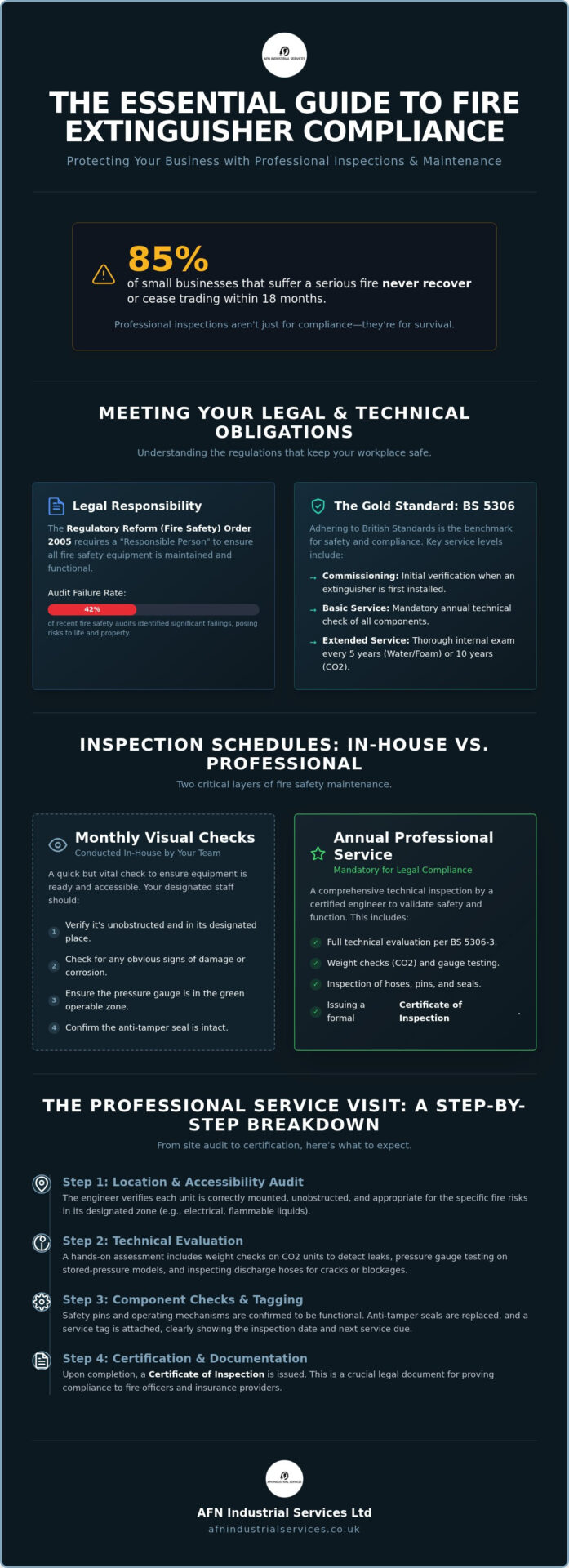
Did you know that 85% of small businesses that suffer a serious fire either never recover or cease trading within 18 months? It’s a sobering reality for any business owner or facility manager. When you’re searching for a reliable fire extinguisher inspection near me, you aren’t just looking to tick a regulatory box; you’re actively protecting your company’s future. Local compliance involves more than just a service sticker. It requires a methodical, expert approach to safety that ensures every unit on your site is ready for an emergency.
Managing multiple sites and tracking various service dates often feels overwhelming, especially with the constant threat of non-compliance fines. We understand the pressure of keeping up with shifting standards like BS 5306-8:2023. This guide provides the professional clarity you need to ensure your equipment remains legally compliant and fully operational. We’ll walk through current UK requirements, documentation for insurance, and how to maintain a safety schedule that offers total peace of mind. By the end, you’ll have a clear roadmap for maintaining a fire-safe environment.
Key Takeaways
- Understand your legal responsibilities under the Regulatory Reform (Fire Safety) Order 2005 and the specific British Standards governing equipment maintenance.
- Identify the criteria for selecting a professional fire extinguisher inspection near me to guarantee technical accuracy and valid certification for insurance purposes.
- Differentiate between necessary monthly visual inspections conducted in-house and the mandatory annual professional servicing required for legal compliance.
- Learn how to efficiently coordinate safety audits across complex industrial sites, ensuring full access to all fire safety equipment in every location.
- Explore how integrating extinguisher maintenance with services like PAT and ladder inspections creates a more resilient safety framework for your business.
What is a Fire Extinguisher Inspection and Why is it Mandatory?
A professional fire extinguisher inspection is a technical examination of your site’s life-saving equipment. It ensures that every unit on your premises is functional, appropriately pressurized, and suitable for the specific risks in its vicinity. To understand the mechanics of these devices, it helps to ask What is a fire extinguisher? and learn about the different agents used to combat specific fire classes. In an industrial or commercial setting, these tools are the first line of defense. They don’t just exist for compliance; they are active components of a broader safety strategy designed to prevent 20,000 annual commercial fires from becoming total losses.
Searching for a fire extinguisher inspection near me is often the first step toward securing insurance validity. By July 2026, insurers have become increasingly stringent regarding documented proof of maintenance. Without a valid certificate from a competent person, many policies are effectively void in the event of a claim. Professional inspections provide the formal validation required to prove you’ve met your safety obligations.
The Legal Requirements for UK Businesses
The Regulatory Reform (Fire Safety) Order 2005 places the burden of safety on a designated “Responsible Person”. This individual must ensure that all fire safety equipment is maintained in an efficient state. Failing this duty carries heavy penalties. Statistics show that 42% of fire safety audits conducted in the last year identified significant failings. These aren’t just administrative errors; they are physical risks to life and property. Regular inspections reduce workplace accidents by ensuring equipment works when needed. They also help lower insurance premiums by proving your business is a low-risk operation.
The Importance of BS 5306 Standards
Adhering to British Standards is the only way to guarantee your equipment meets the “gold standard” of safety. BS 5306-3:2017 dictates how portable equipment should be commissioned and maintained. BS 5306 is the code of practice for the commissioning and maintenance of portable fire extinguishers. There are three main levels of professional attention that your inspector will carry out:
- Commissioning: The initial check when an extinguisher is first installed to ensure it survived transit and is placed correctly.
- Basic Service: An annual technical check of the valves, gauges, and internal components to ensure reliability.
- Extended Service: A more thorough internal examination, typically required every five years for water and foam units, or every ten years for CO2 overhauls.
Maintaining these standards ensures your business remains protected. In South Yorkshire and the Midlands, where industrial risks are often higher, these technical benchmarks are non-negotiable for operational safety.
The Professional Inspection Process: What Happens During a Service?
A professional service visit is a structured technical procedure, not a cursory glance at your equipment. When you arrange a fire extinguisher inspection near me, the attending engineer follows a methodical sequence to ensure every unit complies with BS 5306-3:2017. This process starts with an assessment of the extinguisher’s location. We verify that each unit is mounted at the correct height and remains unobstructed, ensuring it is suitable for the specific fire risks in that zone. Identifying the correct placement is just as critical as the mechanical integrity of the device itself.
The technical evaluation is exhaustive. Engineers perform weight checks on CO2 extinguishers to detect internal leakage, while stored-pressure units undergo gauge testing to confirm accurate readings. We examine discharge hoses for blockages or age-related cracking and replace anti-tamper seals that show signs of wear. This level of detail is necessary to fulfill your UK fire safety responsibilities. Upon completion, you receive a formal Certificate of Inspection. This document serves as vital evidence for fire officers and insurance providers, confirming that your safety equipment is maintained by a competent person.
Step-by-step: The Annual Maintenance Visit
The visit begins with a visual audit of mounting brackets and safety signage. We then move to a physical inspection of the safety pin and operating mechanism to ensure they haven’t seized. Every unit is cleaned, and the discharge hose is removed to check for obstructions. Finally, the engineer records the results in your site’s fire logbook and applies a new service label to the extinguisher body. This methodical approach identifies issues before they become critical failures during an emergency.
Identifying Common Faults and Corrective Actions
Corrosion is a frequent issue in industrial settings, particularly in damp or chemical-heavy environments. If we find deep pitting or rust on the canister, the unit must be replaced immediately to prevent a dangerous rupture. Tampering is another common fault; broken seals often indicate that an extinguisher has been partially discharged and requires a refill. We only use manufacturer-approved refills and spare parts. Mixing incompatible chemicals can lead to equipment failure or even dangerous reactions within the canister. Proactive fire extinguisher maintenance ensures these faults are corrected during the visit, keeping your facility safe and compliant.
Monthly Visual Checks vs. Annual Professional Servicing
Effective fire safety relies on two distinct layers of oversight: routine visual checks and technical maintenance. While searching for a fire extinguisher inspection near me ensures your annual legal obligations are met, the interim months require internal diligence. The law mandates that the “Responsible Person” keeps fire safety equipment in efficient working order. This means you can’t simply wait for an annual visit if a unit is damaged or discharged in the meantime. Both layers are essential to a functional safety strategy.
Integrating these checks into your standard workplace safety routine is the most reliable way to prevent equipment failure. By documenting these monthly inspections in your fire logbook, you create a robust audit trail. This proof of diligence is often the first thing a fire officer or insurance investigator will ask to see. It demonstrates proactive management rather than reactive compliance.
Your Monthly Fire Safety Checklist
A monthly inspection is a non-technical assessment of visibility and accessibility. It’s a quick but essential process that ensures your equipment is ready for immediate use. Your checklist should include these three primary points:
- Obstruction checks: Ensure extinguishers aren’t hidden behind pallets, office furniture, or stock. They must be visible from a distance and easily reachable.
- Pressure gauge verification: The needle must be firmly in the green “safe” zone. If it’s in the red, the unit is either over-pressurised or has leaked and won’t function.
- Operating instructions: The labels must be legible, clean, and facing outward so a user can read them instantly during a crisis.
Why the Professional Service is Non-Negotiable
A visual check only confirms that the extinguisher is present and appears pressurized. It cannot detect internal corrosion, compacted powder, or a perished valve seal. Professional servicing involves technical tools and specific training to test the internal mechanisms that a visual check can’t reach. Without this annual audit, there’s no guarantee the unit will actually discharge when the lever is squeezed. A professional has the equipment to verify weight and pressure with precision that an in-house check simply cannot match.
Engaging a specialist also provides access to expert advice regarding the specific kinds of extinguisher required for your evolving hazards. If you’ve added new machinery, moved departments, or installed lithium-ion charging stations, your existing equipment may no longer be suitable. For localized support and technical guidance, contacting AFN Industrial Services Ltd ensures your safety infrastructure remains effective as your operations grow.
Preparing Your Site for a Fire Safety Audit in South Yorkshire
Organising a professional fire extinguisher inspection near me requires logistical foresight, especially for facility managers overseeing complex sites in Sheffield and Rotherham. Before the engineer arrives, you must ensure all areas of your premises are accessible. This includes often-overlooked spaces like plant rooms, remote storage units, and mezzanine levels. Blocked access leads to incomplete records, which are a major red flag during an official safety audit. A pre-visit walkthrough ensures every unit is accessible, preventing service delays and compliance gaps.
Your existing fire risk assessment serves as the blueprint for the engineer’s visit. It’s vital that your equipment layout matches the hazards identified in your latest report. If you’ve modified your floor plan or added new machinery, your suppression tools must be updated accordingly. Coordinating this with your portable appliance testing is a strategic way to manage site safety. Handling both ignition sources and suppression equipment in a single window minimizes operational downtime and ensures a unified approach to risk management.
Local Compliance for Regional Businesses
Industrial sites in Doncaster and Barnsley often operate on a much larger scale than urban offices. Heavy manufacturing environments and sprawling logistics hubs have unique risk profiles that require seasoned oversight. Partnering with a Rotherham-based team provides the benefit of rapid response and deep familiarity with regional industrial architecture. This proximity allows for more flexible scheduling and localized expertise. A local expert understands the specific expectations of fire safety officers in this region, helping you maintain a high standard of equipment readiness without the logistical friction of a distant provider.
Streamlining Your Safety Documentation
Documentation is the cornerstone of a successful audit. Your fire logbook should be organized to allow for immediate review by regulatory bodies. By linking your extinguisher records with your emergency light testing data, you present a comprehensive view of your facility’s safety status. Consolidated safety records simplify HSE inspections by providing auditors with a transparent, methodical history of compliance. Maintaining these records digitally or in a dedicated safety folder ensures that you can produce proof of maintenance the moment it is requested. For direct support in managing these rigorous requirements, contact AFN Industrial Services Ltd for professional fire safety audit support from AFN Industrial Services Ltd.
Why Choose AFN Industrial Services Ltd for Your Inspection?
Facility managers require a partner who understands the high stakes of industrial maintenance. When you search for a fire extinguisher inspection near me, you need more than a technician; you need an expert who integrates safety into your operational workflow. AFN Industrial Services Ltd brings over 25 years of HSE consultancy experience to every site visit. We don’t just check boxes. We ensure your suppression equipment is part of a resilient, documented safety framework that protects your personnel and your assets. Our team operates with a steadfast professionalism that mirrors the heavy-duty nature of the industries we serve.
Our reach extends across South Yorkshire, the Midlands, and the North East, providing a reliable local presence for regional businesses. Being based in Rotherham allows our team to offer rapid response times and a deep understanding of the local industrial landscape. We recognize that every site has unique requirements, which is why we provide highly individualized solutions rather than a one-size-fits-all service. This methodical approach ensures that your specific regulatory and operational benchmarks are always met with precision.
The AFN Difference: Reliability and Expertise
Our seasoned team specializes in navigating the complex safety challenges inherent in heavy industry and commercial hubs. We adhere to the highest professional benchmarks, ensuring every inspection is technically accurate and fully compliant with current UK standards. Reliability is our core value. We provide transparent, honest advice on equipment replacement, only recommending new units when a repair is technically unfeasible or unsafe. This no-nonsense, hardworking persona is why industrial operators trust AFN Industrial Services Ltd as a calm, capable partner in high-stakes environments. We prioritize results and safety above all else, maintaining a clear focus on execution and professional validation.
In these high-stakes environments, physical security often goes beyond fire safety; for comprehensive site protection, Shelter & Bunker manufactures reinforced concrete shelters and blast-resistant doors designed for extreme industrial and institutional needs.
Get a Professional Quote Today
Efficiency is critical for large-scale operations. AFN Industrial Services Ltd offers a single point of contact for multiple compliance requirements. By combining fire extinguisher maintenance with portable appliance testing or face-fit testing, you can streamline your safety schedule. Scheduling these services as a coordinated project reduces site downtime and ensures your documentation is synchronized for your next audit. Our Rotherham-based team is ready to provide a tailored solution for your facility, ensuring you remain fully compliant while searching for a fire extinguisher inspection near me that you can trust.
Secure your site with a professional fire extinguisher inspection from AFN Industrial Services Ltd. Our methodical approach guarantees that your equipment remains a reliable asset in any emergency, backed by decades of industry expertise and a commitment to the highest safety protocols.
Secure Your Site Compliance for 2026 and Beyond
Fire safety is a continuous commitment to your operational integrity. As established throughout this guide, professional servicing is a legal mandate that ensures your equipment functions correctly when it’s needed most. By combining diligent monthly visual checks with a rigorous annual technical audit, you create a resilient safety framework that protects both your personnel and your business assets. Maintaining documented proof of these inspections is your primary defense against non-compliance fines and insurance complications.
When you’re searching for a reliable fire extinguisher inspection near me, you need a partner who understands the specific demands of industrial environments. AFN Industrial Services leverages 25+ years of safety consultancy experience to provide methodical, high-stakes maintenance solutions. We specialize in industrial compliance across South Yorkshire, offering comprehensive HSE services including PAT and Face-Fit testing to simplify your regulatory obligations and streamline your site management.
Just as industrial equipment requires expert care, mobile assets like motorhomes also need regular professional attention; you can learn more about LeisureVan Service Solutions for specialist mobile habitation and safety maintenance.
Book your expert fire extinguisher inspection with AFN Industrial Services today. Taking this proactive step ensures your documentation is audit-ready and your facility remains a safe, productive environment for the long term.
Frequently Asked Questions
How often do fire extinguishers need to be inspected in the UK?
Fire extinguishers require two distinct types of inspection: a monthly visual check and an annual professional service. The monthly check, performed by your site’s Responsible Person, ensures equipment is visible and unobstructed. The annual service must be conducted by a competent professional to comply with BS 5306-3. This dual-layered approach guarantees that equipment remains functional between technical audits and meets legal safety standards.
Is it a legal requirement to have fire extinguishers serviced every year?
Annual servicing is a mandatory legal requirement under the Regulatory Reform (Fire Safety) Order 2005. This legislation dictates that all fire safety equipment is maintained in an efficient state and in good repair. Failing to provide documented proof of an annual service can lead to significant fines or the invalidation of your commercial insurance. It is a critical component of your workplace safety obligations.
Can I carry out a fire extinguisher inspection myself?
You can perform the monthly visual inspections yourself as the designated Responsible Person. However, the mandatory annual maintenance must be completed by a competent person with the necessary training and tools. When searching for a fire extinguisher inspection near me, ensure the provider has the technical expertise to issue a valid certificate of compliance. Professional servicing involves internal checks that require specialized industry knowledge.
What happens if a fire extinguisher fails its annual inspection?
If a unit fails, the engineer will recommend either a technical repair or an immediate replacement. Common failure points include deep corrosion, damaged valves, or failed pressure tests. In industrial environments, equipment is often exposed to harsher conditions that accelerate physical wear. A failed extinguisher must be removed from service and replaced immediately to maintain your site’s required level of fire protection and legal compliance.
How long does a professional fire extinguisher service take?
A standard service typically takes between 15 and 20 minutes per extinguisher, though this varies based on the unit type and site complexity. For larger industrial facilities or multi-site operations, the total duration depends on the number of units and their accessibility. A methodical engineer will also factor in the time needed to audit mounting brackets and safety signage for every individual unit on your premises.
Do brand new fire extinguishers need to be commissioned before use?
All new fire extinguishers must be commissioned on-site before they are officially put into service. Commissioning involves a thorough check to ensure the unit wasn’t damaged during transit and remains correctly pressurized. This process also confirms that the extinguisher is suitable for its specific intended location. Only once a unit is commissioned and tagged by a professional is it considered compliant with British Standards.
What is the difference between a basic and an extended service?
A basic service is the standard annual technical check of all external and internal components. An extended service is a more invasive procedure performed every five years for water, foam, and powder extinguishers. It involves discharging the unit, inspecting the internal lining, and refilling the agent. CO2 extinguishers undergo a similar technical overhaul every ten years. These intervals ensure the long-term structural integrity of the pressurized canisters.
How many fire extinguishers does my business need to be compliant?
The number of extinguishers required depends on your total floor area and the specific fire risks present, such as electrical equipment or flammable chemicals. As a general rule, most premises require at least two Class A extinguishers per floor, but a detailed assessment is necessary. When you book a fire extinguisher inspection near me, our engineers can audit your current provision against BS 5306-8 standards to ensure your coverage is technically adequate.
