Did you know that fire incidents in England rose by 19% in the year ending March 2026, with Fire and Rescue Services attending over 170,000 fires? For many facility managers, fire safety often feels like a complex burden of technical jargon and worrying about potential audit failures. You’re likely balancing several compliance tasks at once, from PAT testing to ladder inspections, and the last thing you need is a hidden cost or a piece of equipment that fails when it matters most.
This guide provides the clarity you need for fire extinguisher maintenance retford, ensuring your business remains fully compliant with the latest BS 5306-3:2024 standards. We’ll explain the critical 2025 ban on certain AFFF foam extinguishers and show you how to secure your insurance coverage through professional servicing. By the end of this article, you’ll have a clear roadmap to maintain a safe, legally sound workplace without the stress of regulatory guesswork.
Key Takeaways
- Understand how to align your facility with the latest BS 5306-3:2024 standards to ensure full legal compliance and equipment reliability.
- Discover why professional fire extinguisher maintenance retford is essential for validating your business insurance and protecting against legal liability.
- Identify the critical 2025 regulatory changes regarding AFFF foam extinguishers and the mandatory requirements for hazardous waste disposal.
- Learn the technical details of a professional audit, including the pressure gauge calibration and weight checks that guarantee equipment performance.
- Gain insights into streamlining your compliance schedule by combining extinguisher servicing with other essential tasks like PAT testing and ladder inspections.
Why Retford Businesses Require Professional Fire Extinguisher Maintenance
Retford’s commercial landscape is diverse, ranging from heavy-duty industrial operations to traditional high-street retail. Regardless of the sector, every business shares a common legal duty. The Regulatory Reform (Fire Safety) Order 2005 mandates that fire-fighting equipment must be kept in good working order. Professional fire extinguisher maintenance retford ensures that your site meets these rigorous safety benchmarks through structured technical audits rather than guesswork.
Retford’s Industrial and Retail Safety Needs
Industrial units on Brunel Drive face different challenges compared to the boutique shops on Carolgate. In a warehouse or factory setting, vibrations from machinery and the presence of airborne particulates can compromise the integrity of an extinguisher’s valve. These environments often require a strategic deployment of various fire extinguisher types, such as CO2 for electrical risks or dry powder for chemical hazards. Regular servicing identifies hidden corrosion or settling of powder that could render the unit useless during a crisis.
Retail and hospitality venues in the town centre deal with high footfall. This increases the likelihood of accidental impact or “prank” discharges. While local staff should perform monthly visual checks to spot missing pins or obvious damage, these don’t replace the professional annual service. A technician uses calibrated tools to verify the internal pressure and the precise weight of the extinguishing agent, ensuring the unit is ready for immediate deployment.
The Cost of Non-Compliance
Neglecting your maintenance schedule creates significant financial and legal exposure. If a fire occurs and your equipment is found to be non-compliant, insurance companies have the right to repudiate your claim. This means the business owner is personally responsible for the costs of property damage and any liability claims from staff or customers. Beyond the financial impact, the legal repercussions include heavy fines or even custodial sentences for the designated Responsible Person if negligence is proven.
Accurate maintenance records are more than just paperwork; they’re your primary defence during a fire safety audit. Validated documentation proves that you’ve taken all reasonable steps to protect your premises. By integrating extinguisher servicing with other safety tasks like PAT testing, you create a robust compliance shield that protects your business, your staff, and your livelihood. It’s a proactive approach that ensures your equipment works when it’s needed most.
The Legal Framework: UK Regulations and BS 5306-3 Standards
UK law is precise about fire safety equipment. The primary standard for commissioning and maintaining portable units is BS 5306-3:2024. This regulation mandates that every extinguisher must be commissioned on-site before use. It isn’t enough to buy a unit online; a competent person must verify it is fit for purpose at its specific location. Professional fire extinguisher maintenance retford ensures your site meets these technical benchmarks through rigorous adherence to these national standards.
Standard maintenance follows a strict timeline. Basic services are required annually to confirm the unit’s operational readiness. However, certain units require an “Extended Service” or “Overhaul” at specific intervals. For water, foam, and powder extinguishers, this occurs every five years and involves a detailed internal examination. CO2 extinguishers require a 10-year overhaul, which includes a hydrostatic pressure test to ensure the high-pressure cylinder remains safe. Adhering to these cycles is a core part of UK fire safety regulations.
Understanding the Annual Inspection Cycle
The maximum allowable interval between professional inspections is 12 months. If you exceed this window, your compliance status expires immediately. While a technician handles the technical audit, the “Responsible Person” on-site must conduct monthly visual checks. These checks ensure units haven’t been moved, discharged, or obstructed. All findings, both monthly and annual, must be recorded in your fire safety logbook to provide a clear audit trail for fire officers. You can simplify this process by booking your safety inspections as part of a managed compliance schedule.
Certification and Proof of Compliance
Following a service, you must receive a valid maintenance certificate. This document should list the quantity and types of extinguishers serviced, any remedial work performed, and the technician’s credentials. Each unit will also receive a service label indicating the date of inspection and the next due date. These labels act as an immediate indicator of safety for both staff and visiting authorities. For a broader look at regional requirements, see our Workplace Safety in Rotherham & Sheffield guide. Maintaining these records is essential for proving due diligence during any official safety audit.
What Happens During a Professional Fire Extinguisher Service?
Professional fire extinguisher maintenance retford is a rigorous technical audit designed to ensure your equipment operates perfectly under pressure. It’s not a cursory visual inspection; it’s a structured evaluation of every mechanical component. A technician follows the BS 5306-3 standards to verify that the unit’s internal pressure and chemical weight align with manufacturer specifications. This level of detail is vital because even a minor drop in pressure or a blocked nozzle can render an extinguisher useless during a fire.
The process involves testing the physical integrity of the cylinder and the functionality of the discharge hardware. Technicians check for corrosion, which is a common issue in damp industrial environments or outdoor locations. We also look for obstructed nozzles and cracked hoses that could cause a failure during deployment. By identifying these faults early, we prevent the catastrophic failure of safety equipment when it’s needed most.
The 5-Step Maintenance Process
Our technicians use a methodical approach to verify every unit on your site. This structured workflow ensures nothing is missed:
- Step 1: Visual integrity check. We examine the cylinder for dents, gouges, or signs of external corrosion. We also verify that the correct signage is in place and clearly visible.
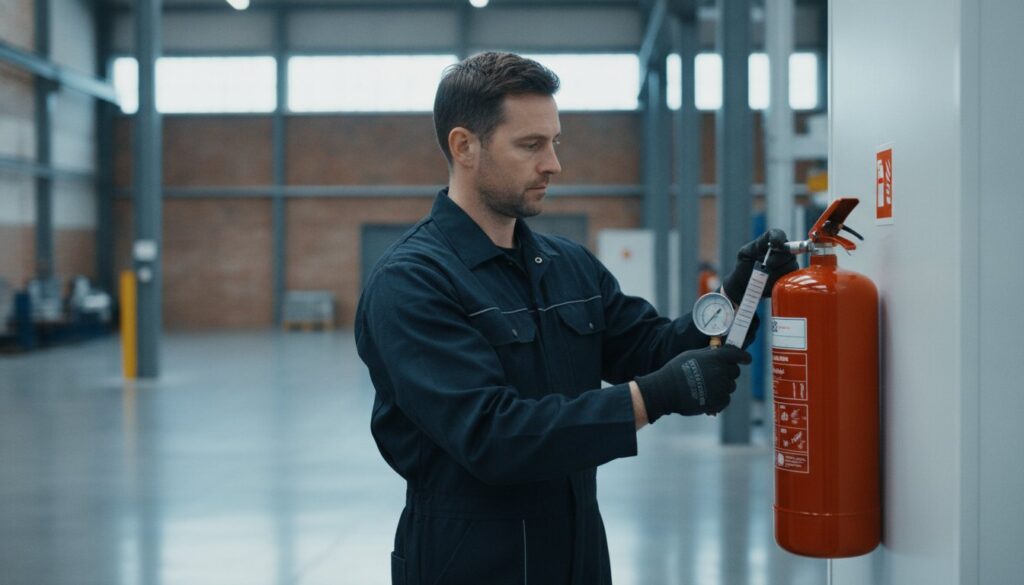
- Step 2: Weight and pressure verification. Every unit is weighed. If a gas-cartridge extinguisher has lost more than 10% of its contents, it must be recharged. We also calibrate the pressure gauge to ensure it’s providing an accurate reading.
- Step 3: Component testing. We remove the discharge hose and nozzle to check for blockages or debris. The operating mechanism is tested to ensure it moves smoothly without sticking.
- Step 4: Consumable replacement. We replace the safety pin and fit a new anti-tamper seal. These parts provide immediate visual proof that the unit hasn’t been discharged since its last service.
- Step 5: Documentation. The service label is updated with the date, technician’s name, and unit weight. We also update your site logbook to maintain your legal audit trail.
Identifying ‘End of Life’ Equipment
During a service, we may identify units that are beyond economical repair. Cylinders with deep corrosion or those that have reached their 20-year limit often require replacement rather than servicing. Using outdated equipment is a liability risk that could invalidate your insurance. For example, any AFFF foam extinguishers containing PFOA must be removed and disposed of as hazardous waste following the 2025 ban. You’ll find more detail on equipment lifecycles in our Fire Extinguisher Servicing Pillar. We provide clear, honest advice on when to repair and when to replace, ensuring you only spend money where it’s necessary for safety.

Choosing the Right Extinguisher Types for Your Retford Site
Fire safety isn’t a one-size-fits-all solution. A retail unit on Carolgate has different risks than a fabrication workshop in a Retford industrial estate. Selecting the wrong media can be dangerous. For instance, using water on an electrical fire can lead to electrocution. Professional fire extinguisher maintenance retford starts with a technical assessment of your specific fire classes. These include Class A (combustible solids like paper), Class B (flammable liquids), and Class F (cooking oils).
Most Retford offices require a combination of Foam and CO2 units. Foam handles wood and paper fires effectively, while CO2 is essential for electrical equipment. This gas leaves no residue that might damage sensitive computers or server hardware. Commercial kitchens, however, must have Wet Chemical (Class F) extinguishers to manage high-temperature fat fires safely. Matching the media to the environment is the only way to guarantee a safe response during an emergency.
Extinguisher Colour Codes Explained
Identifying the right equipment in a panic depends on clear colour coding. Standard UK units feature a large red body with a specific colour band. Red indicates Water, Cream is for Foam, Blue represents Dry Powder, Black is for CO2, and Yellow signifies Wet Chemical. Signage is equally critical. Every unit must have a corresponding ID sign mounted above it. This ensures staff can identify the correct tool even if the extinguisher itself is obscured. Common mistakes include placing water-based units near high-voltage server racks or using incorrect brackets that fail under the weight of the unit.
The Industrial Perspective: Powder and CO2
Industrial operators in Retford often rely on Dry Powder extinguishers because they cover Class A, B, and C fires. They’re versatile but messy. We typically advise against using powder in small, enclosed offices. The discharge creates a dense cloud that obscures vision and can cause respiratory distress in confined spaces. It also damages electronics beyond repair. In these environments, CO2 is the logical choice for protecting electrical panels. Ensuring your equipment matches the findings of your Fire Risk Assessment is a legal requirement. If your current setup feels outdated, you can book a professional equipment audit to verify your selection remains compliant with current standards.
AFN Industrial Services: Your Retford Compliance Partner
AFN Industrial Services Ltd brings over 25 years of specialized experience to the North Nottinghamshire region. We understand that facility managers often struggle with the administrative weight of managing multiple safety contracts. Our approach is built on steadfast professionalism and a no-nonsense pricing model. Unlike many providers, we operate on a transparent, per-item basis. This ensures you only pay for the specific maintenance performed, with no hidden call-out fees or unexpected administrative charges added to your invoice.
Our local coverage extends across Retford, Worksop, and the surrounding areas. This proximity allows us to be a responsive partner for industrial operators and commercial businesses alike. By choosing a local specialist, you ensure that your safety documentation is always current and compliant with UK standards. We don’t just tick boxes; we provide the technical validation required to protect your business and satisfy insurance requirements. Professional fire extinguisher maintenance retford is the anchor of a safe workplace, and we deliver it with precision.
Streamlining Your Safety Compliance
Managing fire extinguisher maintenance retford alongside other mandatory checks is more efficient when handled by a single-source provider. We integrate our extinguisher servicing with other essential health and safety services, such as emergency light drain tests and ladder inspections. This unified approach reduces the number of site visits required and simplifies your compliance logbook. You can also combine your fire safety with Portable Appliance Testing (PAT) to ensure all electrical and fire risks are mitigated in one comprehensive sweep. This coordination helps reduce workplace accidents through thorough, expert inspections that identify faults before they lead to equipment failure.
Book Your Retford Service Visit
When our engineers visit your Retford premises, they follow a structured project plan to ensure minimal disruption to your daily operations. We understand that downtime is costly in industrial and commercial environments. Our team works methodically, moving from unit to unit with precision. Upon completion, you receive a full suite of safety documentation, including maintenance certificates and updated service labels. This provides immediate proof of compliance for any visiting fire officer or insurance auditor.
If you’re looking for a reliable, experienced partner to manage your site’s safety obligations, contact AFN Industrial Services Ltd for a tailored safety consultation. We’ll assess your inventory and provide a clear, itemised quote that reflects the specific needs of your facility. Our goal is to provide a calm, capable service that leaves you with full peace of mind regarding your legal obligations.
Securing Your Business Compliance for 2026 and Beyond
Maintaining a safe workplace requires more than just hanging equipment on a wall. It demands a rigorous adherence to BS 5306-3:2024 standards to ensure every unit is functional during an emergency. We’ve explored how professional technical audits protect your liability, why specific media choices matter for Retford’s industrial sites, and how to stay ahead of the latest AFFF foam regulations. By consolidating your safety tasks, you can reduce administrative burdens while ensuring your insurance coverage remains valid and your staff stay protected.
AFN Industrial Services Ltd provides the technical expertise and over 25 years of industry experience needed to keep your facility safe. Our local engineers specialize in full compliance and no-nonsense pricing, offering a reliable partnership for businesses across Nottinghamshire. Don’t leave your safety documentation to chance or risk the consequences of an audit failure. Secure your Retford business with professional fire extinguisher maintenance from AFN Industrial Services Ltd. Taking these proactive steps today ensures your equipment is ready and your business is protected for the long term.
Frequently Asked Questions
How often should fire extinguishers be serviced in Retford?
Fire extinguishers require a professional basic service every 12 months to comply with BS 5306-3. This annual interval ensures the unit remains pressurized and the extinguishing agent hasn’t settled or clumped. Regular fire extinguisher maintenance retford identifies faults before they become critical. Additionally, the responsible person at your site should conduct monthly visual inspections to check for obvious damage or tampering.
Is fire extinguisher maintenance a legal requirement for small businesses?
Yes, maintaining fire-fighting equipment is a mandatory requirement under the Regulatory Reform (Fire Safety) Order 2005. This law applies to all non-domestic premises, regardless of the business size or number of employees. Failure to maintain your equipment can lead to heavy fines or the invalidation of your insurance policy. Keeping accurate maintenance records is the only way to demonstrate compliance during a fire safety audit.
What is the difference between a basic and an extended fire extinguisher service?
A basic service is an annual external inspection of the unit’s weight, pressure, and mechanical components. An extended service occurs every five years for water, foam, and powder units, involving a detailed internal examination and a full recharge. CO2 units require an overhaul every 10 years, which includes a hydrostatic pressure test. These technical audits ensure the cylinder’s structural integrity remains safe under high pressure.
Can I service my own fire extinguishers to save money?
No, UK regulations require that maintenance is carried out by a competent person with the necessary training and specialized tools. Professional technicians use calibrated scales and pressure testing equipment that isn’t available to the general public. Attempting to service units yourself can lead to equipment failure during a fire. It also creates a significant legal liability for the business owner if an incident occurs.
How long do fire extinguishers last before they need replacing?
Most extinguishers have a functional lifespan of 10 to 20 years, provided they pass their periodic pressure tests. However, units must be replaced immediately if they show signs of deep corrosion, cylinder damage, or if they’ve reached their manufacturer’s end-of-life date. Specific types, like AFFF foam units containing PFOA, must also be removed following the 2025 ban. We provide clear advice on when replacement is more cost-effective than repair.
What should I do if my fire extinguisher pressure gauge is in the red?
If the needle is in the red zone, the extinguisher is either over-pressurized or has lost its charge. In either case, the unit is unsafe and may not function correctly during an emergency. You should contact a professional technician immediately to investigate the leak or fault. Do not attempt to discharge the unit yourself, as a faulty pressurized cylinder can be hazardous if handled incorrectly.
Do I need a different extinguisher for electrical fires in my office?
Yes, you must have an extinguisher suitable for electrical risks, typically a CO2 unit. Using water or standard foam on live electrical equipment can cause electrocution. CO2 is the preferred choice for Retford offices because it leaves no residue, protecting your computers and server hardware from secondary damage. Most offices utilize a pair consisting of a foam extinguisher for general combustibles and a CO2 unit for electrical hazards.
How many fire extinguishers does my Retford business actually need?
The number of units depends on your floor area and the specific risks identified in your Fire Risk Assessment. As a general rule, most premises require at least two Class A extinguishers per floor, with additional specialist units for specific risks like kitchens or server rooms. Travel distance to the nearest extinguisher should usually not exceed 30 metres. We can help determine the exact requirements for your specific site layout.