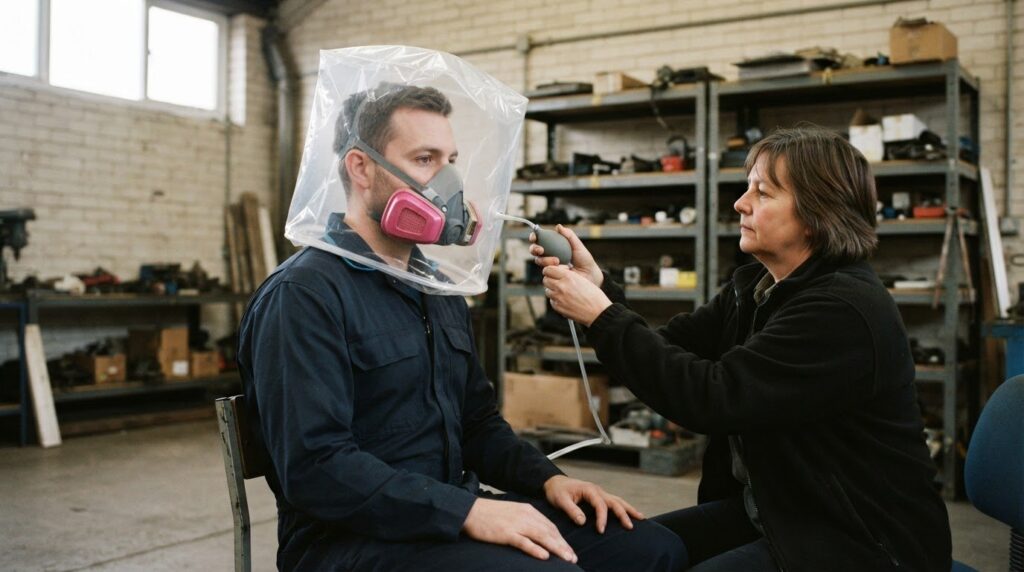
A respirator protects as intended only when its facepiece seals against the wearer’s face. A half mask respirator qualitative fit test in Bawtry checks that seal using a test substance the wearer can detect by taste or smell. If the wearer detects it during the test, the facepiece has not achieved a suitable fit.
Choosing the right respirator matters because the same facepiece will not fit everyone. This guide explains how a half mask respirator qualitative fit test in Bawtry works, what can cause a failure and how a different facepiece may help. It also covers how qualitative testing differs from quantitative methods and why fit should be assessed before a tight-fitting respirator is used.
Key Takeaways
- Understand when UK guidance calls for fit testing and how qualitative testing differs from quantitative methods.
- Recognise why facial hair and changes to a wearer’s face can affect the seal of a tight-fitting respirator.
- Learn what a failed result can indicate and why changing the facepiece may call for another fit test.
- See how taste- or smell-based testing assesses fit through a structured series of wearer exercises.
- Know what a pass or fail result tells you, and what it cannot measure numerically.
What Are the Two Types of Respirator Fit Testing?
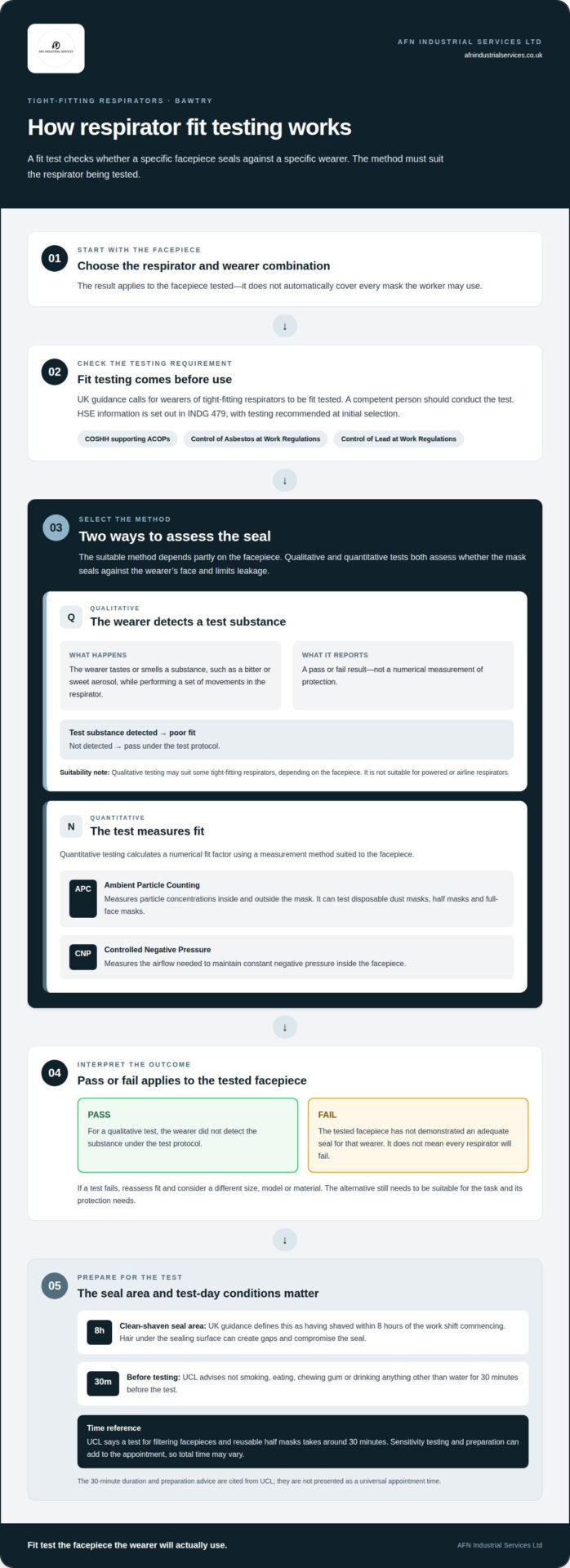
UK fit testing for tight-fitting facepieces uses either a qualitative or quantitative method before the wearer uses the facepiece. Both assess whether the mask seals against that person’s face and limits leakage. The suitable method depends partly on the respirator type. A result applies to the facepiece tested, not automatically to every mask the worker may use.
ACOPs supporting COSHH, the Control of Asbestos at Work Regulations and the Control of Lead at Work Regulations require wearers of tight-fitting respirators to be fit tested. Employers should ensure a competent person conducts the test. The UK Health and Safety Executive (HSE) provides information on expected testing practice in INDG 479 and recommends fit testing at the initial selection stage.
Qualitative testing relies on the wearer detecting a test substance, such as a bitter or sweet aerosol, by taste. The wearer performs a set of movements while wearing the respirator. Detecting the substance indicates poor fit; not detecting it gives a pass under the test protocol. The result is pass or fail, not a numerical measurement of protection.
Qualitative testing may be an option for some tight-fitting respirators, depending on the facepiece. Quantitative testing instead measures fit to calculate a numerical fit factor. Ambient Particle Counting (APC) measures particle concentrations inside and outside the mask. Controlled Negative Pressure (CNP) measures the airflow needed to maintain constant negative pressure inside the facepiece.
APC can test disposable dust masks, half masks and full-face masks. The suitability of a quantitative fit-testing method depends on the facepiece. Qualitative methods are also unsuitable for powered or airline respirators. The method must match the facepiece, rather than simply the wearer’s preference.
How much does qualitative respirator fit testing cost near Bawtry? The cost depends on factors such as the test method, facepiece and booking arrangements. Pricing is case-specific, with a quote provided after a request; there is no single price for every test.
How long does a qualitative half-mask fit test take? At UCL, a test for filtering facepieces and reusable half masks takes around 30 minutes. The total appointment can also include a sensitivity test and preparation, so the process may vary.
What preparation is required? UCL advises attendees not to smoke, eat, chew gum or drink anything other than water for 30 minutes before testing. A clean-shaven seal area also matters for a tight-fitting respirator, since facial hair can disrupt the seal.
What alternatives are available near Bawtry? Quantitative testing is the main alternative. APC measures particles inside and outside the mask, while CNP assesses airflow under negative pressure. The respirator type determines which method is suitable.
Facial hair and respirator seals
A tight-fitting half mask relies on contact between its sealing edge and the wearer’s face. Stubble, a beard or other facial hair within the seal area can create gaps. Air may then pass between the facepiece and skin instead of through the respirator’s filtration system. Even a mask that feels secure can leak if hair interrupts this contact.
The issue is where the hair grows, not simply whether the wearer has a beard. Hair beneath the sealing surface can compromise the seal around the nose, cheeks or chin. Facial hair elsewhere may not cross that contact area, but the respirator must still fit the individual. Fit testing assesses that specific wearer and facepiece combination.
For the face-seal area, UK guidance defines clean-shaven as having shaved within 8 hours of the work shift commencing. That timing matters because a test conducted after shaving may not reflect the seal during the shift if hair has grown back. The wearer should arrive prepared to test in the condition in which the respirator will be worn.
A qualitative test can reveal leakage if the wearer detects the test substance by taste or smell. If facial hair breaks the seal, the substance may reach the wearer inside the facepiece, indicating poor fit. Passing a test while clean-shaven does not show that the same tight-fitting mask will seal properly over facial hair.
The UK Health and Safety Executive (HSE) advises wearers to check for a good mask fit each time they put it on. This user seal check is a repeatable check at the point of use, not a substitute for formal fit testing. Follow the facepiece manufacturer’s instructions and reassess the fit if the seal changes.
Some people have good reasons for keeping facial hair, including religious reasons. They can use alternative respiratory protective equipment that does not rely on a tight facial fit. This addresses the barrier created by facial hair without expecting the wearer to shave the seal area. The equipment must still be suitable for the work and respiratory hazard.
Fit testing should reflect the facepiece the wearer will use and the conditions in which it will be worn. If facial hair overlaps the seal, a tight-fitting half mask may not be suitable, even if the size seems right. A different type of facepiece may be needed to provide protection without relying on direct contact with bare skin.
For wider workplace safety information, explore health and safety guidance alongside your respiratory protection arrangements.
Alternative facepieces after a failed test
A failed fit test means the tested facepiece has not demonstrated an adequate seal for that wearer. It does not mean every respirator will fail. Reassess the fit and consider a different size, model or material. Changes to these features can alter where the mask contacts the face and how it seals.
Selection must still match the work. Respiratory protective equipment needs to be adequate and suitable for the task, so an alternative facepiece must meet the protection needs as well as fit the wearer. A more comfortable mask is not automatically suitable if it does not provide the required protection. Fit and task suitability are separate considerations.
After changing the respirator type, size, model or material, repeat the fit test. The new test assesses the replacement facepiece; the first result does not carry over. For example, a wearer who fails one half-mask model needs a test for a different model before relying on its fit. A pass applies to the make, model, type and size tested.
This distinction matters when a worker uses more than one tight-fitting facepiece. Each type needs its own fit test. The employer should provide the same make, model, type and size that passed. Substituting another size or model changes the tested combination and requires another assessment.
If a wearer’s face or head-worn equipment changes, reassess whether the previous fit remains valid. Relevant changes include weight change, substantial dental work, facial changes, facial piercings or changes to other head-worn PPE. These may affect how a particular facepiece sits or seals. Repeat fit testing if a change could alter the respirator fit.
A competent person can use the result to guide the next selection, then assess an alternative facepiece under the appropriate protocol. Qualitative testing gives a pass or fail, not a numerical fit factor, so it cannot quantify the difference between two masks. If qualitative testing is unsuitable for the respirator, reconsider the method. Powered and airline respirators are not suitable for qualitative fit testing.
Record the tested facepiece details alongside the result so the correct equipment can be issued. If the make, model, type or size changes, arrange another fit test before the replacement is used as a tight-fitting respirator. This links the outcome to the specific equipment that passed, rather than treating it as approval for every facepiece.
Qualitative fit-test methods using taste or smell
Qualitative testing uses the wearer’s sensory response to assess whether test substance enters a facepiece. For half masks, the test combines a sensitivity check with structured exercises.
Taste and Smell Methods
A taste-based method exposes the wearer to an aerosol, then checks whether they can detect it while wearing the respirator. Bitrex and saccharin are examples of test substances used for this purpose. Detecting the substance inside the mask indicates leakage and poor fit. The result assesses the facepiece tested but does not produce a numerical fit factor.
The sensitivity check establishes whether the wearer can recognise the chosen substance before the mask test begins. This matters because someone who cannot detect the substance cannot reliably report whether it passes through the facepiece. At UCL, a quantitative test is used if someone cannot complete qualitative testing because they have no sense of taste.
What the Test Includes
A qualitative half-mask fit test includes a sensitivity assessment, the facepiece being tested and a set of wearer exercises. It checks whether the wearer detects the substance while moving, rather than relying only on a stationary fitting. This can reveal leakage that occurs as the mask shifts during ordinary actions.
How is the test conducted? A bitter or sweet spray is introduced into a testing hood worn by the person, who completes the protocol while wearing the respirator. If they taste the spray during the mask test, the facepiece is considered a poor fit. The facepiece must be adequate and suitable for the wearer’s work.
A qualitative protocol should include at least seven exercises, each lasting at least one minute. The exercises challenge the seal through movements such as breathing normally, speaking or moving the head. The tester follows the applicable protocol and observes whether the wearer detects the substance. A pass requires completing the required exercises without detection.
At UCL, the sensitivity test lasts between 5 and 10 minutes, and the Face Fit test is conducted in 2 parts with a short break. UCL reports around 30 minutes for testing filtering facepieces and reusable half masks. These are UCL’s timings, not a universal appointment length; preparation and the test protocol affect the process.
Preparation also affects the reliability of sensory testing. UCL advises attendees not to smoke, eat, chew gum or drink anything except water for 30 minutes beforehand. Such steps help avoid interfering with the wearer’s ability to detect the test substance. A person who can’t taste the chosen agent needs a different testing method, not an assumed pass.
Fit test pass and fail results
A qualitative fit test gives a pass or fail, not a numerical fit factor. The result records whether the wearer detected the test substance during the protocol. Detection while wearing the respirator indicates poor fit. If the wearer does not detect it, the facepiece passes that qualitative test, but the result does not measure protection as a number.
This distinction matters when employers interpret the result. A pass applies to the wearer and the specific facepiece tested, not every respirator in the workplace. After a pass, the employee should receive the same make, model, type and size tested. A different model or size changes the facepiece being assessed and requires another fit test.
A failed test means the facepiece has not demonstrated an adequate seal for that wearer. It does not mean another suitable facepiece will also fail. Reassess the fit and selection, including whether a different size, model or material may be suitable. Once the facepiece changes, repeat the test to assess the new combination.
Quantitative testing provides a different result. It measures fit by calculating a numerical fit factor, using either Ambient Particle Counting or Controlled Negative Pressure. Ambient Particle Counting compares particle concentrations inside and outside the mask. Controlled Negative Pressure measures the airflow required to maintain constant negative pressure inside the facepiece.
For full-face masks tested by Ambient Particle Counting or Controlled Negative Pressure, UK guidance sets a minimum quantitative fit factor of 2,000. That figure is a quantitative benchmark, not a score from a qualitative test. A qualitative pass cannot be converted into a fit factor, and the two methods report results differently.
The UK Health and Safety Executive (HSE) advises that fit testing form part of a comprehensive respiratory protective equipment programme covering selection, use and maintenance. The result therefore sits alongside wider decisions about whether the respirator suits the task. It does not replace correct use or maintenance after testing.
For workplace records, link the pass or fail result to the wearer and facepiece details. This makes the outcome useful when issuing equipment or reviewing a later change. If the wearer’s face or other head-worn PPE changes, reassess whether the tested fit still applies. Repeat the fit test if a change could alter the seal.
For safety decisions, treat a failed result as a reason to reassess the facepiece, not issue it as suitable. A successful fit test supports selection of the tested model and size. The employer still needs to provide equipment that matches the result and the work being carried out.
AFN Industrial Services Ltd: Portable Appliance Testing
AFN Industrial Services Ltd supports workplace safety through Portable Appliance Testing, Emergency Light Drain Tests, Fire Extinguisher Maintenance and Health and Safety Services. These services address other site requirements alongside respiratory protection. A half mask respirator qualitative fit test in Bawtry assesses facepiece fit, while AFN’s other services help businesses manage separate equipment and safety needs.
If you’re arranging a half mask respirator qualitative fit test in Bawtry, use the result to guide facepiece selection and ensure the tested model, type and size are issued to the wearer. For other workplace safety requirements, contact AFN Industrial Services Ltd to discuss the relevant service.
Contact AFN Industrial Services Ltd to discuss your workplace safety requirements.
Make fit-test results part of your next safety decision
Use the outcome of a half mask respirator qualitative fit test in Bawtry to guide respiratory protection across each role. Before issuing equipment, match the tested facepiece to the wearer’s tasks and any protective equipment they will use alongside it. When work practices or equipment change, review respiratory protection rather than treating the original result as permanent.
A clear record linking the facepiece and wearer also helps keep selection consistent. It gives managers a practical reference when replacing equipment, planning new tasks or reviewing a worker’s needs. The aim is to connect the assessment to real work and day-to-day safety decisions.
AFN Industrial Services Ltd can also support wider workplace arrangements through its safety services. If you’re reviewing your site’s safety needs, contact AFN Industrial Services Ltd to discuss the next step. A considered approach helps keep equipment decisions clear and workplace safety firmly in view.
Frequently Asked Questions
Does Respirator Fit Matter?
Yes. A tight-fitting respirator depends on a seal between the facepiece and the wearer’s face; gaps can allow contaminated air to bypass the mask. A respirator that suits one worker may not seal properly on another. Fit matters during selection and continued use, especially if the wearer’s face or head-worn equipment changes. A fit test assesses a specific wearer and facepiece combination, not a model for everyone.
What are the face fit requirements in the United Kingdom?
Wearers of tight-fitting respirators need fit testing under ACOPs supporting COSHH, the Control of Asbestos at Work Regulations and the Control of Lead at Work Regulations. Test at the initial selection stage, using a competent person. The test assesses the selected facepiece on its wearer. If someone uses more than one type of tight-fitting facepiece, each type needs its own fit test.
What does a fail mean?
A fail means the wearer detected the test substance during a qualitative test, indicating that the tested facepiece did not achieve a suitable fit. It does not mean every respirator will fail for that person. A different size or model, for example, may fit differently. Do not treat the failed facepiece as having passed. Assess another suitable option and test it before issuing it for use.
What does a pass mean?
A pass means the wearer did not detect the test substance during the qualitative protocol. It applies to the facepiece tested on that wearer, not all masks of a similar style. The employee should receive the same make, model, type and size tested. If a replacement differs in type, size, model or material, arrange another fit test rather than relying on the earlier result.
What is a Face Fit test?
A Face Fit test assesses whether a tight-fitting respiratory facepiece seals adequately on an individual wearer. Qualitative testing uses the wearer’s ability to detect a test substance; quantitative testing measures fit and calculates a numerical fit factor. The facepiece determines the suitable method. For example, qualitative testing can suit a reusable half mask, while some respirators need another method to assess fit.
What is the problem with facial hair?
Facial hair crossing a tight-fitting mask’s seal area can create gaps between the facepiece and skin. Stubble can affect the seal as well as a beard. UK guidance defines clean-shaven in the seal area as having shaved within 8 hours of the work shift commencing. Someone who keeps facial hair, including for religious reasons, can use respiratory protective equipment that doesn’t rely on a tight facial fit.
What UK HSE rules require face-fit testing for tight-fitting respirators?
ACOPs supporting COSHH, the Control of Asbestos at Work Regulations and the Control of Lead at Work Regulations require wearers of tight-fitting respirators to be fit tested. The UK Health and Safety Executive (HSE) provides information on expected testing practice in INDG 479 and recommends testing at initial selection. Employers should ensure a competent person conducts the test and includes fit testing within a respiratory protective equipment programme.
Which respirator types and filters can be tested using qualitative fit testing?
Qualitative testing can be used for disposable and half-face respirators, as well as some full-face respirators. Filtering facepieces can be tested using qualitative taste methods. This method is unsuitable for powered or airline respirators. For employers coordinating respiratory protection across Bawtry, Sheffield, Rotherham, Doncaster, Worksop, Retford, Wakefield, Barnsley, Mansfield, Scunthorpe and Pontefract, match the test method to each facepiece type rather than assuming one method fits all.