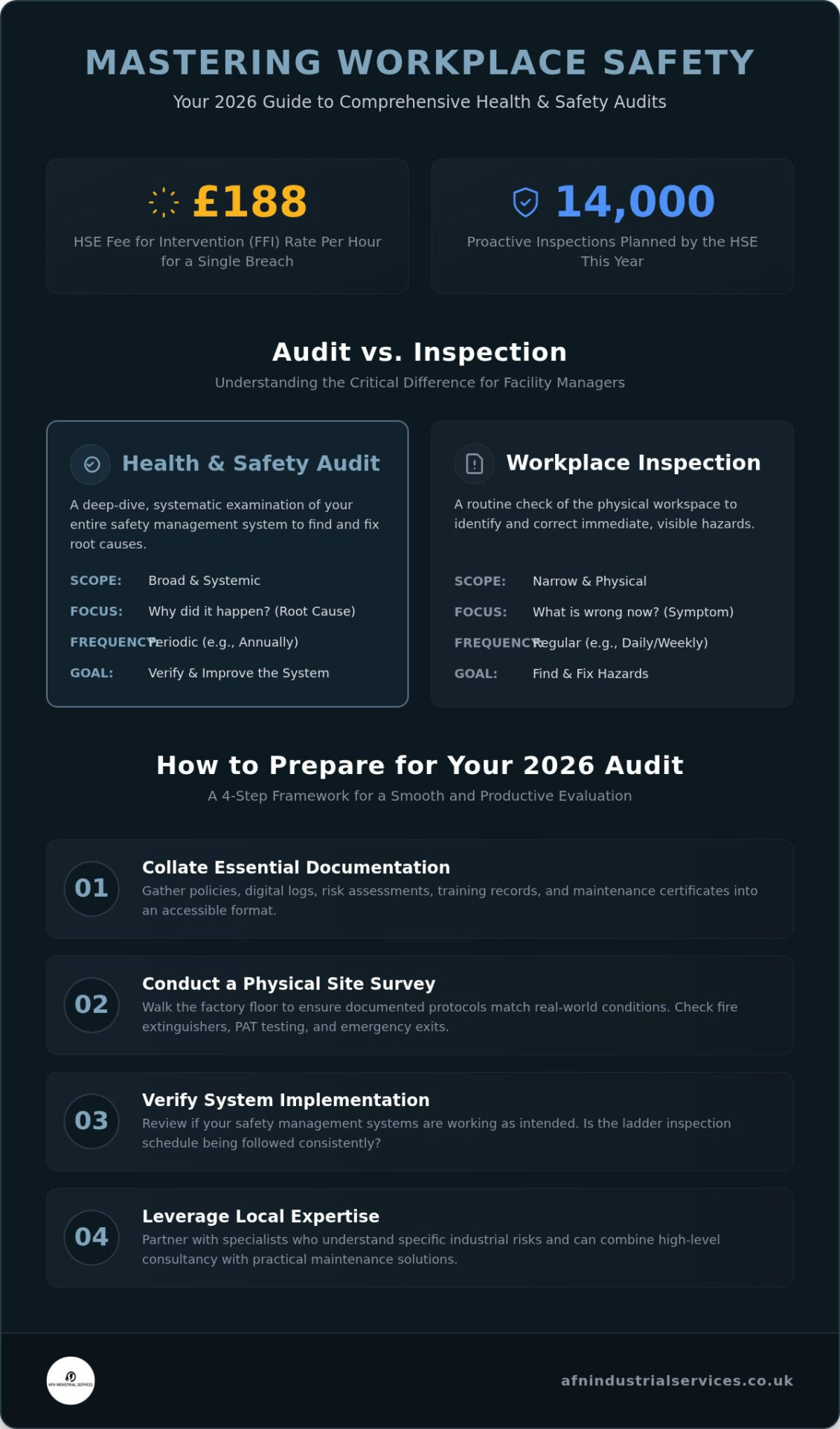
With the HSE Fee for Intervention rate currently set at £188 per hour, a single material breach can quickly escalate into a significant financial burden. It’s a high price to pay for oversight, yet many facility managers remain caught between a mountain of documentation and the fear of legal action. You’re likely looking for a way to move beyond reactive fixes and establish a robust, compliant framework through a professional Health & Safety Audit.
We understand that the distinction between a routine check and a comprehensive audit often feels blurred, leaving you uncertain about your actual level of protection. This guide provides the clarity you need to master workplace safety requirements in 2026. You’ll learn how to prepare for professional evaluations, integrate critical maintenance like PAT and fire extinguisher servicing, and adapt to new legislation such as Martyn’s Law.
By following this methodical approach, you can achieve full legal compliance and reduce the risk of workplace accidents. We’ll show you how a structured safety management system leads to lower insurance premiums and provides the operational stability your industry demands. This overview ensures you’re ready for the 14,000 proactive inspections the HSE has planned for the coming year.
Key Takeaways
- Understand that a Health & Safety Audit is a systematic examination designed to verify that your written policies translate into safe daily operations on the factory floor.
- Distinguish between narrow weekly inspections and broad-spectrum audits to ensure your facility remains fully protected against regulatory intervention and HSE fines.
- Learn how to collate essential documentation, including digital logs and maintenance certificates, to transform a stressful audit into a productive tool for business improvement.
- Discover why a physical site survey is critical for matching documented safety protocols with actual workplace conditions, including vital checks on fire extinguishers and portable appliances.
- Leverage local expertise in South Yorkshire to navigate specific industrial risks while benefiting from a combined approach of high-level consultancy and practical maintenance solutions.
What is a Health & Safety Audit? Defining Compliance in 2026
A Health & Safety Audit is a structured evaluation of safety protocols against UK legal benchmarks like the Health and Safety at Work etc. Act 1974. It functions as a systematic, independent examination of an organization’s entire safety management system. Many facility managers maintain extensive documentation, but the primary goal of this process is to verify that policies aren’t just written; they must be effectively implemented on the shop floor. Within a broader Environment, Health, and Safety (EHS) framework, the audit acts as a critical diagnostic tool. It identifies where your safety culture thrives and where it faces potential collapse. These findings provide a clear roadmap for continuous improvement rather than a simple pass or fail grade.
The Legal Framework: Why Audits are Essential
Compliance isn’t optional for industrial operators. The Management of Health and Safety at Work Regulations 1999 specifically requires employers to make formal arrangements for the effective planning, organization, and review of protective measures. Regular auditing protects directors from personal liability and potential corporate manslaughter charges by proving a proactive approach to risk management. The HSE uses these audit-led improvements as a benchmark for your safety maturity. If an inspector identifies a material breach, the Fee for Intervention (FFI) costs of £188 per hour begin to accrue immediately. This makes the audit a defensive necessity. It provides a documented history of due diligence that can be vital during legal proceedings or insurance renewals.
Audits vs. Inspections: Clearing the Confusion
It’s easy to confuse these two functions, but they serve different purposes in a workplace safety strategy. Inspections focus on immediate physical hazards, such as a blocked fire exit or a frayed cable. They are snapshots in time that address visible issues. In contrast, a Health & Safety Audit is a deep dive into the systems that manage those hazards. While an inspection asks, “Is this ladder safe?”, an audit asks, “Does the ladder inspection system ensure all equipment is checked every six months?” One addresses the symptom; the other secures the system. When used together, they create a comprehensive shield. Inspections provide daily or weekly monitoring, while the audit ensures the underlying management structure is fit for purpose and compliant with 2026 standards.
Audit vs. Inspection: Key Differences for Facility Managers
Facility managers often mistake weekly walk-throughs for formal audits. This misconception leaves industrial operations vulnerable during HSE visits, as a simple inspection is merely a tactical snapshot of a single moment. A professional Health & Safety Audit serves a different purpose. It’s a periodic, broad-spectrum examination of your entire safety culture. While an inspection might note that a fire extinguisher is unserviced, an audit asks why the maintenance schedule failed in the first place. It probes the underlying management system to identify the root cause of the oversight.
Correctly distinguishing these two functions ensures your budget is allocated effectively between routine maintenance and high-level consultancy. Following HSE guidance on performance monitoring, businesses must implement both active and reactive monitoring to maintain a safe environment. This dual approach ensures that physical hazards are caught early, while systemic failures are corrected before they lead to fines or accidents. It shifts your strategy from merely reacting to problems to actively preventing them.
When to Conduct an Inspection
Inspections are your first line of defense. They focus on physical hazards and immediate operational integrity. They should be handled by staff who understand the daily rhythms of the workshop or factory floor. Regular checks include:
- Daily or weekly checks of high-traffic industrial zones, ensuring fire exits remain clear and equipment is stored correctly.
- Monthly emergency light drain tests to ensure battery integrity during power failures.
- Post-incident walk-throughs to identify and isolate immediate physical dangers before work resumes.
When to Schedule a Formal Audit
Audits provide the bird’s-eye view required for legal stability. They’re less frequent but significantly more intensive than a standard walk-through. You should schedule a Health & Safety Audit during the following scenarios:
- Annual reviews of the entire Safety Management System (SMS) to ensure it remains fit for purpose and compliant with 2026 regulations.
- Following major organizational changes, such as the installation of heavy machinery or significant site expansion.
- Triggered audits following a “near-miss” or a noticeable increase in minor accidents, which often indicates a systemic management failure.
Maintaining this distinction allows you to focus on execution. When you treat these as separate but complementary tools, you build a culture of reliability. If your internal team handles daily inspections but lacks the time for a deep-dive evaluation, partnering with an external expert provides the necessary validation to protect your business and its employees.
Core Components of a Comprehensive Workplace Safety Audit
A comprehensive Health & Safety Audit examines the intersection of policy and practice. It involves a rigorous documentation review where risk assessments, COSHH sheets, and training matrices are scrutinized for accuracy. However, the audit’s true value lies in the physical site survey. This phase verifies that the “paper” safety matches the “actual” safety on the factory floor. If a policy states that eye protection is mandatory at a specific station, the auditor observes whether staff are compliant. Interviews with employees further ensure that safety procedures aren’t just signed off but are fully understood by those at risk.
Integrating specialized maintenance into the auditing process closes the gap between theoretical safety and operational reality. This methodical approach identifies where systems are failing before they result in injury or legal action. By focusing on the following core components, you build a foundation of reliability that satisfies both the HSE and your insurance providers.
Fire Safety and Equipment Maintenance
This attention to detail is equally vital for recreational assets; if your facility includes staff fitness areas or outdoor courts, you can learn more about specialized inspections for sports equipment and surfacing.
Fire safety is a pillar of any industrial audit. It involves verifying that fire extinguisher servicing is up to date and meticulously recorded. Auditors check the visibility and accessibility of fire blankets and safety signage to ensure they remain unobstructed by stock or machinery. For work-at-height compliance, ladder inspections must be documented and equipment tagged. These physical assets are often the first things an HSE inspector will check, so their maintenance logs must be impeccable.
Electrical Safety and PAT Testing
Electrical failures remain a leading cause of workplace fires. A robust audit reviews the portable appliance testing register for all site equipment. It isn’t enough to simply have a register; the auditor identifies “failed” items and verifies they’ve been removed from service. They also ensure that high-use industrial tools are tested at appropriate intervals based on their environment. This systemic check prevents faulty equipment from lingering in the workshop, reducing the risk of electric shock or ignition.
Occupational Health: Face-Fit and PPE
The 2026 audit focus includes occupational lung health and long-term wellbeing. This involves auditing qualitative face-fit testing records for respiratory protective equipment (RPE). Auditors ensure that PPE is fit for purpose, correctly stored, and that staff have received training on its use. Neglecting these details can lead to long-term health liabilities and immediate regulatory fines. A proactive approach to health also requires monitoring the environment for damp and mold; for facility managers seeking to understand the technical side of moisture control, Floodsafe Restoration LLC provides a detailed look at the science of structural drying. By examining these core components, the Health & Safety Audit transforms from a passive document into an active tool for operational stability.
How to Prepare for Your 2026 Health & Safety Audit
Preparation is the difference between a stressful audit and a productive one that improves the business. It’s the mechanism that allows you to identify gaps before an external auditor or HSE inspector finds them. Start by collating all safety folders, digital logs, and maintenance certificates. This centralized approach ensures you aren’t scrambling for proof of compliance mid-audit. You should treat the preparation process as a dry run for the real event, verifying that every claim made in your safety manual is backed by evidence.
Notify your staff in advance. Key personnel, such as shop floor supervisors and maintenance leads, must be available for interviews. Their ability to explain safety procedures proves that your policy is active, not just a document on a shelf. Finally, conduct a pre-audit walk-through. This informal check helps you catch obvious housekeeping issues like blocked aisles or missing signage. It sets a professional tone for the formal Health & Safety Audit and demonstrates a proactive management culture.
The Documentation Checklist
Your paperwork is the first thing an auditor will scrutinize. It’s essential to ensure the following items are current and accessible:
- Collate current Risk Assessments and Safe Systems of Work (SSoW) for every major industrial task.
- Organize emergency light testing logs and annual test certificates to prove battery integrity.
- Ensure your Health and Safety Policy is signed and dated within the last 12 months. An outdated policy suggests a lack of leadership oversight.
Preparing Your Physical Environment
The physical state of your facility must reflect your documentation. A Health & Safety Audit will fail if the factory floor contradicts your safety manuals. Focus on these high-priority areas:
- Clear all fire exits and ensure extinguishers are correctly mounted on their brackets.
- Verify that all electrical items have visible PAT labels with valid dates.
- Check that all hazardous substances are stored in COSHH cupboards with relevant safety data sheets (SDS) attached.
If you find that your documentation is lagging or your equipment maintenance is behind schedule, our team can help you get back on track. You can book a consultation with a Reliable Expert at AFN Industrial Services to ensure your facility is fully prepared for its next compliance review.
Professional Safety Auditing in Rotherham, Sheffield, and South Yorkshire
Local expertise is a critical factor when conducting a Health & Safety Audit in the industrial heartlands of South Yorkshire. Understanding the specific heritage and operational risks associated with Northern manufacturing and engineering allows for a more precise evaluation of your facility. AFN Industrial Services provides a Reliable Expert approach that bridges the gap between high-level consultancy and practical maintenance. With over 25 years of industry experience, our team identifies common regional compliance pitfalls before they attract the attention of the HSE. We serve facility managers across Rotherham, Sheffield, and Doncaster, extending our reach into the North East and Midlands to ensure industrial stability.
Our approach is built on the reality of heavy-duty operations. We don’t just provide a list of theoretical improvements; we offer the technical capability to implement the necessary fixes. This dual focus on documentation and physical maintenance makes us a calm, capable partner for businesses navigating complex or urgent safety challenges. By choosing a partner with deep roots in the region, you benefit from a sophisticated understanding of the regulatory landscape and the unique demands of South Yorkshire’s industrial sector.
Tailored Safety Solutions for Northern Industry
We provide specialized audits for the manufacturing, warehousing, and engineering sectors in Barnsley and Wakefield. These environments require more than a generic checklist. We integrate physical maintenance, such as fire extinguisher servicing and portable appliance testing, into a single, manageable compliance plan. This holistic view ensures that your safety systems are not just theoretically sound but physically verified. Having a local partner means we can be on-site quickly for urgent safety reviews or to address immediate maintenance needs discovered during the process. This proximity allows for a level of customization and responsiveness that larger, national firms often lack.
Next Steps: Booking Your Audit
Securing your facility begins with a bespoke quote tailored to your site size and industry requirements. Our methodical process starts with an initial consultation to understand your specific operational challenges. This is followed by a comprehensive on-site Health & Safety Audit and the delivery of a detailed, prioritized action report. We don’t simply leave you with a list of failures. We help you close the “compliance gap” by addressing the technical requirements identified during the review. This results in a safer workplace, lower insurance premiums, and the peace of mind that your business meets every 2026 regulatory benchmark with precision and reliability.
Securing Your Industrial Future with Strategic Compliance
Achieving full legal compliance in 2026 requires more than just a reactive approach to hazards. It demands a systematic evaluation of your management systems and the physical integrity of your equipment. By distinguishing between routine inspections and a professional Health & Safety Audit, you ensure your facility’s protected against both immediate risks and long-term legal liabilities. Success lies in the seamless integration of detailed documentation with practical maintenance, such as fire safety checks and electrical testing.
AFN Industrial Services brings over 25 years of industrial safety experience to every project. We provide local support across Rotherham, Sheffield, and South Yorkshire, offering a comprehensive service that covers professional audits, PAT, and fire safety maintenance. Our team acts as a reliable partner, helping you identify and close compliance gaps before they lead to regulatory intervention or workplace accidents. Book your professional Health & Safety audit with AFN Industrial Services today to secure your facility’s future. You’ll find that proactive compliance is the most effective way to maintain operational stability and protect your workforce.
Frequently Asked Questions
Is a Health & Safety audit a legal requirement in the UK?
A Health & Safety Audit isn’t explicitly named as a single mandatory document in all cases, but the Management of Health and Safety at Work Regulations 1999 requires employers to monitor and review their safety arrangements. This effectively makes regular auditing a legal necessity to prove compliance. Without documented audits, directors in Sheffield and Rotherham face increased personal liability and potential Fee for Intervention charges from the HSE if breaches are identified during an inspection.
How often should my business undergo a Health & Safety audit?
Most industrial businesses in South Yorkshire should schedule a formal audit annually. However, you must trigger a review sooner if you introduce new machinery, expand your site, or experience a near-miss incident. Maintaining a steady, methodical schedule ensures your safety management system remains fit for purpose. For high-risk environments in Doncaster or Wakefield, more frequent evaluations may be required to manage complex operational challenges and keep insurance premiums at a minimum.
Who is responsible for carrying out a Health & Safety audit?
The legal responsibility for ensuring a Health & Safety Audit is completed lies with the employer or the most senior site manager. They must appoint a competent person with the necessary skills, knowledge, and experience to conduct the evaluation. While internal staff can handle routine inspections, many facility managers in Barnsley and Sheffield use external consultants to provide an independent, unbiased perspective that meets the highest professional benchmarks and regulatory requirements for 2026.
What happens if my business fails a Health & Safety audit?
An internal or third-party audit doesn’t result in a legal fail in the same way an HSE inspection does. Instead, it provides a prioritized action report to close compliance gaps. If you ignore these findings and the HSE later identifies a material breach, you’ll face Fee for Intervention rates of £188 per hour. By acting on the audit results immediately, businesses in Worksop and Retford can prevent accidents and avoid the severe financial penalties associated with non-compliance.
How much does a professional Health & Safety audit cost?
The cost of a professional evaluation varies based on the size of your site and the complexity of your industrial processes. For a single-site business in the UK, costs typically range between £600 and £1,200 as of 2026. This investment covers a thorough documentation review and physical site survey. For facility managers in Rotherham and Sheffield, this expense is often offset by reduced insurance costs and the avoidance of costly workplace accidents or regulatory fines.
What is the difference between a safety audit and a risk assessment?
A risk assessment identifies specific hazards and implements controls for individual tasks or areas. In contrast, a Health & Safety Audit is a broad examination of your entire safety management system. While the assessment asks how to safely operate a specific machine in a Sheffield workshop, the audit checks if your overall process for conducting and updating those assessments is working correctly. Both are essential components of a robust, compliant safety framework for industrial operators.
How long does a typical workplace safety audit take to complete?
A typical on-site Health & Safety Audit for a medium-sized industrial facility in South Yorkshire usually takes one full working day. This includes a documentation review, staff interviews, and a physical survey of equipment like fire extinguishers and portable appliances. Following the visit, a detailed action report is typically delivered within a few working days. Complex sites in Mansfield or Scunthorpe with multiple departments or high-risk processes may require additional time for a truly thorough evaluation.
Can I conduct a Health & Safety audit myself or do I need an external consultant?
You can conduct an audit internally if you have a competent person with sufficient training and experience. However, many businesses in Pontefract and Wakefield prefer external consultants to ensure total independence and avoid internal blindness to common hazards. An external expert brings a seasoned perspective and up-to-date knowledge of 2026 regulations, providing the formal validation and industry-standard documentation that insurance providers and regulatory bodies often require for high-stakes industrial environments.