What if a complete-looking safety folder still left your business exposed? If you’re asking, “is my business compliant with safety laws?”, the answer depends on whether the duties that apply to your work are understood, acted on and reviewed, not just filed away.
It’s reasonable to feel unsure. Requirements can vary with your activities, workplace and workforce, while records may be scattered, outdated or missing. The most useful check is to compare your written arrangements with what people actually do at work, then identify which gaps need attention first.
This 2026 checklist gives you a repeatable, risk-led way to review responsibilities, risk assessments, training, equipment, emergency procedures and records. Use the findings to assign actions, set priorities and keep evidence of progress. It also explains how competent health and safety support can help with clearer documentation, audits and practical testing such as PAT or emergency light drain tests. Treat the checklist as a working review, not a one-off tick-box exercise: effective compliance depends on keeping controls current as your work changes.
Key Takeaways
- To answer “is my business compliant with safety laws?”, start with your actual work activities, hazards and applicable duties.
- Review risk assessments, controls, training and records consistently, and note when each measure was last checked.
- Paperwork matters, but it doesn’t prove that safety controls are being followed or working effectively in practice.
- Prioritise imminent danger and serious risks, assign each corrective action an owner, and verify it’s complete.
- Audits, clear safety documentation and safe systems of work can help turn identified gaps into a structured improvement plan.
Is my business compliant with safety laws? Start with this workplace checklist
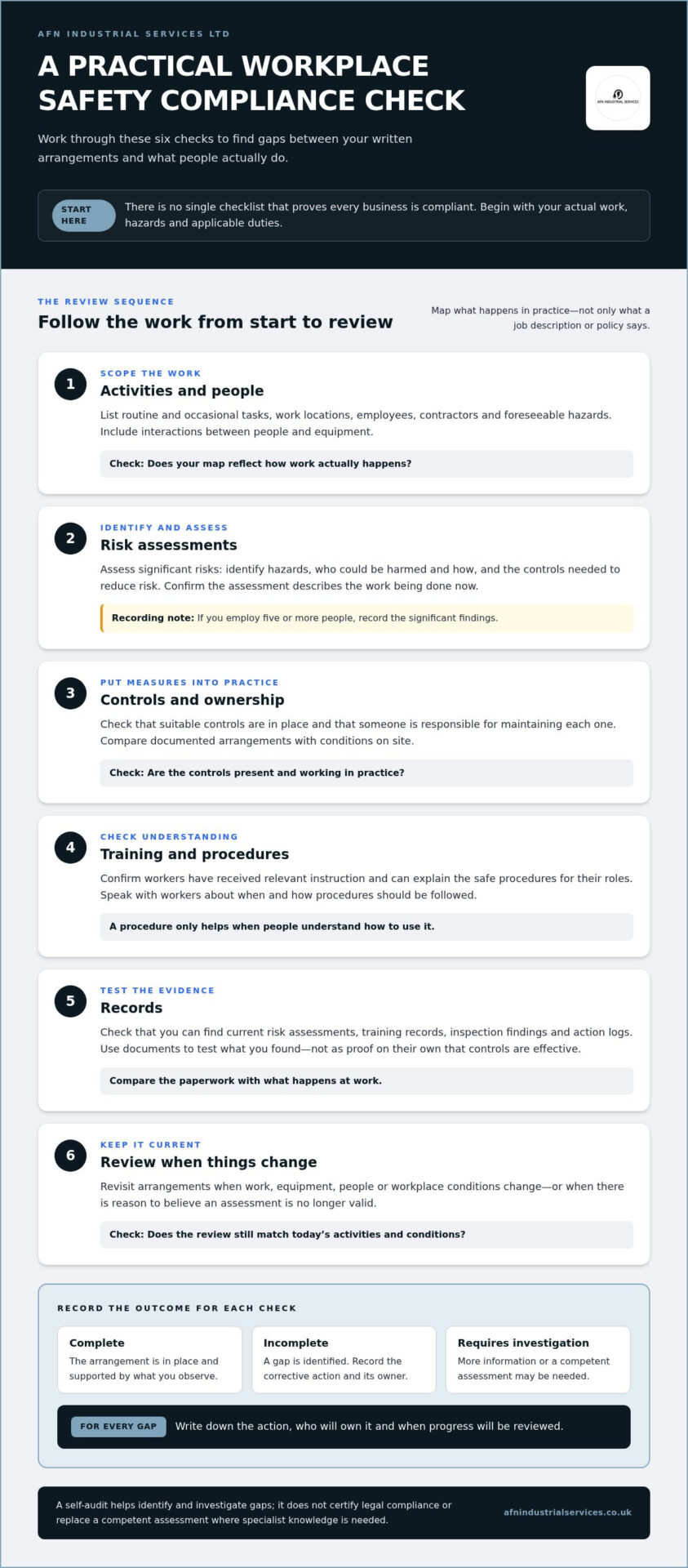
There’s no single checklist that proves every business is compliant. Start with your actual activities, workplace hazards and the legal duties that apply to them. If you’re asking, “is my business compliant with safety laws?”, use this review to identify gaps and decide what needs attention.
For each item, mark it complete, incomplete or requires investigation. For anything incomplete, record the action, who will own it and when you’ll review progress.
- Activities and people: Have you listed routine and occasional tasks, work locations, employees, contractors and foreseeable hazards?
- Risk assessments: Have you assessed significant risks, and do the findings reflect the work being done now?
- Controls and ownership: Are suitable controls in place, and is someone responsible for maintaining each one?
- Training and procedures: Have workers received relevant instruction, and can they explain the safe procedures for their roles?
- Records: Can you find current risk assessments, training records, inspection findings and action logs?
- Review: Do you revisit arrangements when work, equipment, people or workplace conditions change?
What should a first safety compliance check cover?
Map the work as it happens, not just as a job description or policy describes it. Include routine and less frequent tasks, different work areas, contractors, and interactions between people and equipment. Then check whether controls address significant risks and whether someone is accountable for keeping them effective. Speak with workers as well: a procedure only helps if people understand when and how to follow it.
Use documents to test your findings, but treat a self-audit as a way to identify and investigate gaps. It doesn’t certify legal compliance or replace a competent assessment where specialist knowledge is needed.
Who is responsible for workplace safety compliance?
The employer or relevant business dutyholder is responsible for managing health and safety in the organisation. The Health and Safety at Work etc. Act 1974 is the foundation of UK workplace health and safety law. Leaders can delegate tasks such as maintaining records or carrying out inspections to managers and competent advisers. They still need to provide direction, resources and oversight.
For a broader overview of duties and practical arrangements, read the workplace safety compliance guide.
Which UK safety laws and duties apply to your business?
Compliance means meeting the legal duties that apply to your work and keeping controls effective in practice. There isn’t one set of checks for every organisation. The duties relevant to a Sheffield office, for example, may differ from those affecting a workshop that uses machinery or handles hazardous substances.
Start with the hazards created by your work, then consider your sector, premises, equipment and working arrangements. In Great Britain, the Health and Safety at Work etc. Act 1974 sets out broad duties for employers and others, while the Management of Health and Safety at Work Regulations 1999 require employers to assess risks and make suitable arrangements for managing them. Use HSE guidance for businesses to orient your review, then identify the specific duties that apply to your operations.
Regulatory frameworks differ across the UK. Great Britain and Northern Ireland have separate health and safety legislation and regulators, and fire safety requirements also vary across the nations. If your business operates in more than one, account for the rules that apply at each location.
How do risk assessment duties work in practice?
Employers must assess workplace risks and put suitable preventive or protective measures in place. A useful assessment identifies hazards, who could be harmed and how, and the controls needed to reduce risk. If you employ five or more people, you must record the significant findings. Even where that specific recording requirement doesn’t apply, written information can help you communicate controls and track actions.
Review assessments when work activities, equipment or working conditions change, or if there’s reason to believe an assessment is no longer valid. The document should describe the work being done now, not a process that has since changed.
Which additional rules might affect your workplace?
Other legislation applies according to your risks. COSHH may be relevant where work involves hazardous substances, while PUWER covers the safe use of work equipment. RIDDOR sets reporting duties for certain work-related injuries, diseases and dangerous occurrences. Fire safety duties depend on the premises and how they’re used, so identify the requirements relevant to your site rather than assuming one set of arrangements fits all.
For workplaces using fire extinguishers, maintenance should form part of the wider fire safety arrangements. See fire extinguisher servicing guidance for related information. If you need help interpreting your responsibilities, tailored health and safety support can help clarify applicable duties and turn them into practical next steps.
Do paperwork and policies prove your business is compliant?
No. Documents can show that your business has planned for safety, but they don’t prove that controls are in place or working. Compare records with what happens on site. Check whether staff follow procedures, equipment is in suitable condition and identified actions have been completed.
Use this table to test what your records show and where to look for gaps:
| Evidence | What it demonstrates | Common gaps to investigate |
|---|---|---|
| Risk assessments | Hazards and controls have been considered | Assessment doesn’t reflect current tasks, equipment or work areas |
| Training records | Instruction or training has been recorded | Workers can’t explain or follow the procedures relevant to their roles |
| Inspection and maintenance logs | Checks and maintenance have been documented | Records are overdue, incomplete or don’t match the equipment on site |
| Corrective-action and incident records | Issues have been reported and tracked | Actions lack an owner, completion evidence or follow-up |
What evidence should a business retain and review?
Keep records relevant to your work, including risk assessments, training, equipment maintenance, inspections and incident reports where applicable. Retention periods vary according to the legal requirement and record type, so check the rule that applies rather than using one timeframe for everything. For current official information, use the GOV.UK Health and Safety Executive resource.
A useful audit trail is clear and traceable. Include dates, the person responsible, findings and actions taken. If an inspection identifies a defect, for example, record how it was addressed and whether the equipment was checked again before use. Store records where responsible people can access them, and review them against current working conditions.
Are equipment checks and staff training reflected in practice?
Check more than the paperwork. Ask workers to explain the safe systems relevant to their roles, then observe whether they follow them. Compare inspection logs with the equipment on site, including its condition, location and any defects. A completed form isn’t enough if the equipment has changed or a recorded fault remains unresolved. For businesses that operate material handling machinery, consulting heavy lifting specialists like Nortruck Forklifts can provide practical advice on maintaining safe, compliant equipment.
Where portable electrical equipment is part of your work, make sure checks are appropriate to the equipment and its use. Read the PAT testing guide for more on portable appliance testing. This evidence-based review helps answer “is my business compliant with safety laws?” by testing whether documented arrangements match working practice, not simply whether files exist.
How can you find and prioritise safety compliance gaps?
A gap becomes manageable when it’s clearly described, ranked and assigned. Use a consistent process so urgent hazards don’t get lost among routine paperwork updates.
- Identify the gap. Record what’s missing or not working, where it occurs and who could be affected. Be specific: note which machine has an unclear operating procedure rather than writing “review machinery safety”.
- Assess the risk. Consider how likely harm is, how serious the outcome could be, who may be exposed and whether existing controls reduce the risk effectively.
- Assign ownership. Name a person who can coordinate the action and make sure they have the authority and resources to progress it.
- Act and set a deadline. Choose a completion date that reflects the risk. If the risk can’t be removed immediately, record interim controls and how they’ll be maintained.
- Verify and close. Check that the action is complete and effective, then keep evidence. Reopen it if conditions show the control isn’t working.
Address imminent danger and serious risks first. Administrative improvements matter, but shouldn’t take priority over a hazard that could cause immediate harm. Review priorities after an incident, a change to work or equipment, or evidence that controls have failed. Escalate overdue high-risk actions rather than letting them sit on an action log without a decision.
How should you rank risks and corrective actions?
Use judgement grounded in the actual task. Weigh likelihood, potential severity, exposure and the strength of existing controls. A hazard affecting several workers regularly may need faster action than a low-exposure issue with effective safeguards. Set a deadline that reflects the risk and the practical steps needed. A scoring matrix can help organise decisions, but no generic scoring system replaces assessment of the circumstances or is automatically a legal requirement.
When should a business request specialist support?
Get competent support if the hazards are complex, the right controls aren’t clear or your team lacks the knowledge to assess the issue confidently. An audit can identify gaps, document findings and structure follow-up actions with owners and review points. AFN Industrial Services supports businesses in Sheffield, Rotherham and surrounding areas with tailored health and safety support.
If you need help turning audit findings into a prioritised action plan, arrange health and safety support from AFN Industrial Services.
How can AFN Industrial Services support an ongoing compliance process?
External support can strengthen your safety arrangements, but it doesn’t replace your business’s responsibility to manage health and safety. AFN Industrial Services Ltd works with commercial and industrial clients to turn identified needs into practical checks, clear documentation and planned improvements. This can help managers answer “is my business compliant with safety laws?” and decide where focused action is needed.
What does practical health and safety support look like?
Support should reflect your site activities, identified risks and operational needs, rather than rely on a generic set of documents. An audit can reveal where procedures, records or workplace controls need attention. Risk documentation and safe systems of work can then give managers and workers clear guidance for the tasks they carry out.
Clear findings make follow-up easier. Record each issue with a priority, an accountable person and a suitable next step, so managers can track progress and retain evidence of completed actions. AFN Industrial Services Ltd supports commercial and industrial clients with health and safety services, alongside practical services such as:
- Portable Appliance Testing (PAT)
- Qualitative face-fit testing
- Fire extinguisher maintenance
- Emergency light drain tests
These services can form part of a wider programme of workplace controls, depending on your activities and risks. The focus is on helping your business organise and maintain its own safety arrangements.
What should happen after an audit or compliance review?
Use the findings to create an action plan, not just a report. Record the issue, its priority, who owns the action, the target date and what evidence will show it’s complete. If a high-risk issue can’t be resolved straight away, document interim controls and review them until the permanent action is finished.
Managers should review progress periodically, verify that completed actions work as intended and update relevant documentation when workplace conditions, equipment or activities change. This connects the review to day-to-day operations and helps prevent old findings from being treated as closed when the underlying risk remains.
AFN Industrial Services Ltd supports businesses in Sheffield, Rotherham and surrounding areas with tailored health and safety support. Discuss workplace safety support with AFN Industrial Services Ltd to explore practical next steps for your business.
Turn your safety review into a clear action plan
Asking “is my business compliant with safety laws?” is a useful starting point. The practical answer comes from identifying which duties apply, comparing written arrangements with work on site and acting on gaps according to their risk. Keep the process live: assign each action an owner, set a target date and verify that the control works once it’s in place.
Specialist support can help if your team needs a clearer view of its risks or a structured way to follow up audit findings. AFN Industrial Services supports commercial and industrial businesses with audits, safety documentation and safe systems of work, alongside PAT, face-fit testing and fire extinguisher maintenance. Its team has more than 25 years of experience supporting clients in Sheffield, Rotherham and surrounding areas.
Your business remains responsible for its safety arrangements, but you don’t have to organise every part of the review alone. Discuss tailored workplace safety support with AFN and take the next step towards a more organised, practical compliance process.
Frequently Asked Questions
Is my business legally required to comply with health and safety laws?
Yes. In Great Britain, employers and other relevant dutyholders must meet the health and safety responsibilities that apply to their work. Specific duties depend on activities, workplace, equipment and workforce, so a small office and an industrial site may face different requirements. This FAQ is general information, not a legal determination. Identify relevant duties, assess workplace risks and seek competent advice if you’re unsure which rules apply.
How can I check whether my business is compliant with safety laws?
If you’re asking, “is my business compliant with safety laws?”, review work activities, hazards, risk assessments, controls, worker training, equipment checks and records. Compare documents with conditions on site. Record each gap, assign an owner and priority, then verify that the action is complete and effective. A checklist helps identify issues, but it can’t certify compliance or replace an assessment suited to your specific workplace.
What happens if a business is not compliant with health and safety law?
Consequences depend on the nature and seriousness of the breach and the applicable enforcement framework. A regulator may investigate and take enforcement action, and workers may be exposed to harm if risks aren’t controlled. In addition to statutory penalties, unaddressed hazards significantly increase exposure to costly employee injuries and claims, where commercial specialists such as Hako Risk Advisors assist businesses in navigating general liability and workers’ compensation risks. Outcomes vary, so don’t assume one penalty applies to every situation. If you identify a gap, assess the risk promptly, introduce suitable interim controls where needed, and document the action taken to address it.
Does a small business need a written risk assessment?
Employers must assess risks, but the requirement to record findings depends on the applicable rules and business circumstances. Don’t assume that being a small business removes the need to assess risks or document important information. Record significant findings and the controls you’ve chosen, review them when work or conditions change, and check current requirements for your situation. Written records also help communicate responsibilities and monitor whether controls remain suitable.
Are policies and safety records enough to prove compliance?
No. Policies and records support your evidence, but don’t show on their own that controls work in practice. Compare documents with current site conditions, worker understanding, inspection findings and completed actions. For example, a written safe procedure is of limited value if staff can’t explain or follow it. An equipment log may also fail to reflect the current position if checks are overdue or a recorded fault remains unresolved.
When should I review my business’s safety arrangements?
Review arrangements when work activities, equipment, premises or staffing change, after an incident, or when monitoring shows that controls may not be effective. Also consider whether a review is due under requirements relevant to your work. There’s no single review interval that fits every workplace. Record what changed, the decisions made and any follow-up actions, then check that updated arrangements reflect actual working conditions.
Can a safety consultant guarantee that my business is compliant?
No consultant can guarantee ongoing compliance: applicable duties and workplace conditions can change, and the business remains responsible for maintaining suitable arrangements. A consultant can help assess your systems, identify gaps and organise corrective actions. AFN Industrial Services provides tailored health and safety support to businesses in Bawtry, Sheffield, Rotherham, Doncaster, Worksop, Retford, Wakefield, Barnsley, Mansfield, Scunthorpe and Pontefract, alongside audits and safety documentation.