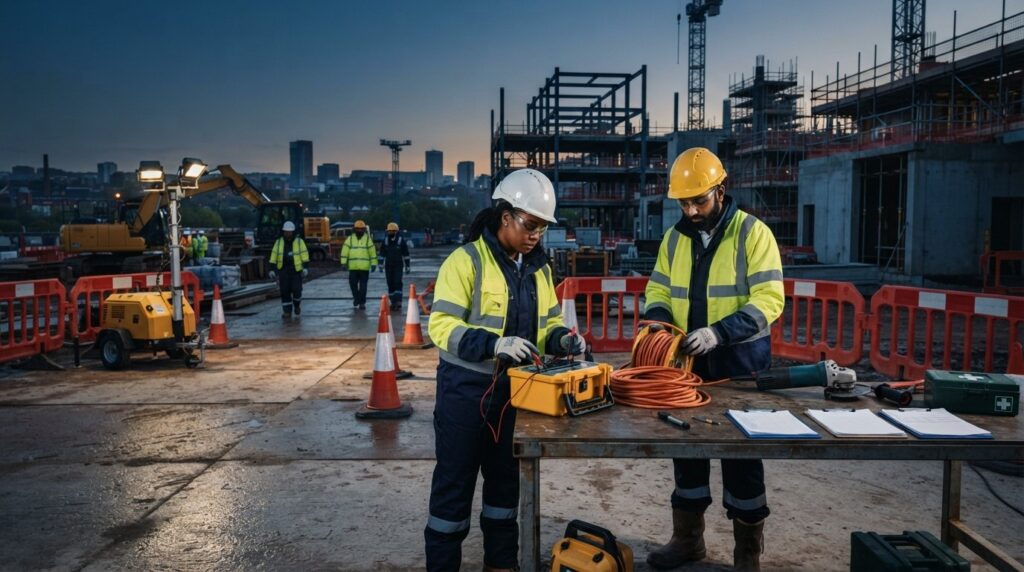
What if your pristine health and safety paperwork is completely failing to protect your bottom line? Across Sheffield and the Don Valley, site managers often carry comprehensive digital accreditations yet still face sleepless nights over unexpected Health and Safety Executive inspections, mounting Fee for Intervention costs at £188 per hour, and the dread of unannounced site audits. Adopting a modern approach to on site construction safety services means recognizing that safety isn’t merely an administrative tick-box exercise; it requires relentless, physical execution on the ground.
You already know the frustration of juggling disconnected subcontractors, chasing missing paperwork, and deciphering opaque pricing structures from national providers who treat local industrial realities as an afterthought. Managing site safety shouldn’t feel like an endless administrative burden that pulls your attention away from core operations. Discover how proactive maintenance and tailored consultancy transform site safety from a legal burden into a strategic operational advantage, eliminating regulatory anxiety while driving down insurance premiums through verifiable compliance. Here is your operational blueprint for consolidating equipment testing, statutory workplace inspections, and tailored safety documentation into one dependable local partnership.
Key Takeaways
- Transition from reactive administrative compliance to proactive asset maintenance that prevents costly HSE intervention fees and operational stoppages.
- Discover why a modern approach to on site construction safety services hinges on boots-on-the-ground equipment testing rather than mere digital accreditations.
- Consolidate essential statutory tasks, such as Portable Appliance Testing, ladder inspections, and emergency light drain tests, into a unified operational strategy.
- Leverage robust, documented Safe Systems of Work to demonstrate regulatory diligence and secure measurable reductions in commercial insurance premiums.
- Tailor physical safety protocols directly to the heavy-duty environmental hazards common to industrial sites across South Yorkshire and the Midlands.
The Evolution of Construction Safety: Moving Beyond Compliance
Modern site safety is a proactive, data-driven framework that prioritises preventative maintenance over reactive repairs. For decades, the UK building sector treated safety as an administrative burden designed merely to satisfy baseline enforcement bodies. Construction firms collected paper certificates, completed generic risk assessments, and hoped their documentation would pass muster during an audit. This tick-box mindset regularly fails on active sites where heavy machinery, complex electrical installations, and demanding build schedules introduce unpredictable daily hazards.
Implementing a modern approach to on site construction safety services demands moving beyond static paperwork into genuine operational execution. By combining verified industry methodology with over 25 years of hands-on technical experience, contractors can actively prevent incidents rather than scramble after them. Proactive safety structures align physical tool testing and continuous site monitoring with formal construction site safety standards, creating an integrated safety culture. Crucially, insurers now scrutinise physical execution alongside administrative logs. Documented, routine verification of safety assets creates an audit-proof paper trail, protecting commercial viability and directly supporting reduced commercial insurance premiums.
From Reactive to Proactive: A Paradigm Shift
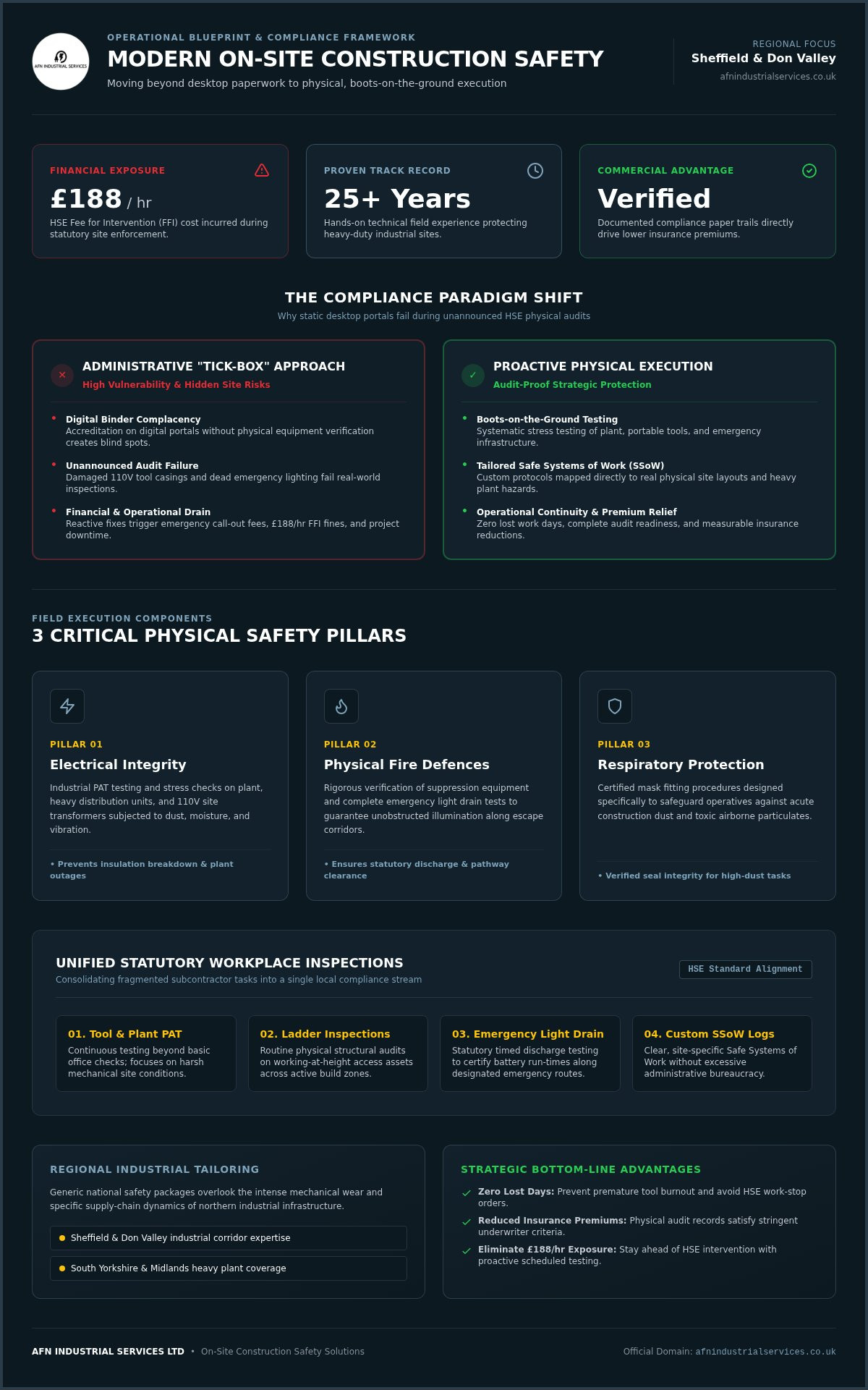
Waiting for an inspector to highlight dangerous defects is the most expensive route to compliance. Reactive responses lead to immediate project downtime, emergency contractor call-out rates, and statutory enforcement penalties under the HSE Fee for Intervention scheme. Scheduled maintenance delivers predictable operational overheads, prevents premature equipment failure, and ensures zero lost days on site. Proactive safety forms the foundational cornerstone of 2026 site management by systematically addressing physical hazards before they trigger financial losses or catastrophic downtime.
The Role of Professional Consultancy in 2026
Modern health and safety consultants operate as dedicated operational partners rather than periodic external auditors. Navigating workplace safety requires deep, local familiarity with regional supply chains and industrial infrastructure. A modern approach to on site construction safety services delivers custom Safe Systems of Work (SSoW) tailored specifically to your site’s physical configuration, ensuring every operative understands exact task-specific safeguards without drowning in unnecessary red tape. For developers managing wider project requirements where specialist traffic documentation is required during early approvals, learn more about ML Traffic Engineers UK to ensure technical planning compliance.
Essential Components of Modern Site Safety Services
Many contractors treat desktop compliance schemes and physical site maintenance as two distinct operations. This artificial separation leaves major blind spots. You might hold verified status on an online supplier portal, yet fail an unannounced site visit because a 110V transformer has a damaged casing or a designated escape corridor lacks functional illumination. A modern approach to on site construction safety services fuses high-level strategic audits directly with physical hardware maintenance.
Aligning hands-on technical testing with official HSE construction health and safety guidance ensures that your safety procedures function in the real world, not just inside a digital binder. Reliable site protection rests on three critical physical components:
- Electrical Integrity: Rigorous, repeated testing of heavy plant, distribution units, and hand tools under industrial operating stress.
- Physical Fire Defences: Continuously inspected suppression equipment and fully verified escape illumination systems.
- Operative Respiratory Protection: Certified mask fitting that protects workers against acute construction dust and toxic airborne particulate.
Portable Appliance Testing (PAT) for Industrial Environments
Industrial testing demands far more than basic visual checks on office kettles. Dust, moisture, and mechanical vibration quickly degrade internal insulation on site machinery. Consult our portable appliance testing guide to understand how transparent, per-item testing protocols keep large volumes of 110V and 240V equipment compliant without disrupting continuous trades.
Fire Extinguisher Maintenance and Emergency Lighting
Routine fire extinguisher servicing protects active building phases where hot works create perpetual hazards. British Standards require regular inspection of extinguisher pressure gauges, hoses, and pins alongside full duration emergency light drain tests. Integrating these checks eliminates sudden equipment failure, safeguarding operational uptime.
Qualitative Face-Fit Testing for Respiratory Safety
Airborne silica and masonry dust remain severe occupational health hazards on Yorkshire developments. HSE guidelines strictly mandate qualitative face-fit testing to confirm that tight-fitting respiratory protective equipment forms an impenetrable facial seal. Applying per-person testing schedules makes workforce compliance simple to track, shielding your business from long-term civil liability claims.
If managing these disparate maintenance requirements strains your current operational resources, exploring a unified partner via afnindustrialservices.co.uk helps consolidate physical hardware inspections under a single standard of accountability.
Accreditation vs. Execution: Why Practical Maintenance Matters
Holding a prestigious health and safety certificate does not guarantee a safe worksite. Industry schemes like CHAS or Constructionline prove that your central office possesses acceptable policies on paper. They do not ensure that an operative on a scaffolding platform in Sheffield is using an undamaged harness or a safe power tool. Paper-only compliance fosters a dangerous illusion of security. When an unannounced inspection occurs, HSE inspectors look past wall certificates straight down to physical equipment, trailing cables, and access points.
Adopting a modern approach to on site construction safety services requires active “boots on the ground” verification. A genuine safety posture demands physical execution where technicians examine machinery under actual site conditions. Adhering to globally acknowledged construction safety and hazard control guidelines means inspecting real hardware alongside desktop reviews. AFN Industrial Services bridges this divide directly. We connect strategic risk profiling with hands-on mechanical and electrical servicing, making sure your physical site conditions consistently reflect your declared compliance standards.
The Limits of Safety Accreditation
Accreditation represents the legal minimum, never the final objective. Over long build schedules, “safety drift” quietly sets in as workers bypass protocols to meet tight deadlines. Routine physical audits systematically validate the practical effectiveness of your Safe Systems of Work, ensuring operational habits match written method statements before dangerous patterns take root.
Integrating Maintenance into the Safety Audit
Separating consultancy advice from physical tooling inspections wastes site time. If a safety consultant identifies an egress hazard but lacks the technical capacity to conduct emergency light testing, you must schedule and pay for another contractor. That creates friction and unnecessary site traffic.
Consolidating compliance tasks into a single site visit transforms project management efficiency. An integrated site visit handles multiple statutory obligations at once:
- Portable Appliance Testing across all 110V site transformers and handheld power tools.
- Physical tag audits and pressure checks for all wall-mounted and stand-mounted fire extinguishers.
- Comprehensive ladder inspections to detect structural hairline cracks, damaged stiles, or worn feet.
Combining these essential tasks into a unified inspection eliminates contractor overlap, slashes administrative scheduling, and provides fully defensible, multi-discipline safety records.
Developing a Tailored Safety Strategy for Northern Industrial Sites
Industrial projects across South Yorkshire operate under distinct physical constraints. The heavy fabrication hubs of the Don Valley, advanced manufacturing corridors in Rotherham, and sprawling logistics developments around Doncaster present operational hazards rarely captured by generic, southern-centric compliance templates. High ambient particulate levels accelerate equipment wear. Heavy machinery vibration degrades electrical terminations faster than standard duty cycles predict. A modern approach to on site construction safety services must account for these regional working conditions rather than relying on one-size-fits-all guidance.
Partnering with a provider established directly within this industrial belt ensures your compliance framework reflects regional enforcement priorities. Local Health and Safety Executive inspectors in Yorkshire actively monitor structural steel plants, heavy civils projects, and industrial retrofits for unaddressed physical hazards. Having a dedicated regional specialist means your site risk assessments, method statements, and technical controls match the specific scrutiny of local authorities, eliminating costly misunderstandings before formal audits take place. Likewise, on major civils operations interfacing with the public road network, project leaders can explore Specialist advisory and technical testing services to ensure statutory alignment with highway and street works legislation.
Local Knowledge: The Rotherham and Sheffield Advantage
Geographic proximity directly dictates service reliability. When project deadlines shift or urgent subcontractor machinery arrives on site, waiting days for a distant national firm to carry out emergency light drain tests or ladder inspections stalls productivity. AFN Industrial Services brings over 25 years of local operational experience directly to Sheffield, Maltby, and Doncaster sites. Our technicians understand local site layouts, providing actionable, hazard-specific risk assessments that keep high-consequence jobs moving safely.
Scalable Safety for Multi-Site Operations
Regional contractors frequently oversee simultaneous contracts spanning Worksop, Mansfield, and Scunthorpe. Managing varied subcontractors across these locations quickly leads to disjointed standards and fragmented paperwork. A modern approach to on site construction safety services establishes a single, uniform standard across every operating footprint:
- Unified Documentation: Consistent risk matrices, Safe Systems of Work, and inspection logs that simplify site manager inductions.
- Synchronised Inspection Schedules: Harmonised testing intervals that ensure tools moved between regional depots remain fully certified.
- Reduced Insurance Overheads: Centralised, verifiable safety records that demonstrate regional risk control to commercial insurers.
Securing dependable safety coverage across your regional contracts starts with local execution. Speak directly with our engineering team at afnindustrialservices.co.uk to align your multi-site safety protocols with seasoned Yorkshire expertise.
How AFN Industrial Services Modernises Your Site Compliance
Modern compliance requires an operational partner who eliminates guesswork. AFN Industrial Services delivers a modern approach to on site construction safety services by bridging hands-on mechanical maintenance with thorough regulatory oversight. Backed by over 25 years of industry experience across South Yorkshire, we align daily site realities with current 2026 enforcement benchmarks. Our objective is straightforward: provide clear, audit-proof protection that keeps your workforce safe and your projects moving without unexpected delays.
Fragmented safety management introduces operational risk and inflated administrative costs. By consolidating physical asset maintenance and bespoke documentation into a cohesive framework, we provide a unified service portfolio:
- Portable Appliance Testing (PAT) for high-wear construction plant and hand tools
- Fire safety provisions, including fire extinguisher maintenance, supply, and fire blankets
- Emergency light drain tests to verify primary escape route compliance
- Periodic ladder inspections and work-at-height asset logging
- Qualitative face-fit testing ensuring airtight respiratory protection under COSHH
- Complete health and safety services, including site audits and tailored Safe Systems of Work (SSoW)
Transparent cost models underpin our delivery. Clear per-item rates for testing and straightforward per-person structures for face-fit assessments eliminate hidden fees, giving commercial managers predictable costs across long build programmes.
The Reliable Expert: Why Experience Matters
Operating from Rotherham, our field experience across the manufacturing and heavy engineering corridors informs every inspection we conduct. We act as a dependable, no-nonsense extension of your site team. That seasoned perspective means we recognise operational hazards immediately, designing individualized solutions rather than forcing rigid, off-the-shelf policies onto dynamic build environments.
Getting Started: Your Site Safety Roadmap
Modernising your site compliance begins with a structured initial assessment. During our first site walkthrough, our technicians evaluate both physical safety hardware and current method statements, pinpointing immediate compliance gaps before they trigger costly enforcement actions. We then produce tailored risk assessments and operational Safe Systems of Work designed around your exact plant and subcontractor workflows.
Take control of your site compliance today. Contact our Rotherham office to discuss your project requirements and receive a comprehensive, transparent compliance quote tailored to your operational schedule.
Elevating Site Safety to an Operational Advantage
Shifting your focus from reactive paper compliance to proactive physical maintenance protects your build programme against costly regulatory intervention and unexpected project standstills. Integrating routine asset inspections with bespoke documentation turns statutory requirements into a genuine commercial safeguard. Committing to a modern approach to on site construction safety services ensures your sites remain productive, protected, and fully defensible against evolving scrutiny.
AFN Industrial Services brings over 25 years of industrial safety experience directly to your workforce. Rotherham-based with full coverage of South Yorkshire, our technicians operate as trusted specialists in PAT and Face-Fit testing alongside physical equipment inspections and practical risk consultancy. Build confidence into every phase of your project. Request a professional site safety consultation from AFN Industrial Services to streamline your compliance, safeguard your operatives, and keep your developments moving forward without interruption.
Frequently Asked Questions
What are the core legal requirements for on-site construction safety in 2026?
Legal compliance centres on the Construction (Design and Management) Regulations 2015, the Health and Safety at Work etc. Act 1974, and the Provision and Use of Work Equipment Regulations (PUWER). Duty holders must provide certified plant, verified protective gear, and robust Safe Systems of Work. Adopting a modern approach to on site construction safety services guarantees that physical maintenance matches these statutory requirements directly, keeping operations fully aligned with current Health and Safety Executive standards.
How often should portable appliances be tested on a construction site?
Construction tools face harsh environmental exposure, requiring visual checks weekly and formal Portable Appliance Testing every three months. Heavy 110V site transformers, extension reels, and power tools suffer constant mechanical strain and moisture exposure. High-volume testing schedules conducted by certified technicians ensure that damaged wiring or deteriorating internal insulation is identified and isolated before faulty tools cause electrical shocks, ground faults, or severe worksite stoppages.
Is qualitative face-fit testing a one-time requirement for employees?
Face-fit testing is not a permanent, one-off check for your workforce. Operatives require retesting whenever they change mask models, experience significant facial changes, or alter dental structures that compromise the perimeter seal. Regular repeat assessments remain standard industry practice under COSHH regulations. Conducting qualitative testing on a per-person basis ensures full respiratory protection against hazardous construction dusts, preventing harmful inhalation and long-term health liabilities.
Can a modern safety approach really reduce my business insurance premiums?
Consistent physical maintenance and documented safety audits directly support lower commercial insurance premiums. Underwriters evaluate worksite risk profiles based on verifiable loss prevention data rather than basic policy intent. When your business provides comprehensive service logs for equipment, verified fire maintenance, and structured Safe Systems of Work, insurers view your operations as low-risk. This systematic documentation defends against disputed claims while securing preferential underwriting terms.
What is included in a professional fire extinguisher maintenance service?
Professional extinguisher maintenance involves a thorough physical inspection conducted in line with British Standard BS 5306. Technicians verify internal pressure gauges, check safety pins and anti-tamper seals, clear discharge nozzles, and inspect hose assemblies for perishing or blockages. Extinguishers are weighed to verify contents, confirmed for proper wall or stand mounting, and updated with signed physical service tags to document statutory compliance.
How do Safe Systems of Work (SSoW) differ from standard risk assessments?
A risk assessment identifies potential hazards and rates their severity, whereas a Safe System of Work outlines the exact step-by-step procedure required to execute the job safely. An SSoW defines necessary equipment controls, environmental safeguards, competence levels, and emergency responses for high-risk operations. Modern health and safety services focus on producing bespoke, site-specific work systems that site managers and subcontractors can easily apply on the ground.
Why should I choose a local safety consultant in Rotherham or Sheffield?
Local providers understand the specific mechanical and structural hazards common across South Yorkshire’s industrial corridors. Proximity across Sheffield, Rotherham, Doncaster, and Barnsley ensures rapid response times when immediate inspections or equipment testing are needed. National providers often struggle with regional logistics, whereas a local partner provides consistent technicians who understand regional supply chains and build ongoing working relationships with your site managers.
What happens if my site fails a safety audit or HSE inspection?
Failing an audit or facing an HSE intervention leads to immediate operational disruption, potential improvement notices, and statutory hourly fees under the Fee for Intervention scheme. Implementing a modern approach to on site construction safety services prevents these outcomes through proactive preventative servicing. If an issue is flagged, your safety partner immediately remediates physical faults, updates method statements, and provides the documentation needed to resume normal operations.