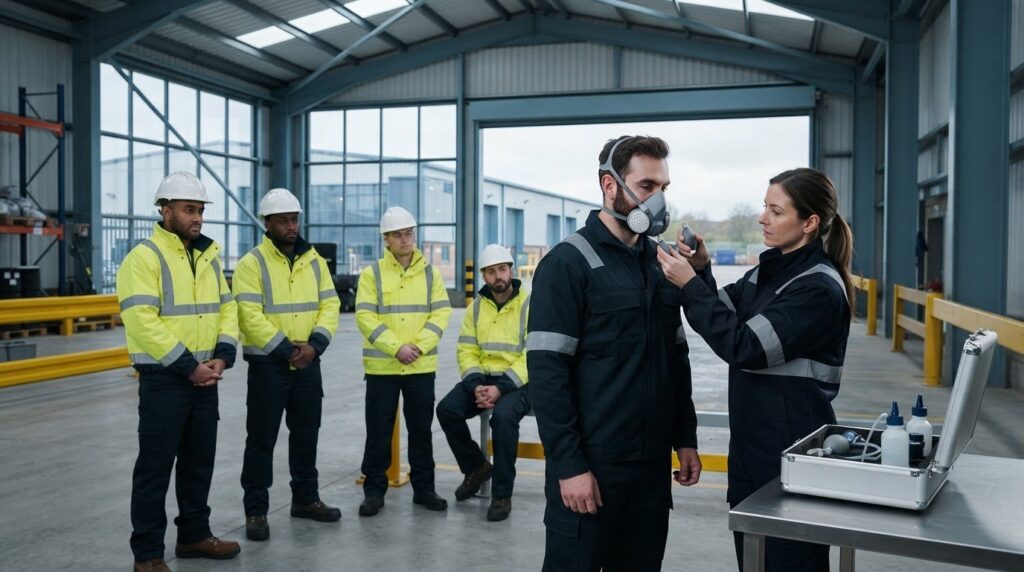
Can your Doncaster team complete face-fit testing without bringing work to a standstill? With on-site dust mask fitting Doncaster, you can organise candidates at their workplace and plan around site demands and the masks they use.
It can be difficult to know who needs testing, which masks are covered and what to arrange before a visit. When workers use tight-fitting respiratory protective equipment (RPE), the equipment must be suitable for the wearer, and fit testing is part of selecting it. AFN Industrial Services provides qualitative face-fit testing for commercial and industrial workplaces, including on-site visits in Doncaster, backed by over 25 years of industry experience.
This guide explains which employees may need testing, how to organise a workplace visit and how to prepare candidates and the site. It also clarifies what a fit test establishes: whether a specific tight-fitting facepiece fits its wearer, not whether it is suitable for every hazard or task. A clear plan helps your team prepare and keep the process practical.
Key Takeaways
- On-site dust mask fitting Doncaster helps employers organise individual testing around their workplace and team arrangements.
- A qualitative fit test checks the seal between a wearer and a specific tight-fitting facepiece. It does not select the right equipment for every hazard.
- Organise candidates, test each wearer and record each individual outcome.
- Prepare a candidate list, work areas, shifts and access arrangements. Ask each person to identify the facepiece they use for work.
- AFN Industrial Services provides qualitative face-fit testing for commercial and industrial workplaces, including on-site visits in Doncaster.
What on-site dust mask fitting in Doncaster checks
Can candidates be tested at your Doncaster workplace? Yes. On-site dust mask fitting Doncaster brings testing to your commercial or industrial premises, so you can coordinate attendance at work rather than arrange separate visits elsewhere. The test has a specific purpose: to assess whether a tight-fitting facepiece forms a suitable seal on the individual wearer.
What does a dust mask fit test assess?
“Dust mask” is a familiar everyday term. Tight-fitting respirator describes the equipment more precisely: respiratory protective equipment that relies on a close seal against the face. A fit test checks the match between one person and the particular facepiece being tested. The result applies to that wearer and facepiece, not automatically to a colleague using the same mask or to another model or size.
A mask can look correctly positioned and feel comfortable without forming a reliable seal. Appearance and comfort alone cannot establish fit. A formal test provides an individual assessment, helping employers distinguish a tested facepiece from one that has only been issued or visually checked. For a general overview of fit-testing approaches, see Respirator Fit Test.
This distinction matters when planning for a team. If two employees use the same type of facepiece, each needs an individual assessment. One person’s result does not establish fit for the other, and the test does not assess every aspect of how the mask is used at work.
Why arrange testing at a Doncaster workplace?
An on-site visit lets you bring candidates together at their workplace and plan attendance around the team and site. This can make coordination more practical where employees work across different shifts or areas. You can organise who attends and ask candidates to identify the facepiece they use before testing begins.
Keep the scope clear: a fit test checks the seal between wearer and facepiece. It is not a full assessment of airborne hazards, working conditions or whether the selected RPE is suitable for a task. Employers still need to consider workplace exposures and whether the chosen protection is appropriate. A successful fit test does not answer those wider questions or guarantee protection in every situation.
AFN Industrial Services provides qualitative face-fit testing for commercial and industrial workplaces, including on-site visits in Doncaster. The service helps local employers arrange individual testing at their premises. To plan the next steps, identify who wears tight-fitting RPE, gather the facepiece details and organise candidates for the visit.
How qualitative face-fit testing works for workplace teams
Qualitative face-fit testing is a pass-or-fail assessment that uses the wearer’s response to a test agent to assess the seal of a tight-fitting facepiece. It is an individual check, not a general approval of a mask type. For a workplace team, organise candidates, facepieces and records in a clear sequence.
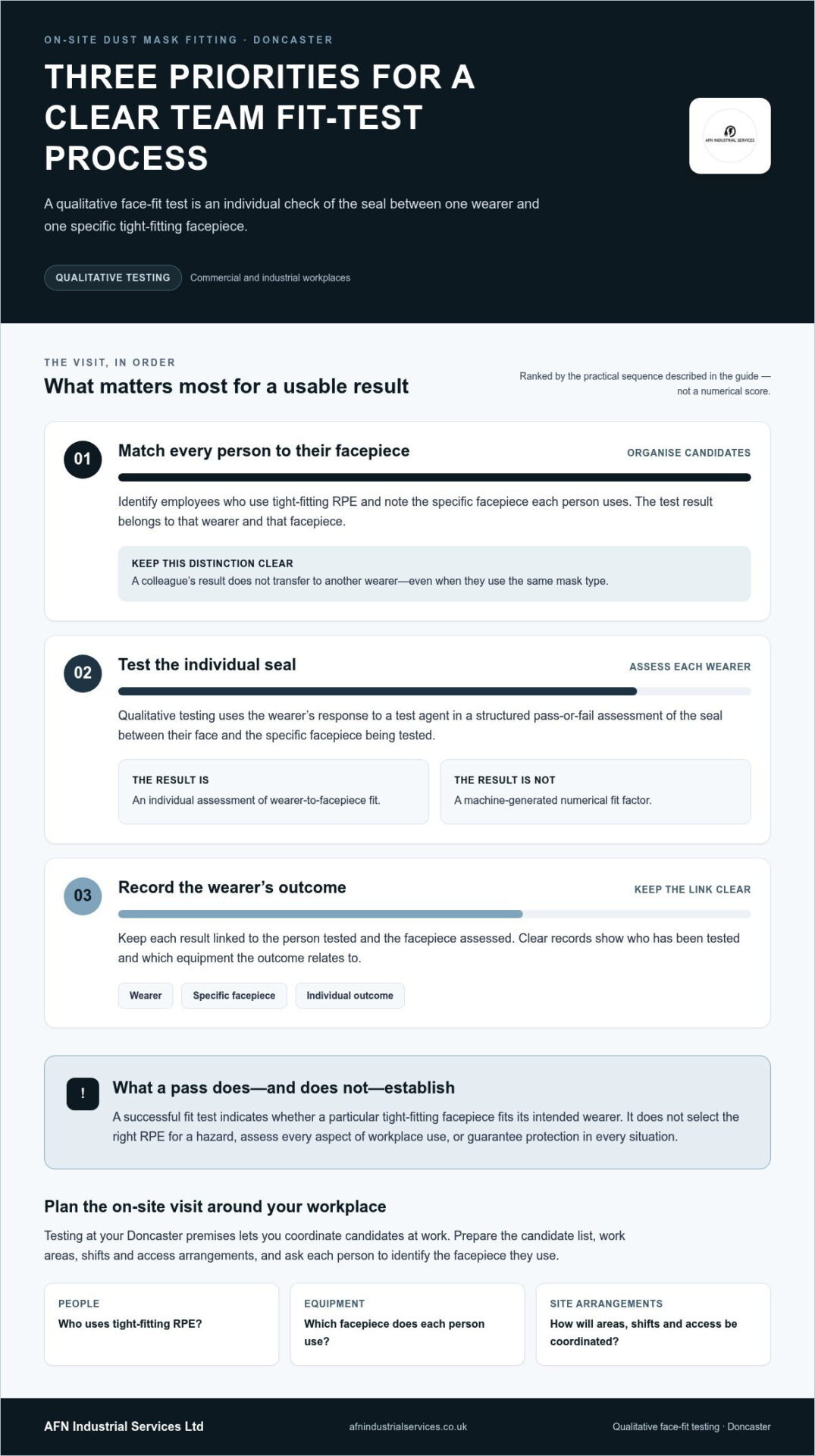
For on-site dust mask fitting Doncaster, employers can structure the visit around three stages:
- Organise candidates. Identify employees who use tight-fitting RPE and note the facepiece each person uses. This links each assessment to the right equipment.
- Test each wearer. Each candidate takes part in a structured assessment of the seal between their face and the specific facepiece being tested. Qualitative testing relies on the wearer’s response, rather than a machine-generated numerical fit factor.
- Record the individual outcome. Keep the result linked to the wearer and facepiece assessed. Clear records show who has been tested and which equipment the result relates to.
What happens during a qualitative test?
The wearer takes part in an assessment to establish whether the tested facepiece seals suitably on their face. The tester evaluates that individual match and records the outcome. The assessment should follow the applicable method and be conducted appropriately.
Qualitative testing does not produce a numerical fit factor. The result is specific to the person and facepiece assessed. If a colleague wears the same model, the first person’s result does not transfer to them. Similarly, a result for one facepiece is not evidence of fit for a different make, model or size.
What does a fit-test result tell an employer?
The result helps an employer assess whether a particular tight-fitting facepiece fits its intended wearer. It provides evidence about that wearer-equipment match, not a certificate that the mask will suit every employee or task. A fit-test result also does not select the correct RPE for a hazard.
Selecting respiratory protection and controlling exposure involve broader workplace decisions. Employers still need to assess the work and relevant hazards, consider suitable controls and determine whether the chosen equipment is appropriate. Fit-test evidence addresses one specific part of that picture: the seal on the wearer tested.
The OSHA Respiratory Protection Standard is a US regulation, not UK legal guidance. For Doncaster employers, treat the fit-test outcome as an individual record and manage it alongside workplace risk controls and RPE decisions. AFN Industrial Services provides qualitative face-fit testing for commercial and industrial workplaces through on-site face-fit testing support.
Which employees and masks should Doncaster employers consider?
Start with the equipment people use, not their job titles. Identify workers who wear tight-fitting respiratory protective equipment (RPE) for their tasks, then check which facepiece each person uses. This may include disposable filtering facepieces or reusable half-face and full-face masks. The key question is whether the equipment relies on a close seal against the wearer’s face.
For guidance on duties and circumstances requiring fit testing, consult current Health and Safety Executive (HSE) guidance on respiratory protective equipment and fit testing. A candidate list helps you plan, but it does not replace assessing workplace risks or deciding which RPE is suitable for the work.
How to identify candidates across a workplace
Review tasks and work areas to identify where tight-fitting RPE is used. Then group candidates by area or shift to make attendance easier to manage. Job titles do not always show who uses RPE: people with the same role may do different tasks, while workers in different roles may use similar protection. Ask supervisors to help identify actual equipment users.
For each candidate, note their work area, usual shift and facepiece. This can reveal practical details, such as employees being spread across separate parts of a site or working different patterns. It also shows which facepieces are used across the team before you arrange on-site dust mask fitting Doncaster.
Why the exact facepiece matters
A fit-test result belongs to a particular wearer and the facepiece assessed. Keep those details linked in your records. If an employee changes facepiece, do not assume an earlier result applies. A different make, model or size may fit differently, so the previous result should not be used as proof of fit for the replacement.
A fit test does not approve the facepiece for every hazard or task. The employer must consider the work and required protection separately. A suitable seal for one wearer is part of the wider respiratory protection picture, not a complete equipment selection decision.
| Check | What it addresses | What it doesn’t establish |
|---|---|---|
| Individual fit test | Whether the tested tight-fitting facepiece seals suitably on that wearer | Fit for colleagues or a different facepiece |
| General equipment check | The condition or general suitability of equipment for its intended use | A seal assessment for a specific wearer |
Keep these checks distinct. An equipment inspection cannot replace individual testing, and a fit-test result does not establish that equipment is suitable for all workplace hazards. Use this distinction, task-based candidate planning and current HSE guidance to arrange testing for the right people and link each outcome to the facepiece assessed.
How to prepare candidates and your Doncaster site
Good preparation helps keep an on-site visit organised and ensures candidates know which facepiece to bring. Give one site contact responsibility for coordinating names, work areas, shifts and access. Then share clear instructions with each person being tested. This helps you plan around operational needs without assuming a fixed visit duration or disrupting essential activities.
Prepare employees before the visit
Tell candidates why they are attending and ask them to bring, or identify, the tight-fitting facepiece they use for work. If someone uses different masks for different tasks, record which one is intended for assessment so the test is linked to the right equipment. Give candidates an opportunity to raise practical concerns about their usual mask before testing.
Keep results individual. A team may attend as a group, but each person’s outcome relates to that wearer and the facepiece assessed. Avoid a single team-level record that makes it unclear who was tested or which mask the result concerns.
Prepare the workplace and schedule
Choose an appropriate area for the visit and coordinate access with the site contact. Share arrival and site-entry arrangements in advance, and consider how candidates can attend without leaving essential duties uncovered. For a larger or mixed-shift team, group people by work area or shift and plan an order that suits normal operations.
Use this checklist to organise the practical details:
- Candidate list: Record who needs testing and how to reach them on the day.
- Work areas: Note where candidates are based and any access arrangements for those areas.
- Shifts: Map attendance to shift patterns and essential workplace activities.
- Facepieces: Ask each candidate to bring or identify the facepiece they use for work.
- Site contact: Confirm who will coordinate access and direct candidates to the testing area.
Preparation supports a smoother visit, but it does not determine whether a facepiece is suitable for a particular hazard or task. Keep the fit-test plan connected to wider workplace safety arrangements, including how respiratory risks and controls are managed. Clear coordination helps fit testing into your site plan.
AFN Industrial Services provides qualitative face-fit testing for commercial and industrial workplaces, including on-site visits serving Doncaster. To arrange on-site dust mask fitting Doncaster, organise workplace face-fit testing with AFN and have your candidate, shift and facepiece details ready.
Arrange on-site face-fit testing in Doncaster with AFN
Arranging a workplace visit starts with a clear picture of your site and the people who need testing. AFN Industrial Services provides qualitative face-fit testing for commercial and industrial workplaces, including on-site visits in Doncaster and the wider South Yorkshire area. Sharing practical details early helps shape arrangements around your workplace rather than relying on a one-size-fits-all plan.
What information helps organise a site visit?
Gather the key details before arranging testing. Accurate information helps coordinate the site visit and link each candidate to the facepiece they use.
- Workplace location: Provide the Doncaster site address and the preferred contact for coordinating arrangements.
- Candidate numbers: Estimate how many people need individual assessments and note their work areas or teams.
- Shifts and access: Explain relevant shift patterns, site-entry arrangements and access considerations for the testing area.
- Facepiece details: Identify the tight-fitting facepieces employees use for work, including differences between candidates where relevant.
If candidates use different facepieces, include that in your plan. The assessment is tied to the individual wearer and facepiece tested, so these details help keep arrangements and records specific. A candidate estimate, shift information and facepiece details provide a useful basis for coordinating the visit.
What to expect from AFN’s local service
AFN brings over 25 years of industry experience to workplace safety support. Its qualitative face-fit testing is tailored to commercial and industrial workplaces, with on-site arrangements serving Doncaster and the wider South Yorkshire area. The service focuses on organising individual assessments at your workplace. The test addresses the fit of a facepiece on its wearer, not whether that equipment suits every hazard or task.
Welding employers looking for trade-specific context can also refer to the Face Fit Testing for Welders in Doncaster guide. This guide covers a broader range of workplace teams, including employers coordinating candidates across different areas, shifts or facepiece types.
Before making arrangements, bring together your site address, contact details, candidate estimate, shift and access information, and the facepieces employees use. This gives AFN a practical starting point for discussing a workplace visit and helps your team prepare.
Arrange on-site face-fit testing with AFN for your Doncaster workplace.
Make your next step a well-planned one
Use your preparation as the starting point for a respiratory protection process your team can maintain. Keep candidate and facepiece records clear, and review them when workplace tasks or equipment change. A fit-test outcome is most useful when it remains linked to the person and facepiece assessed, alongside wider decisions about workplace hazards and controls.
For employers arranging on-site dust mask fitting Doncaster, bring the site details, candidate estimate, shift arrangements and facepiece information together. AFN provides qualitative face-fit testing for commercial and industrial workplaces, drawing on over 25 years of industry experience and serving Doncaster and wider South Yorkshire. Its local coverage also includes Bawtry, Sheffield, Rotherham, Worksop, Retford, Wakefield, Barnsley, Mansfield, Scunthorpe and Pontefract.
To plan a workplace visit around your team and site, arrange on-site face-fit testing with AFN.
Frequently Asked Questions
Is face-fit testing required for every dust mask?
No. Fit testing applies to tight-fitting respiratory protective equipment, not every type of face covering. Identify what equipment workers use for each task, then follow current Health and Safety Executive guidance and your workplace RPE arrangements. AFN provides qualitative face-fit testing. Each result relates to the specific wearer and facepiece assessed, so it is not evidence for a different person or mask.
Can an employee use the same fit-test result after changing masks?
Do not assume an earlier result applies after a mask change. A fit-test result concerns the wearer and particular facepiece assessed, and a change in make, model, type or size may affect the fit. For example, switching from one disposable mask model to another means the existing result should not automatically be relied on. Follow current HSE guidance and your workplace RPE arrangements when deciding what assessment is needed.
Can face-fit testing be carried out at a Doncaster workplace?
Yes. AFN provides qualitative face-fit testing for commercial and industrial workplaces, including on-site visits in Doncaster. Employers can coordinate candidate attendance with site access and work schedules, making on-site dust mask fitting Doncaster a practical option for teams working across different areas or shifts. The assessment concerns the fit of a particular facepiece on its wearer, not general approval of masks across the workplace.
How long does an on-site face-fit test take?
There is no fixed visit duration to rely on. The time needed can depend on the candidate group and workplace arrangements. A site with workers on different shifts may need a different attendance plan from a team available together. To help organise the visit, prepare an estimated candidate list, shift details and the facepieces in use. Avoid scheduling candidates too tightly around essential duties.
Can facial hair affect a tight-fitting dust mask fit test?
Yes. Facial hair in the area where a tight-fitting facepiece seals against the face can interfere with the seal being assessed, including hair under the sealing surface. Before the appointment, tell candidates to follow current HSE guidance and the workplace RPE procedure on facial hair. The assessment remains individual: it evaluates the wearer with the specific facepiece being tested, rather than making a general judgement about all masks.
What should an employer do if a worker does not pass a fit test?
Do not treat an unsuccessful result as confirmation that the facepiece fits. Follow current guidance and workplace respiratory protection arrangements to decide the next step. This may involve reviewing whether the facepiece is appropriate for that worker and arranging another assessment with a suitable option. Keep the outcome linked to the worker and equipment tested, and make sure work decisions account for the result. A further test does not guarantee a pass.