A PAT test isn’t itself a specific legal requirement, but UK rules require electrical equipment at work to be maintained in a safe condition. Portable appliance testing in Rotherham helps identify visible damage and electrical faults, giving businesses a clearer basis for managing equipment safety. Checks can be planned around the appliances on site and how they’re used.
Before arranging testing, it helps to know what will be checked, what happens if an appliance fails and how the work may affect your premises. This guide explains the inspection and testing process, who may need it and how to manage equipment that doesn’t pass.
Planning is easier when you understand what affects the scope of the work, such as the number and type of appliances and the site layout. Sharing these details helps organise access, limit disruption and plan practical next steps for keeping equipment safe to use.
Key Takeaways
- UK rules require work equipment to be maintained in a safe condition, but PAT testing itself isn’t specifically required by law.
- Assess which appliances are used by staff or provided to tenants, and consider their condition and working environment when planning checks.
- If an appliance fails, it should be taken out of use, clearly labelled and reported to the responsible manager or business owner.
- The number and complexity of appliances, along with site access, shape the work and its scheduling.
- Visual inspections and electrical tests can help identify faults and inform decisions about maintenance or replacement.
Is PAT testing a legal requirement in Rotherham?
No UK rule specifically requires every business to carry out PAT testing. Employers and other duty holders must maintain electrical equipment in a safe condition, and inspections or tests can help demonstrate how they manage that responsibility. The appropriate checks depend on the equipment, its condition and how it is used.
The National Archives (legislation.gov.uk) lists the Provision and Use of Work Equipment Regulations 1998 as legislation relevant to electrical maintenance in the UK. It also lists the Electricity at Work Regulations 1989 and the Health and Safety at Work Act 1974. These references sit within a wider workplace safety framework, rather than creating a universal testing interval for every appliance.
The National Archives (legislation.gov.uk) also lists the Management of Health and Safety at Work Regulations 1999 and the Workplace (Health, Safety and Welfare) Regulations 1992 as relevant legislation. For a Rotherham workplace, the practical question is whether equipment is being kept safe and whether the inspection approach suits the risks. A kettle in an office and a power tool used on a construction site may need different attention because their use and operating conditions differ.
You don’t have to be a qualified electrician to carry out PAT testing, but you must be competent, with the knowledge and equipment needed for the checks. That means understanding the inspection process, using test equipment correctly and recognising when a result points to a safety concern. A code of practice can help structure this work; the 5th Edition IET Code of Practice for In-Service Inspection and Testing of Electrical Equipment is one reference used for PAT testing.
For a business, a useful record links each appliance to its inspection result and any next action. Testing documentation may include a results table and a certificate of compliance for the inspected equipment. These records help managers track which items passed, which need attention and what decisions were made after testing.
- Results table: records the outcome for each tested appliance.
- Certificate: provides a summary of compliance for the inspected equipment.
- Failed result: identifies an appliance requiring follow-up, rather than treating the paperwork as a substitute for action.
Repairs aren’t automatically part of an inspection or certificate. If a fault is identified, the report can inform whether the appliance needs repair, replacement or removal from use; any repair work and its cost depend on the fault and the work required. The testing charge itself depends on the case and is given after a quote request, with appliance volume and complexity affecting the cost.
AFN Industrial Services Ltd provides Portable Appliance Testing for businesses in Rotherham and across South Yorkshire. A clear scope, including the site address and access arrangements, helps plan the visit. The resulting report gives the responsible manager a documented basis for decisions about the tested equipment.
Businesses and premises needing PAT testing
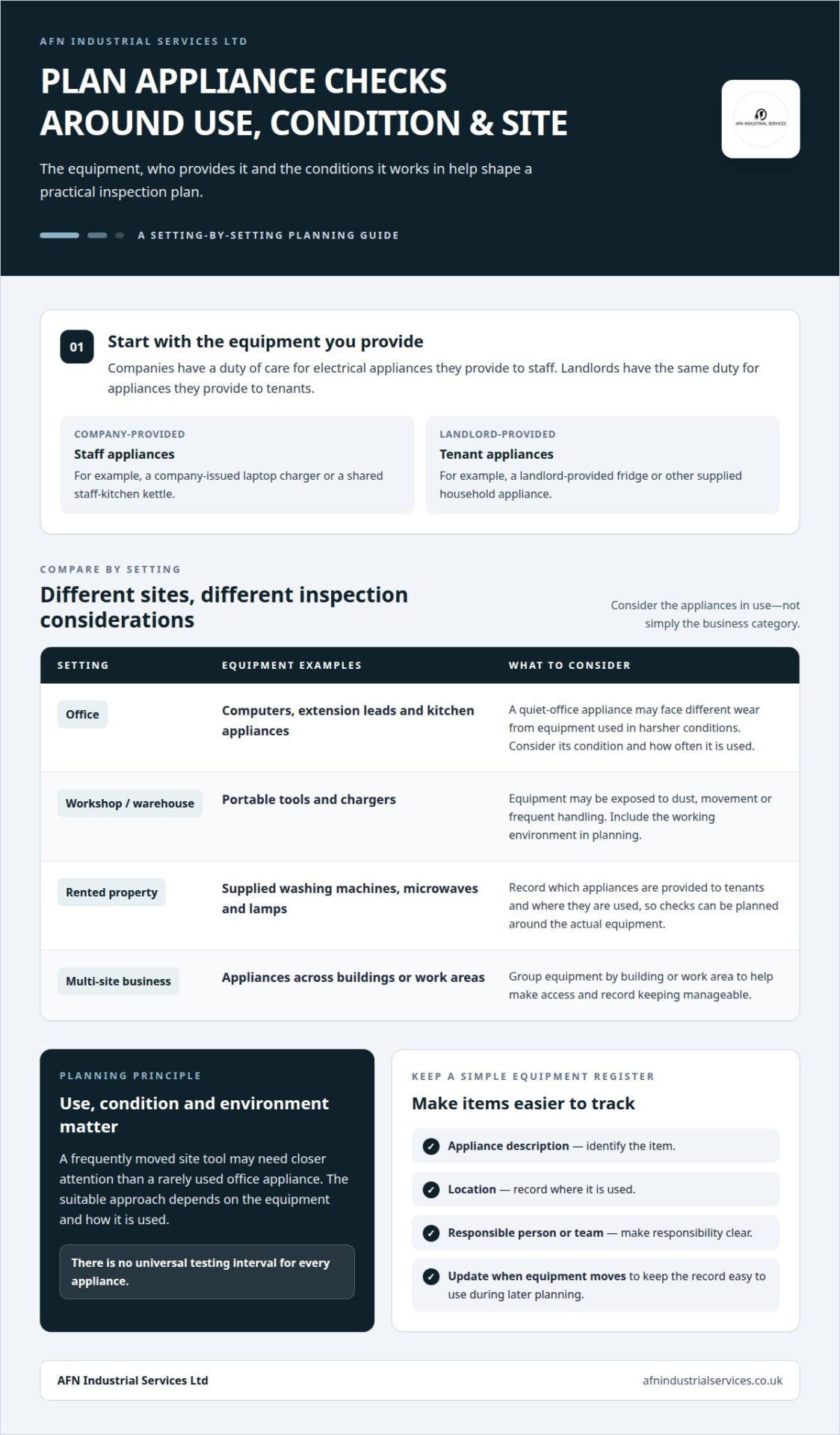
Portable electrical equipment is found in offices, workshops, shops, schools, rented homes and industrial sites across Rotherham. The need for inspection depends on who provides the equipment, how it is used and the conditions around it. A desk lamp in a quiet office faces different wear from a drill moved between a workshop and a building site. Consider the appliances in use, not simply the business category.
Companies have a duty of care to ensure electrical appliances they provide to staff are safe to use. Landlords have the same duty for appliances they provide to tenants. Examples include a company-issued laptop charger, a shared kettle in a staff kitchen or a landlord-provided fridge. The responsible organisation should know which appliances it supplies and where they’re used, so checks can be planned around the actual equipment.
Workplaces contain different appliance types, each with its own inspection considerations. A small office may have computers, extension leads and kitchen appliances. A warehouse or workshop may use portable tools and chargers exposed to dust, movement or frequent handling. A rental property’s inventory might include a washing machine, microwave and supplied lamp. These examples help identify which items fall within the organisation’s control.
A practical starting point is to list equipment by location and use. This makes it easier to identify items shared by several people, moved between rooms or exposed to harsher conditions. A simple register can record an appliance description, its location and the person or team responsible for it. Update the record when equipment moves to keep it easy to track during later inspection planning.
- Offices: list shared kitchen appliances, computer equipment and extension leads.
- Workshops: identify portable tools and equipment subject to regular handling.
- Rented properties: record appliances supplied to tenants, such as fridges or washing machines.
- Multi-site businesses: group equipment by building or work area to make access and record keeping manageable.
Regulations don’t make every appliance or premises identical. A suitable approach considers the equipment’s condition, frequency of use and environment. A frequently moved site tool may need closer attention than a rarely used office appliance. This helps a business decide where inspections are most useful while keeping responsibility clear for the appliances it supplies.
Businesses arranging portable appliance testing in Rotherham can organise checks around the equipment and its working conditions. Grouping appliances by site and type also helps plan access and keep records aligned with items present. For support with portable appliance testing, consider the appliances your business provides and the conditions in which staff or tenants use them.
Failed appliance procedures
An appliance that fails should not remain available for normal use. Take it out of use, attach a failed warning label and report the result to the manager or business owner. This creates a clear handover, whether the appliance is a kettle in a staff kitchen or a portable tool in a workshop.
The person responsible for the workplace should make sure the warning is visible and the appliance cannot be mistaken for equipment that passed. For example, separate a failed extension lead from usable leads and identify it clearly. If staff share equipment across departments, tell the relevant team so no one returns the item to service without seeing its status.
What follows depends on the fault and the appliance’s condition. A manager can arrange for the item to be assessed for repair or decide to replace it. A damaged plug, exposed conductor or failed electrical test can point to different issues, so treat a pass or fail result as a guide to the next decision, not as a repair diagnosis.
Keep the failed result with the appliance’s inspection record. A useful record identifies the item, its location, the test outcome and the action taken. If a replacement is bought, update the equipment register so the old item isn’t confused with the new one. After a repair, the appliance should be assessed again before returning to workplace use.
- Remove: take the failed appliance out of normal use.
- Identify: apply a clear failed warning sticker.
- Report: notify the manager or business owner.
- Decide: arrange assessment, repair or replacement according to the fault.
- Record: document the outcome and any follow-up action.
How often should workplace appliances be PAT tested? There’s no single interval that suits every item. Regular maintenance usually takes place every 12 months; high-risk equipment, such as tools used on construction sites, is recommended for testing every three months, while low-risk offices might need annual testing.
Use inspection intervals as planning points, then account for wear, equipment type and working conditions. A frequently moved site tool may need closer attention than a rarely used office appliance. Reassess the plan if the environment changes, equipment is damaged or staff report a concern. Testing can also take place after an appliance is new or repaired, helping establish its condition before continued use.
After a failed test, the key control is not to lose track of the item during follow-up. A labelled appliance, a named responsible manager and a recorded decision make the status clear across shifts and work areas. This process helps ensure a failed appliance stays out of service until the business has addressed the result.
PAT testing prices and access conditions
The price of PAT testing depends on the case and is given after a quote request; appliance volume, item complexity and site access affect the cost. A batch of similar, readily accessible office equipment differs from a mixed inventory of tools and appliances spread across several work areas. A clear scope helps the quote reflect the actual work required.
Before arranging testing, gather details about the number and types of items, where they are and how easily they can be reached. Equipment grouped in one room may need a different plan from appliances distributed across separate warehouse zones. Complex or specialist items can also take more inspection time than straightforward equipment.
How can I compare PAT testing providers in Rotherham? Compare like for like: give each provider the same appliance count, equipment types, site layout and access details. Check that the scope explains what testing and records are included, and how failed items will be reported.
Access affects the visit plan and how efficiently the work can proceed. Appliances may be in offices, kitchens, workshops, storage areas or shared spaces. If equipment is in use, staff may need to make it available at an agreed time. Restricted areas or production activity can also affect the order in which equipment is tested.
How do I prepare appliances and premises for a PAT testing visit? Gather equipment in accessible locations where practical, and tell staff which items need to be available. Identify restricted rooms, busy work areas and appliances that cannot be moved easily, so the testing route can be planned around normal operations.
- Prepare an inventory: note appliance types, quantities and locations.
- Make access clear: move items from obstructed areas where safe and practical.
- Coordinate staff: explain which shared or in-use appliances need to be available.
- Flag site constraints: identify restricted spaces and operational tasks that affect access.
These steps help prevent delays caused by missing equipment or rooms that cannot be accessed. For example, a list separating workshop tools from office appliances gives the testing team a clearer route through the premises. Accurate counts help define the scope, while noting complex equipment sets realistic expectations for the visit.
Most PAT testing jobs in Rotherham take 1 to 2 hours, depending on the number and complexity of appliances. Large facilities with numerous items may require several days. The number of items, their location and the time needed to access them shape the schedule, so a site plan and accurate inventory are useful preparation.
Good access planning supports a thorough inspection without treating every workplace as identical. Grouping appliances by area, arranging access with relevant staff and identifying operational constraints gives the visit a practical structure. It also helps ensure electrical equipment across the premises is accounted for.
Portable appliance inspections and fault detection
A thorough appliance check combines a formal visual inspection with electrical testing. The visual inspection looks for visible damage, such as a cracked plug, frayed cable or loose casing. The electrical test then checks whether the appliance meets relevant safety test requirements. Both stages matter: an appliance can look intact but still produce an unsatisfactory electrical result.
The checks vary with appliance design. For Class 1 equipment, testing can include earth continuity, which checks the protective earth connection. Insulation resistance testing can apply to Class 1 and Class 2 equipment. Protective conductor or touch current testing can also form part of the assessment. The tester selects appropriate tests for the equipment rather than applying an identical sequence to every item.
Examples show why the checks need to suit the appliance. A metal-bodied workshop appliance may require attention to its earth connection, while a double-insulated office device has a different construction. A damaged lead or loose plug may be spotted visually before electrical testing. Testing should be carried out by a competent person with the necessary knowledge and equipment.
Portable appliance testing can take place after equipment is new, after repairs and periodically during use. A repaired appliance should be assessed before returning to service, while recurring inspections help track its condition as use and wear continue. The approach should reflect the appliance, its environment and how staff handle it. A power tool used on a busy site faces different conditions from a desk lamp in a controlled office.
Following testing, records connect each result to a specific item. Safe equipment may receive a pass sticker showing the inspection date, recommended next inspection date, engineer details and appliance identification. Under the 5th Edition, a label may show the next inspection due date or just the test date. The identification helps distinguish, for example, one extension lead from another in the same work area.
Reports can help managers assess appliance condition and decide whether maintenance or replacement is appropriate. A failed result should lead to clear follow-up, not simply a note in a file. Fault findings can also reveal patterns, such as repeated cable damage in a particular work area, prompting a review of storage or handling practices. Faulty portable appliances are stated to cause 25% of accidents reported to the Health and Safety Executive.
- Visual: identify visible damage to plugs, casings and cables.
- Electrical: select suitable tests for the appliance’s class and design.
- Record: connect the result and label details to the correct item.
- Act: use findings to guide maintenance, replacement or removal from use.
Arrange portable appliance testing to assess equipment condition and document test results for your premises.
AFN Industrial Services Ltd: Portable Appliance Testing
AFN Industrial Services Ltd provides Portable Appliance Testing to help Rotherham businesses assess workplace equipment and record inspection results. It’s a practical option when you need checks across an office, workshop, commercial premises or industrial site, or when equipment has been repaired or its condition needs reviewing.
Testing supports informed decisions about appliances that pass and those requiring follow-up. When arranging testing, share the equipment types, locations and any access considerations. This helps shape the work around your premises and operating conditions. AFN Industrial Services Ltd also provides Fire Extinguisher Maintenance, Emergency Light Drain Tests and Health and Safety Services for related workplace safety needs.
Contact AFN Industrial Services Ltd to discuss Portable Appliance Testing for your premises.
Make equipment safety part of your routine
Use inspection findings to build a practical equipment register and repeatable review process. Assign responsibility for updating records when appliances are added, moved, repaired or removed. This gives managers a clearer view of equipment across changing work areas and keeps follow-up actions visible.
For portable appliance testing in Rotherham, consider the appliances on your premises and how they’re used. A focused discussion about equipment types, locations and access can help shape a testing plan around your working environment. AFN Industrial Services Ltd also provides Fire Extinguisher Maintenance and Emergency Light Drain Tests.
Contact AFN Industrial Services Ltd to discuss testing for your premises and plan a clear next step. A structured approach can help your team manage equipment responsibly and keep safety considerations integrated into everyday operations.
Frequently Asked Questions
What Is PAT Testing?
PAT testing is the inspection and testing of electrical appliances to assess their safety during use. It combines a visual assessment with electrical checks suited to the item. For example, a portable heater in a staff room and a power tool in a workshop have different designs and operating conditions. The findings help a business decide whether equipment can stay in use or needs follow-up.
What is involved in a PAT test?
A PAT test involves examining an appliance for visible damage, then carrying out appropriate electrical checks. The tester identifies the item and selects checks according to its design and electrical class. A cracked plug or worn cable may be visible during inspection, while electrical testing can reveal faults that aren’t obvious from appearance alone. Results are recorded against the appliance so its status is clear.
What types of PAT testing are available in Rotherham?
Testing involves a visual inspection and electrical checks selected for each appliance, rather than separate packages that suit every workplace. Checks may include earth continuity for Class 1 equipment, insulation resistance for Class 1 and Class 2 items, and protective conductor or touch current testing. AFN Industrial Services Ltd testing covers 110 V, 230 V and 415 V appliances. Local businesses across South Yorkshire can arrange checks for their equipment.
What happens if an appliance fails the test?
A failed appliance should be taken out of use until the business decides how to address the fault. For example, don’t return a damaged extension lead to a shared workspace while its status is unresolved. Communicate the failed result to the responsible manager and record it against the item. The business can then arrange assessment, repair or replacement before considering the appliance for further use.
What is a Portable Appliance?
A portable appliance is electrical equipment that can be moved, even if it isn’t carried around during everyday use. Examples include a kettle, desktop monitor, vacuum cleaner, extension lead or portable drill. AFN Industrial Services Ltd PAT testing covers equipment that is permanently connected as well as equipment plugged into a socket outlet. Its electrical supply and use help define the relevant checks.
What is included in the service?
The service involves inspecting and testing the agreed appliances, recording individual results and identifying items that need follow-up. Documentation can include a results table and a certificate of compliance for inspected equipment. Passed appliances may receive an identifying label, helping staff distinguish tested items in shared spaces. Repairs aren’t automatically part of testing; the findings help the business decide what action is appropriate.
What is portable appliance testing (PAT testing)?
Portable appliance testing, also called PAT testing, checks electrical appliances for safety through inspection and suitable electrical tests. The acronym describes the testing process, not a particular appliance or single test method. For a Rotherham business, testing can cover different equipment types and supply voltages, with checks selected for each item rather than applying one identical test to all appliances.
Is PAT testing a legal requirement in the UK?
No UK regulation specifically requires every employer to carry out PAT testing. The requirement is to maintain electrical equipment in a safe condition, and testing can help assess and document its condition. The appropriate inspection plan depends on the equipment, how frequently it is used and its environment. For example, equipment exposed to regular movement or damage may need a different approach from an item used occasionally in an office.
