Could a mask that fits one worker still leak on another, or fail when the facepiece changes? For teams planning asbestos work, RPE fit testing for asbestos removal Doncaster starts with the exact make, model and size each person will wear. A successful test applies to that facepiece and wearer, not every mask on site.
It’s understandable to want clear answers without disrupting a working schedule unnecessarily. HSE guidance requires tight-fitting RPE to be fit tested, and the right testing approach depends on the facepiece and workplace requirements. Qualitative and quantitative tests aren’t interchangeable, so choosing an appropriate method is an important first step.
This guide explains what a fit test establishes, how the two approaches differ and what to consider when organising a group session. AFN Industrial Services Ltd provides qualitative face-fit testing for commercial and industrial clients in Doncaster and wider South Yorkshire, with a tailored, risk-led approach informed by over 25 years of industry experience. You’ll also find practical points for planning around staff numbers and site arrangements.
Key Takeaways
- Understand how a face-fit test checks the seal between an individual wearer’s face and a specific facepiece.
- Identify the exact make, model and size of the RPE your staff use before arranging testing.
- Compare qualitative and quantitative testing to understand which approach may suit the facepiece and workplace requirements.
- Use a staff-and-site checklist to organise a practical testing visit with less disruption to your schedule.
- Plan RPE fit testing for asbestos removal Doncaster by bringing together facepiece details, wearer numbers and site arrangements.
RPE fit testing for asbestos removal in Doncaster: what employers need to know
For an asbestos-removal team, suitable respiratory protective equipment (RPE) must fit each person who wears it. A mask selected for a task is not automatically suitable for every worker. A face-fit test checks whether a particular tight-fitting facepiece forms an effective seal on an individual wearer. The result is specific to that wearer and the make, model and size tested.
This distinction helps employers plan clearly. Selecting RPE means assessing the work and the protection needed. Training covers how to wear, maintain and check the equipment. Exposure controls address how asbestos risks are managed at the worksite. Fit testing assesses the face seal; it doesn’t select equipment or replace training and other controls. For a general overview of equipment types and their purpose, see Respiratory Protective Equipment (RPE).
What does an RPE face-fit test establish?
A fit test assesses the seal between the facepiece and one wearer’s face using the chosen test method. It helps establish whether that specific tight-fitting mask is suitable for that individual, rather than relying on the product’s appearance or a colleague’s experience. A pass doesn’t apply to a different make, model or size, and it isn’t proof that the wearer is protected in every circumstance. Correct fitting and use still matter.
Employers should match the test to the equipment workers will actually use. If a facepiece changes, the earlier result cannot simply be carried across. HSE’s guidance on RPE fit testing, INDG479, and its practical guide HSG53 provide further direction on fit testing and workplace RPE arrangements.
Why does asbestos-removal work make fit testing important?
Asbestos work requires careful planning of exposure controls, including the selection and use of appropriate RPE where needed. A poor face seal can allow contaminated air to bypass a tight-fitting facepiece, undermining its intended performance. Fit testing is one part of a wider risk-led system, not a substitute for controlling exposure at source or following safe work procedures.
Employers can use the test result to make a more informed decision about the facepiece for each worker. They should also ensure the wearer understands how to put it on correctly and carry out the checks required by the equipment guidance. Consult current HSE guidance for requirements and advice relevant to the work being planned.
- Identify the equipment: note the facepiece make, model and size workers use.
- Plan for each wearer: a test result relates to one individual, not the whole team.
- Keep controls connected: treat fit testing as one element of the workplace RPE and exposure-control plan.
For employers arranging RPE fit testing for asbestos removal Doncaster, getting these details straight is a practical starting point. AFN Industrial Services Ltd provides qualitative face-fit testing for commercial and industrial workplaces in Doncaster and wider South Yorkshire, using a tailored, risk-led approach. Next, consider how testing is carried out for individual wearers.
How asbestos RPE face-fit testing works for individual wearers
A well-organised fit-test session starts with a clear match between each worker and the facepiece they use. Before arranging a visit, check the equipment used across different tasks rather than assuming everyone wears the same mask. This helps ensure the test addresses the RPE workers will actually rely on at work.
What should employers identify before testing?
For each wearer, note the tight-fitting facepiece’s make, model and size. If someone uses different masks for different tasks, identify which one needs testing for the relevant work. A result for one facepiece shouldn’t be treated as evidence for another, even if the masks look alike. Use current HSE guidance, including INDG479 and HSG53, when making technical decisions about RPE selection and fit testing.
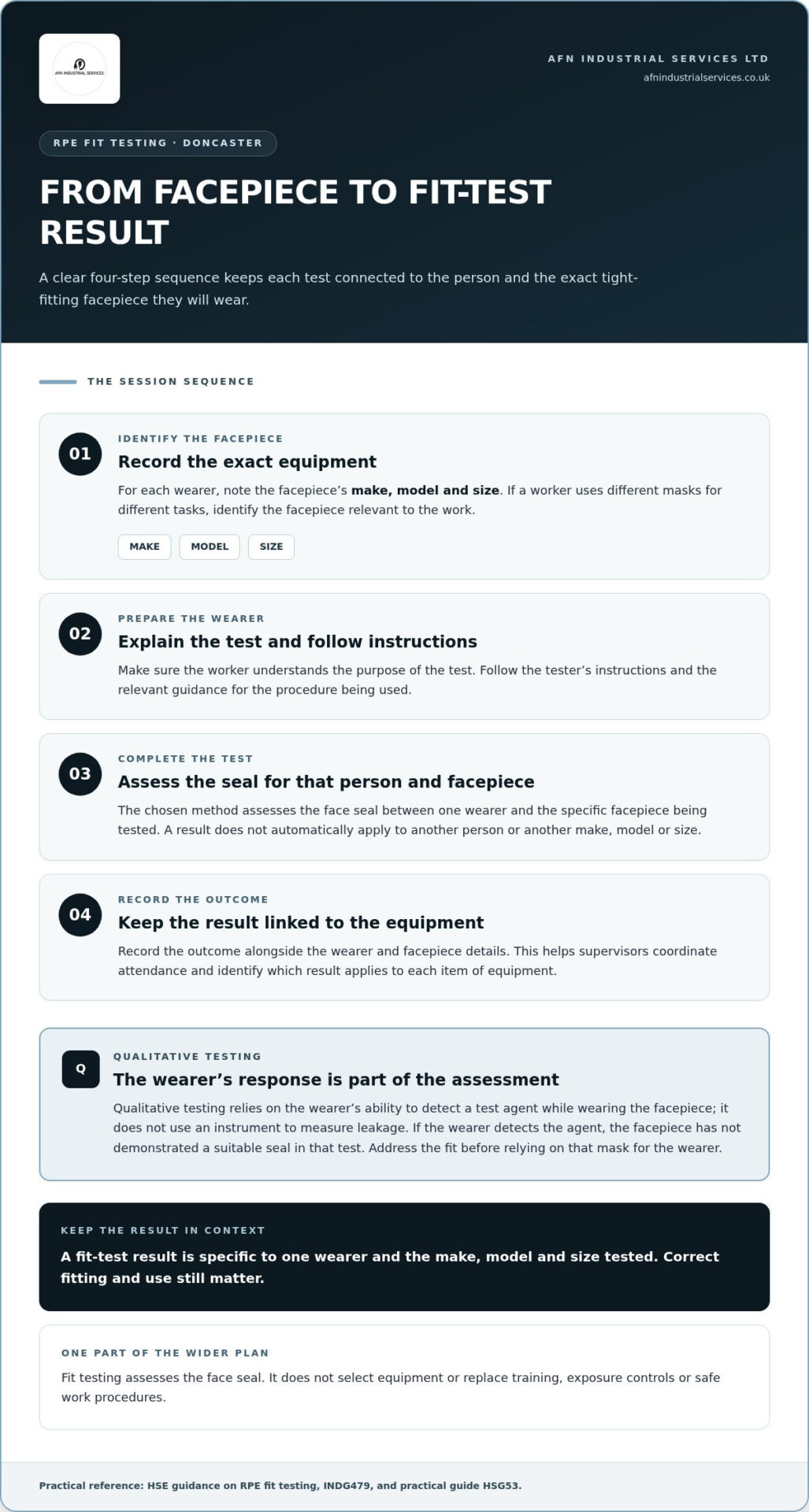
Use this sequence to prepare the session:
- Identify the facepiece. Record the exact make, model and size intended for the wearer.
- Prepare the wearer. Explain the purpose of the test and follow the tester’s instructions and relevant guidance.
- Complete testing. The chosen method assesses the face seal for that person and facepiece.
- Record the outcome. Keep the result connected to the wearer and equipment details for future workplace planning.
This preparation is particularly useful when workers use different RPE. For example, if someone has been issued a replacement mask, make sure the test plan identifies that model rather than relying on details from the previous facepiece. A clear record also helps supervisors coordinate attendance and see which result applies to each item of equipment.
What happens during qualitative testing?
Qualitative testing relies on the wearer’s ability to detect a test agent while wearing the facepiece. The wearer’s response helps assess whether the seal is adequate under the test method. This method doesn’t use an instrument to measure leakage. Follow the procedure being used and current guidance rather than assuming a particular test duration or exercise sequence.
If the wearer detects the test agent, the facepiece hasn’t demonstrated a suitable seal in that test. Address the fit before relying on that mask for the wearer. The employer may need to review how it sits or consider another suitable facepiece, then arrange testing in line with current HSE guidance.
A fit-test result addresses the face seal only. It doesn’t replace user instruction, correct donning, equipment maintenance, pre-use checks or wider controls for asbestos exposure. Keep those parts of the RPE plan in place alongside testing.
AFN Industrial Services Ltd provides qualitative face-fit testing for commercial and industrial clients in Doncaster and wider South Yorkshire. To plan a visit around wearer numbers and site arrangements, get in touch about qualitative face-fit testing.
Qualitative or quantitative RPE fit testing: how to assess the right approach
The choice between qualitative and quantitative testing should follow the facepiece and its intended use, not convenience alone. Both approaches assess fit, but they do so differently. For asbestos-related work, employers should make technical decisions within their risk-led RPE arrangements and follow current HSE guidance. AFN Industrial Services Ltd provides qualitative face-fit testing where this method meets the relevant requirements for the facepiece and workplace.
How do qualitative and quantitative methods differ?
Qualitative testing uses the wearer’s ability to detect a test agent as an indication of whether the face seal is adequate. Quantitative testing uses an instrument to assess leakage around the facepiece and produces a numerical result. The method must be appropriate for the specific facepiece and the guidance that applies to its use.
Method
Basic principle
Considerations
Employer decision
Qualitative
The wearer detects a test agent if it reaches them past the face seal.
Relies on the wearer’s response; suitability depends on the facepiece and applicable guidance.
Use where this method is suitable for the selected facepiece and work requirements.
Quantitative
An instrument measures leakage to provide a numerical fit assessment.
The equipment and procedure must suit the facepiece and current guidance.
Consider where an instrument-based assessment is required by the circumstances or guidance.
The comparison is a starting point, not a substitute for checking current HSE advice. Its HSE Guidance on RPE Fit Testing explains the testing approaches and helps employers assess what applies to their RPE arrangements.
How should an employer decide which method fits the requirement?
Begin with the exact facepiece make, model and size selected for the task. Then consider how it will be used and what the relevant guidance requires. A method that suits one facepiece shouldn’t automatically be assumed suitable for another. If the planned equipment changes, review the testing decision instead of carrying it forward without assessment.
For a practical decision, employers can:
- List the facepieces workers will use for the relevant tasks.
- Check current HSE guidance against each facepiece and its intended use.
- Match the test method to those requirements and the organisation’s RPE arrangements.
- Keep the test outcome linked to the individual wearer and facepiece tested.
AFN’s qualitative testing gives Doncaster and South Yorkshire workplaces a local option when qualitative testing is appropriate. It isn’t suitable for every mask or work situation. A considered choice connects the facepiece, method and task before staff are scheduled, making testing part of a wider, controlled approach to RPE.
Prepare Doncaster staff and site arrangements for an RPE fit-test visit
A little planning helps a fit-test visit run in an orderly way without pulling more staff away from site duties than necessary. Supervisors should coordinate the wearer list, the facepieces staff actually use and a suitable testing area. For RPE fit testing for asbestos removal Doncaster, this preparation also connects the session to the team’s workplace arrangements.
What should the supervisor organise before the visit?
Start with a list of staff who need testing and identify each person’s tight-fitting facepiece, including its make, model and size. Ask workers to bring or have access to the facepiece they use for the relevant task, rather than a convenient substitute. Arrange a suitable area and stagger attendance so the session can take place alongside site operations. Keep relevant RPE arrangements and work context available.
Use this checklist to get the practical details in place:
- Wearers: Prepare names and coordinate staff so each person knows when to attend.
- Facepieces: Identify the actual equipment used for the work, including make, model and size.
- Testing area: Set aside a suitable space where testing can be completed without avoidable interruptions.
- Site schedule: Allow for individual testing and organise attendance around operational needs. Avoid packing the schedule too tightly so each wearer can be assessed properly.
- Work context: Have the relevant RPE arrangements available so the test is planned around the facepieces and tasks involved.
AFN Industrial Services Ltd provides qualitative face-fit testing, with fees calculated per person during a site visit. Sharing the number of wearers and the site arrangements helps shape a practical plan for the visit. Discuss a tailored Doncaster face-fit testing visit with AFN.
What wearer factors can affect a face seal?
Tell staff before the session that anything crossing the facepiece’s sealing surface can interfere with the seal. HSE guidance states that tight-fitting RPE wearers need to be clean-shaven where the mask seals against the face. Stubble or facial hair in that area may prevent an effective fit. Eyewear or other equipment can also matter if it disrupts the facepiece seal, so consider how the worker will wear the RPE in practice.
Don’t set informal pass criteria or assume a mask fits because it feels comfortable. The outcome must be determined through the applicable test method and current guidance. If a wearer’s usual equipment or conditions could affect the seal, include that context in the planning so the testing arrangement reflects the facepiece they need for work.
AFN supports workplaces in Doncaster and across the wider local area, including Bawtry, Sheffield, Rotherham, Worksop, Retford, Wakefield, Barnsley, Mansfield, Scunthorpe and Pontefract. Clear staff, equipment and site details help coordinate the visit and keep each person’s test connected to the RPE they use.
Arrange qualitative RPE fit testing for asbestos-removal teams in Doncaster
Arranging a useful session comes down to three practical decisions: identify the facepiece each worker uses, establish that qualitative testing is appropriate for it, and coordinate the wearers and site arrangements. This gives the testing visit a clear purpose and connects it to the workplace’s RPE plan.
AFN Industrial Services Ltd provides qualitative face-fit testing for commercial and industrial workplaces in Doncaster and the wider South Yorkshire area. The approach is tailored and risk-led, informed by over 25 years of industry experience. Employers remain responsible for planning the wider work and its exposure controls.
What information helps arrange a face-fit testing session?
A focused enquiry helps shape a practical visit. Share the work location, how many staff need testing and the facepieces they use for their tasks. Include the make, model and size where available, and explain any site arrangements that could affect staff scheduling or the testing area. This gives the session a clear starting point without making assumptions about the equipment or workforce.
AFN’s fees are calculated per person during a site visit. To help with planning, supervisors can bring together:
- Staff numbers: identify who needs qualitative face-fit testing and coordinate their attendance.
- Facepiece details: list the tight-fitting masks workers use for the relevant tasks.
- Work location: provide the Doncaster-area site details and any practical access information.
- Site arrangements: note a suitable testing area and how staff can attend without disrupting essential operations.
With these details in hand, AFN can tailor the testing visit to the workplace and the team’s arrangements. Arrange qualitative face-fit testing with AFN.
How does AFN support local workplace safety planning?
A local session is one part of a wider RPE plan. AFN’s tailored, risk-led approach keeps the testing arrangement focused on the workplace, the facepieces in use and the staff who need testing. The company’s experience across commercial and industrial settings provides context for organising the service, without replacing an employer’s own risk assessment, equipment selection, user instruction or exposure controls.
Employers considering other workplace safety arrangements in the region may also find the Workplace Safety in Rotherham & Sheffield: A 2026 Compliance Guide useful alongside this guide. Keep the immediate enquiry focused on qualitative face-fit testing: the staff involved, their facepieces and the practical arrangements for the visit. That makes it easier to move from a general requirement to a clear local plan for RPE fit testing for asbestos removal Doncaster.
Make your next RPE planning step count
Make fit testing a planned part of how your team manages RPE, rather than leaving it until workers are about to start a task. Keep facepiece information connected to the people who use it, and review the arrangements if equipment or workplace needs change. This gives supervisors a clearer basis for organising staff and preparing for future site work. For organisations managing broader industrial infrastructure and compliance, International Testing Services Ltd provides specialised non-destructive testing and comprehensive inspection solutions.
For employers considering RPE fit testing for asbestos removal Doncaster, a practical next move is to gather wearer numbers, the work location and facepiece details. AFN Industrial Services Ltd provides qualitative face-fit testing using a tailored, risk-led approach, informed by over 25 years of industry experience and service to Doncaster and the wider South Yorkshire area.
Bring your team’s testing needs and site arrangements together, then take the next step with a local service focused on workplace requirements. Arrange qualitative face-fit testing with AFN in Doncaster and move forward with a clear plan for your staff.
Frequently Asked Questions
Can a face-fit test be used if a worker changes to a different mask model?
No. A result for one mask model doesn’t transfer to another, even if the replacement looks similar or comes from the same manufacturer. The test relates to the specific facepiece assessed, including its make, model and size. If a worker’s replacement mask differs, arrange testing for that facepiece before they rely on it as tight-fitting RPE. Keep the equipment details with the result so supervisors can distinguish between models.
Can workers with facial hair pass an RPE face-fit test?
Facial hair that crosses the facepiece’s sealing surface can prevent a reliable seal, so a worker shouldn’t expect to pass while wearing a tight-fitting mask over stubble or a beard in that area. HSE guidance advises that the seal area must be clean-shaven for tight-fitting RPE. Hair outside the sealing surface may not affect the seal, but the applicable test method determines the result. Plan attendance with this requirement in mind.
What should an employer do if a worker fails a face-fit test?
Don’t rely on that facepiece for the worker until the fit issue has been addressed. Review whether it’s being worn and adjusted correctly, and consider whether another suitable facepiece is needed as part of the workplace RPE arrangements. Any alternative tight-fitting model needs its own assessment for that wearer. Follow current HSE guidance and the test provider’s instructions, then record the outcome and next action clearly for supervisors.
Does every asbestos-removal worker need an RPE face-fit test?
Each worker who uses tight-fitting RPE needs an individual face-fit test for the facepiece they’ll wear. This applies to the wearer, not simply to a job title or team membership. A worker using loose-fitting RPE, such as a hood, doesn’t need a tight-fitting facepiece test for that equipment. Employers should identify the RPE required by the work and consult current HSE guidance when planning protection for each task.
How often should an employee repeat an RPE face-fit test?
Arrange a test before a worker first uses a tight-fitting facepiece, and repeat it if the make, model or size changes or a significant facial change could affect fit. HSE guidance advises employers to review when retesting is needed. Fit2Fit describes two-yearly retesting as good practice, with more frequent review potentially appropriate for high-risk work. Treat that interval as guidance, not a fixed statutory timetable, and follow current advice.
What records should an employer keep after face-fit testing?
Keep a clear record that lets supervisors match each result to the right person and equipment. Useful details include the wearer’s name, facepiece make, model and size, test method, date and outcome. Note follow-up actions if the wearer didn’t achieve a suitable result. These records help prevent an old result being applied to a different mask and support sensible review when equipment or a worker’s facial fit changes.
Can glasses or other personal protective equipment affect an RPE face seal?
Yes, if glasses or other equipment crosses or presses against the facepiece’s sealing surface, it can interfere with the seal. Consider the combination the worker will actually use, rather than assessing the mask in isolation. For example, check whether required eyewear alters how the mask sits. Mention relevant equipment during planning, and follow the applicable test method and HSE guidance to assess whether the facepiece maintains a suitable seal.
