Could your outdated ladder inventory be the single biggest liability sitting in your Sheffield facility right now? Most facility managers recognize that keeping track of shifting safety standards often feels like a moving target; this is particularly true when the old Class 1 and Class 3 labels you once relied on have been officially withdrawn. To protect your workforce and your business, you must ensure every piece of height-access equipment meets the EN131 Professional standard. This classification isn’t just a label; it represents a rigorous durability benchmark designed for the demanding environments of modern industry.
We understand the frustration of trying to decipher complex regulations while managing daily operations. This guide provides a clear roadmap to the current UK ladder laws, ensuring you have the confidence to purchase the right grade of equipment for heavy-duty use. You’ll learn the critical differences between professional and domestic ratings, how to maintain compliance under PUWER, and what the 150kg load limit means for your team’s safety. By the end of this article, you’ll know exactly how to keep your site compliant and your operators secure.
Key Takeaways
- Understand why the single BS EN 131 standard replaced all previous British classifications for portable ladders to simplify workplace safety.
- Learn the technical requirements for EN131 Professional equipment, including the 150kg total load capacity and 50,000-cycle durability testing.
- Clarify the legal status of withdrawn Class 1 and Class 3 ladders to ensure your current inventory meets modern regulatory expectations.
- Discover the essential role of a “Competent Person” in conducting formal ladder inspections and maintaining compliance under PUWER.
- Identify how tailored risk assessments and safe systems of work provide a robust framework for managing high-stakes industrial maintenance.
What is the EN131 Professional Ladder Standard?
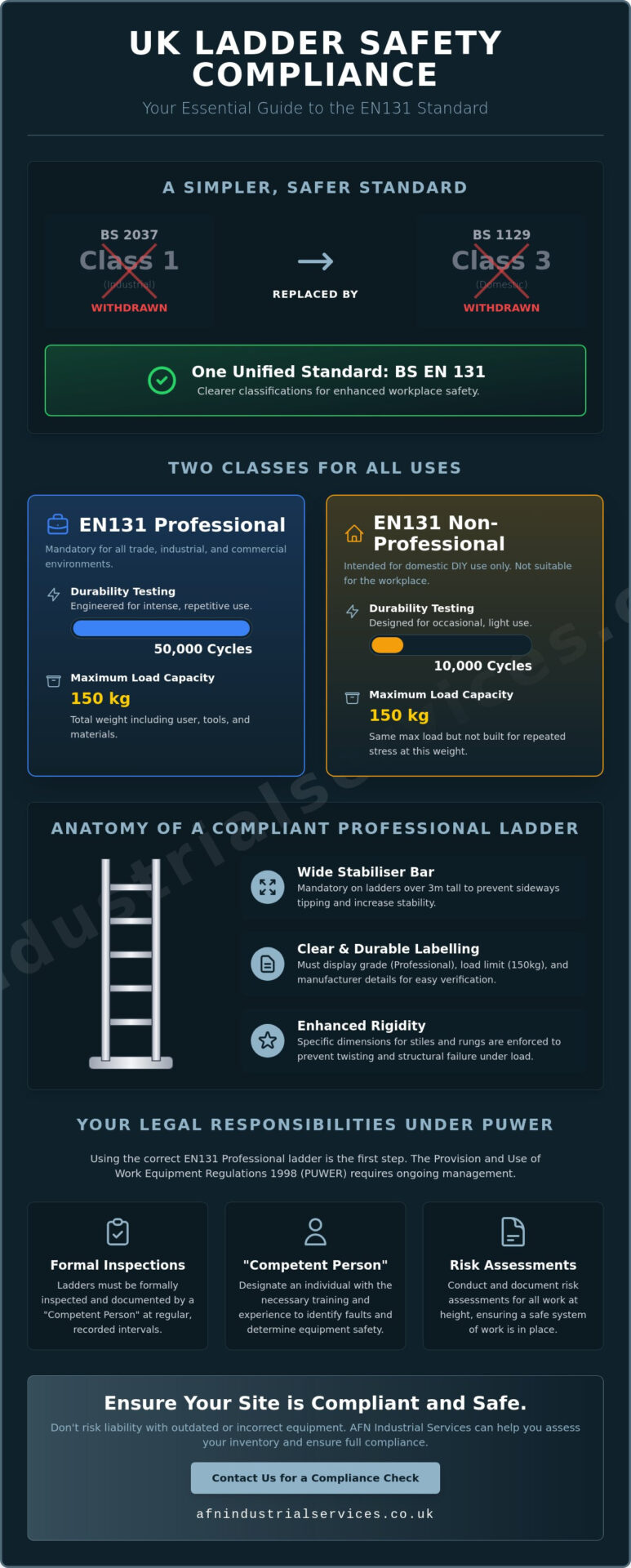
BS EN 131 serves as the single, harmonised standard for all portable ladders manufactured and sold within the United Kingdom. Since January 2019, this standard has replaced the legacy British classifications that many site managers previously relied on. The transition was not merely administrative; it represented a fundamental shift in how safety equipment is tested and validated for industrial use. By choosing an EN131 Professional ladder, you’re selecting equipment that has passed significantly more rigorous durability tests than domestic alternatives.
The 2019 revision saw the official withdrawal of BS 2037 (Class 1) and BS 1129 (Class 3). These older standards allowed for an overlap in equipment grades that often led to confusion on-site. Today, the market is divided into two clear categories: Professional and Non-Professional. For any trade, industrial, or commercial environment, the “Professional” classification is mandatory. It ensures the equipment can withstand the repetitive stresses of a busy workplace. You can find more detail on how these compare to global benchmarks by reviewing European ladder certification standards, which now provide a unified framework for safety across the continent.
The Core Purpose of the EN131 Revision
Safety remains the primary driver behind these regulatory changes. Historically, ladder accidents often stemmed from two main issues: lateral instability and structural failure under load. The revised standard addresses these by harmonising total load capacities at 150kg across all grades. This figure includes the operative, their tools, and any materials. By standardising these requirements, the industry removes the guesswork for facility managers. These ladders are specifically engineered for the frequent, heavy-duty use common in Sheffield’s industrial sectors, ensuring that a piece of kit doesn’t just work on day one, but remains safe after thousands of uses.
Key Features of an EN131 Professional Ladder
You can identify compliant equipment through several physical and visual markers. One of the most significant changes is the requirement for wide stabiliser bars on any ladder exceeding 3 metres in height. This feature significantly reduces the risk of the ladder tipping sideways during use. The standard also dictates specific dimensions for stiles and rungs to maximise rigidity and prevent twisting. These physical markers are the hallmark of an EN131 Professional tool. Compliant ladders must also feature clear, durable visual labelling. These labels indicate the grade, the 150kg load limit, and the manufacturer’s details, allowing safety officers to verify compliance during routine site inspections.
EN131 Professional vs. Non-Professional: Technical Differences
Choosing between professional and domestic equipment isn’t a matter of preference; it’s a matter of technical necessity. While both categories now share a common maximum load limit, the internal engineering and resistance to material fatigue differ significantly. An EN131 Professional ladder is specifically designed to withstand the repetitive, high-stress environment of a commercial site. Using domestic-grade equipment in these settings is a direct violation of safety protocols and can lead to immediate equipment failure.
Load Ratings and Weight Limits
The current standard mandates a maximum total load of 150kg for both grades. This figure is often misunderstood. It doesn’t just represent the weight of the operative. It must include the combined weight of the user, their tools, materials, and heavy industrial PPE. In a trade environment, reaching this 150kg limit is a daily occurrence. Domestic ladders aren’t engineered to handle this maximum load repeatedly without structural degradation. Adhering to the HSE guidance on ladder standards ensures that you select equipment capable of supporting your team safely throughout the working day.
Durability and Cycle Testing
The most critical differentiator between the two grades is the durability cycle test. To achieve the EN131 Professional classification, a ladder must successfully pass 50,000 cycles of testing. A domestic ladder only needs to pass 10,000 cycles. A single cycle simulates the stress of a user ascending and descending the equipment. For a maintenance team in a high-intensity facility, 10,000 cycles can be surpassed surprisingly quickly. Professional-grade materials are chosen for their resistance to torsion and bending, ensuring the rungs and stiles remain rigid even after years of heavy use. This enhanced durability provides a much higher return on investment compared to cheaper, domestic alternatives that require frequent replacement. This focus on long-term structural integrity is a hallmark of all professional site maintenance, including the high-quality fencing and garden improvements offered by Cleveland Fencing Ltd.
Components in professional ladders must also meet higher force requirements during the manufacturing process. This extra strength prevents the ladder from “walking” or twisting when a user is working at height. Deploying a Non-Professional ladder in a workplace is a significant liability. If an incident occurs, the grade of the equipment is one of the first things an inspector will verify. You can simplify your path to workplace safety by seeking expert advice on industrial safety and environmental compliance to ensure all your equipment meets the necessary benchmarks.
The Death of Class 1 and Class 3: Regulatory Impact
The transition in January 2019 marked a definitive end for the old British standards BS 2037 and BS 1129. These were once the staples of industrial safety, categorised as Class 1 and Class 3. Today, they’ve been withdrawn, meaning manufacturers can no longer produce or sell ladders under these designations. If you’re currently trying to source an “Industrial Class 1” ladder, you won’t find one from a compliant supplier. Instead, the industry has moved to the EN131 Professional Ladder Standard. This shift isn’t just a change in nomenclature. The current EN131 Professional grade actually exceeds the old Class 1 requirements in several areas, particularly regarding lateral stability and component durability.
Facility managers often ask if their existing stock is suddenly illegal. The short answer is no. Ladders manufactured to the old standards that are still in good condition can remain in service. However, the burden of proof for safety has shifted. You must be able to demonstrate that these older tools are still robust enough for the tasks at hand. As your older kit reaches the end of its functional life, you’re legally required to replace it with equipment that meets the modern harmonised standard.
PUWER and Your Existing Ladder Stock
The Provision and Use of Work Equipment Regulations (PUWER) place a strict legal obligation on employers to ensure that all work equipment is fit for purpose. This applies regardless of when the equipment was purchased. For ladders, this means regular, documented inspections by a competent person. If an old Class 1 ladder shows signs of wear, it can’t be replaced with like-for-like old stock. An audit of your current inventory is a necessary step for insurance compliance. Insurers look for proactive risk management; continuing to use ageing equipment without a clear inspection history can jeopardise your liability protection.
Transitioning to the New Standard
Managing a site with mixed standards can create confusion for operatives. When some ladders have stabiliser bars and others don’t, it becomes harder to enforce a consistent safety culture. We recommend creating a structured replacement schedule. Prioritise replacing the most frequently used or oldest ladders first with EN131 Professional units. This methodical approach ensures your facility remains compliant without requiring a massive, single-day capital expenditure. Integrating these upgrades into your broader workplace safety protocols demonstrates a commitment to the highest professional benchmarks. It shows your team that you prioritise their safety over the convenience of using outdated kit.
Safe Use and Inspection of Workplace Ladders
Even the most robust EN131 Professional equipment becomes a hazard without a structured inspection regime. Workplace safety relies heavily on the “Competent Person”—an individual with the necessary training and experience to identify potential failures before they lead to an accident. While the manufacturer builds the strength into the ladder, your team’s daily vigilance maintains it. Formal inspections must be recorded and kept on file, providing a clear audit trail for HSE inspectors or insurance providers. In high-use Sheffield industrial environments, we recommend these formal checks occur every three to six months.
The 5-Point Pre-Use Checklist
Every operative should perform a visual check before their boots leave the ground. This isn’t a complex task, but it must be thorough. If any defect is found, the ladder should be tagged “Do Not Use” and removed from service immediately. Use this checklist as your baseline:
- Stiles: Check for any bends, cracks, or significant corrosion that could compromise structural integrity.
- Rungs: Ensure rungs are secure, not spinning, and free from grease, mud, or oil that could cause a slip.
- Feet and Stabilisers: Inspect the rubber feet for wear or missing components. Check that the stabiliser bar is straight and securely attached.
- Locking Mechanisms: On step ladders or extensions, verify that all hinges, catches, and locking bars engage fully and stay in place.
- Ropes and Pulley: For extension ladders, check that ropes aren’t frayed and the pulley system operates smoothly without snagging.
Recording Your Inspections
Maintaining a detailed ladder inspection log is a critical part of your safety management system. Each entry should include the ladder’s unique ID, the date of inspection, and any findings. We recommend tagging every EN131 Professional ladder with a “Next Inspection Due” date to ensure no equipment slips through the cracks. This systematic approach is very similar to how you manage your portable appliance testing and other safety schedules. Consolidating these records helps create a unified view of your site’s compliance status.
If you discover a bend in a stile or a loose rung, don’t attempt a makeshift repair. Structural integrity can’t be restored once the base material is compromised. To ensure your facility remains safe and compliant, consider partnering with a specialist for professional industrial safety maintenance. A reliable expert helps you design safe systems of work that protect both your employees and your business from liability. Taking a proactive stance on equipment maintenance is the only way to guarantee safety in a high-stakes environment.
Ensuring Compliance with AFN Industrial Services Ltd
AFN Industrial Services Ltd provides the expert consultancy required to navigate complex regulatory shifts within the South Yorkshire industrial corridor. In high-stakes environments like those found in Sheffield and Rotherham, a generic approach to safety often fails to meet the specific operational demands of your facility. We deliver tailored risk assessments and safe systems of work that specifically account for your site’s unique height-access requirements. By conducting comprehensive safety audits, we identify non-compliant or ageing equipment before it becomes a liability. This proactive management doesn’t just prevent accidents; it provides the documented evidence of safety excellence that insurers demand to justify lower premiums. Ensuring your EN131 Professional inventory is correctly managed is a fundamental step in protecting your business from legal and financial risk.
Professional Safety Audits in South Yorkshire
Our team brings over 25 years of industrial safety experience to businesses across Rotherham, Doncaster, and Sheffield. We understand that a ladder is just one part of your facility’s safety ecosystem. A truly robust compliance strategy integrates multiple disciplines to create a shield of stability. Our audits look at the big picture, seamlessly combining ladder safety with essential services like fire extinguisher servicing and portable appliance testing. This holistic approach ensures your safety documentation isn’t just a collection of files, but a legally defensible record of your commitment to professional benchmarks. When you invest in EN131 Professional equipment, we help you protect that investment through rigorous, scheduled validation.
Contact AFN Industrial Services Ltd for a Compliance Review
We prioritise results and safety above all else. Facility managers and industrial operators face immense pressure to maintain uptime while adhering to strict safety protocols. AFN Industrial Services Ltd acts as your reliable partner, providing the seasoned expertise needed to handle complex regulatory requirements with precision. We don’t just point out problems; we provide the logical, functional solutions needed to solve them. Transitioning your entire inventory to the current standard is a significant project, and we’re here to help you manage that schedule effectively. Our goal is to eliminate uncertainty, giving you the confidence that your team is working on the safest equipment available.
Don’t wait for an HSE audit or a workplace incident to reveal gaps in your safety system. Take control of your site’s compliance today by partnering with a team that values thoroughness and reliability. We are ready to help you build a safer, more compliant workplace. Book a safety consultation today and ensure your facility meets the highest standards of industrial reliability.
Securing Your Industrial Compliance
Adopting the current standards for height-access equipment is a technical necessity for any high-stakes facility. By prioritizing EN131 Professional equipment, you ensure your site meets the 50,000-cycle durability benchmark required for heavy-duty industrial use. This shift protects your workforce from structural failures and safeguards your business against the legal liabilities associated with withdrawn British standards. A robust safety culture depends on equipment that’s both fit for purpose and properly documented.
AFN Industrial Services Ltd brings over 25 years of industrial safety experience to businesses across Sheffield, Rotherham, and Doncaster. We specialize in creating comprehensive H&S compliance documentation that integrates your equipment audits with wider safety protocols. Our proactive approach helps you identify risks before they lead to costly accidents or insurance disputes. Ensure your business is fully compliant with AFN Industrial Services Ltd today. Taking these steps guarantees a safer, more predictable environment; it’s the most reliable way to protect your operators and your reputation.
Frequently Asked Questions
Is EN131 Professional a legal requirement for UK businesses?
Adhering to the EN131 Professional standard is the established method for demonstrating that your height-access equipment meets the “fit for purpose” mandate under PUWER. While the standard itself is a manufacturing benchmark, using equipment that does not reach these durability levels in a commercial setting can lead to HSE enforcement. It is the only classification designed specifically for the heavy-duty cycles of an industrial environment.
Can I still use my old Class 1 ladders if they are in good condition?
You may continue to use existing Class 1 ladders as long as they remain in a safe condition and pass documented inspections. The 2019 withdrawal of the BS 2037 standard restricts the sale of new Class 1 equipment but does not immediately prohibit the use of older, well-maintained assets. However, any replacement equipment must meet the current EN131 Professional grade to ensure ongoing site compliance.
What is the maximum weight a Professional EN131 ladder can hold?
Every ladder manufactured to the current standard has a maximum total load capacity of 150kg. This figure is a combined total that includes the operator, their tools, materials, and industrial PPE. It is vital to recognize that heavy tool belts and safety gear can quickly approach this limit, so operatives must calculate their total weight before ascending to prevent structural failure.
How often do workplace ladders need to be formally inspected?
Formal recorded inspections should typically occur every three to six months. The exact frequency depends on the intensity of use and the specific environmental conditions of your facility. In busy Sheffield or Rotherham workshops where equipment is used daily, more frequent audits are often necessary to identify wear and tear that could compromise the integrity of the stiles or rungs.
What is the difference between EN131 and EN131 Professional?
The primary differentiator is the durability cycle test; EN131 Professional ladders are tested to 50,000 cycles, whereas Non-Professional ladders are only tested to 10,000. While both have a 150kg load rating, the Professional version utilizes higher-strength components designed to resist the torsion and material fatigue inherent in trade and industrial applications.
Do I need a stabiliser bar for my existing extension ladder?
Current regulations require any new ladder over 3 metres in height to be fitted with a stabiliser bar to minimize the risk of sideways tipping. While you are not legally forced to retrofit older ladders that were not designed with one, they must be strictly risk-assessed for stability. When sourcing new equipment, this safety feature is a mandatory requirement for compliance.
Can I repair a damaged EN131 ladder myself?
No, you must never attempt to repair a damaged ladder. Structural components like stiles and hinges are engineered to specific tolerances, and makeshift repairs can create hidden weaknesses that lead to catastrophic failure. If an inspection reveals a defect, the ladder must be immediately withdrawn from service, tagged as unsafe, and replaced with a new unit.
Does AFN Industrial Services Ltd provide ladder inspection training?
AFN Industrial Services Ltd focuses on delivering comprehensive safety audits, risk assessments, and compliance consultancy to ensure your facility meets all professional benchmarks. While we specialize in the formal validation of your safety systems and documented equipment checks, we do not currently offer standalone ladder inspection training courses. We act as your seasoned partner to manage the inspection process and ensure your safety records are robust and defensible.
