If a fire service inspector arrived at your Sheffield facility tomorrow morning, would your current documentation withstand the scrutiny of a full audit? For many South Yorkshire plant managers, the fear of failing an inspection is a constant pressure, especially as standards evolve for 2026. You understand that maintaining a safe site is a 24/7 commitment, yet the confusion over varying maintenance intervals for extinguishers and emergency lighting often leads to dangerous gaps in compliance. A single missed inspection isn’t just a legal risk; it’s a threat to your entire operation.
We’ve developed a comprehensive, industrial-grade fire safety checklist designed specifically for the 2026 regulatory landscape. This guide eliminates confusion by outlining exact maintenance schedules, allowing you to secure full legal compliance with the Regulatory Reform (Fire Safety) Order 2005. By following this specialist framework, you’ll implement a structured system of daily, weekly, and annual checks that protect your workforce and potentially reduce your insurance premiums. We will break down the essential hardware inspections for Rotherham and Sheffield sites before detailing the rigorous documentation standards required for high-risk industrial environments.
Key Takeaways
- Navigate the 2026 legal landscape for South Yorkshire businesses to ensure your facility remains fully compliant with the Regulatory Reform (Fire Safety) Order 2005.
- Establish rigorous maintenance protocols for extinguishers and alarm systems, ensuring all life-safety equipment meets certified operational standards.
- Secure your premises by identifying structural vulnerabilities, focusing on fire door seal integrity and the elimination of combustible hazards in escape routes.
- Utilize an industrial-grade fire safety checklist to systematically audit high-draw machinery and electrical systems for hidden fire risks.
- Learn how to transition from routine internal inspections to professional specialist audits to guarantee long-term workforce protection and regulatory peace of mind.
Fire Safety Compliance for Sheffield & Rotherham Businesses in 2026
A fire safety checklist is a structured audit tool used by the Responsible Person to identify hazards and verify the integrity of life-safety systems. In the context of Sheffield’s heavy industry, this isn’t a mere tick-box exercise. It’s a critical component of operational continuity. The Regulatory Reform (Fire Safety) Order 2005 remains the primary legal framework, but 2026 updates have introduced stricter requirements for South Yorkshire businesses regarding evidence of maintenance and specialist inspections.
Businesses in Rotherham and Sheffield operate within a high-stakes environment where industrial heritage meets modern compliance. Standard office templates often fail to address the specific risks of manufacturing hubs. Implementing Fire safety best practices requires a bespoke approach that accounts for high-load electrical systems, combustible industrial by-products, and complex building layouts. Reliability in these environments depends on proactive hazard identification rather than reactive repairs.
Local Regulatory Oversight in South Yorkshire
South Yorkshire Fire and Rescue (SYFR) has increased the frequency of site audits for high-risk industrial zones in Rotherham and Doncaster. During these inspections, officers look for evidence of a robust safety culture. They expect to see a fire safety checklist that is updated in real-time, reflecting the actual conditions of the shop floor or warehouse. Under current UK law, the Responsible Person is the individual or entity who has control over the premises, such as the employer or building owner, and holds legal accountability for the safety of everyone on-site.
The industrial risk profile in South Yorkshire is unique. Facilities in the Dearne Valley or near the Advanced Manufacturing Park handle materials that require specialist suppression systems. SYFR inspectors prioritises businesses that demonstrate a clear understanding of these local variables during their annual audits.
The 2026 Compliance Landscape
The shift toward digital record-keeping is now a mandatory standard for larger industrial sites. Paper logs are easily lost or damaged in harsh environments; therefore, digital safety documentation is the expected norm for 2026. This focus on data integrity is a core part of the workplace safety pillar that protects both employees and business assets from catastrophic loss.
Simple checklists from 2006 are no longer sufficient for modern industrial sites. Today’s facilities require comprehensive audits that cover complex fire suppression systems, automated emergency lighting, and integrated alarm networks. AFN Industrial Services understands that Sheffield’s manufacturing legacy brings unique challenges. We provide the technical expertise needed to ensure your facility meets these rigorous benchmarks without disrupting your production schedule. Reliability is our standard, and compliance is the result of our methodical approach to industrial safety.
The Fire Safety Equipment Checklist: Maintenance and Standards
Managing a commercial facility in South Yorkshire requires a methodical approach to hardware maintenance. Your fire safety checklist serves as the primary defense against equipment failure during a crisis. Reliability isn’t accidental; it’s the result of consistent, documented inspections that ensure every component of your safety system functions as intended.
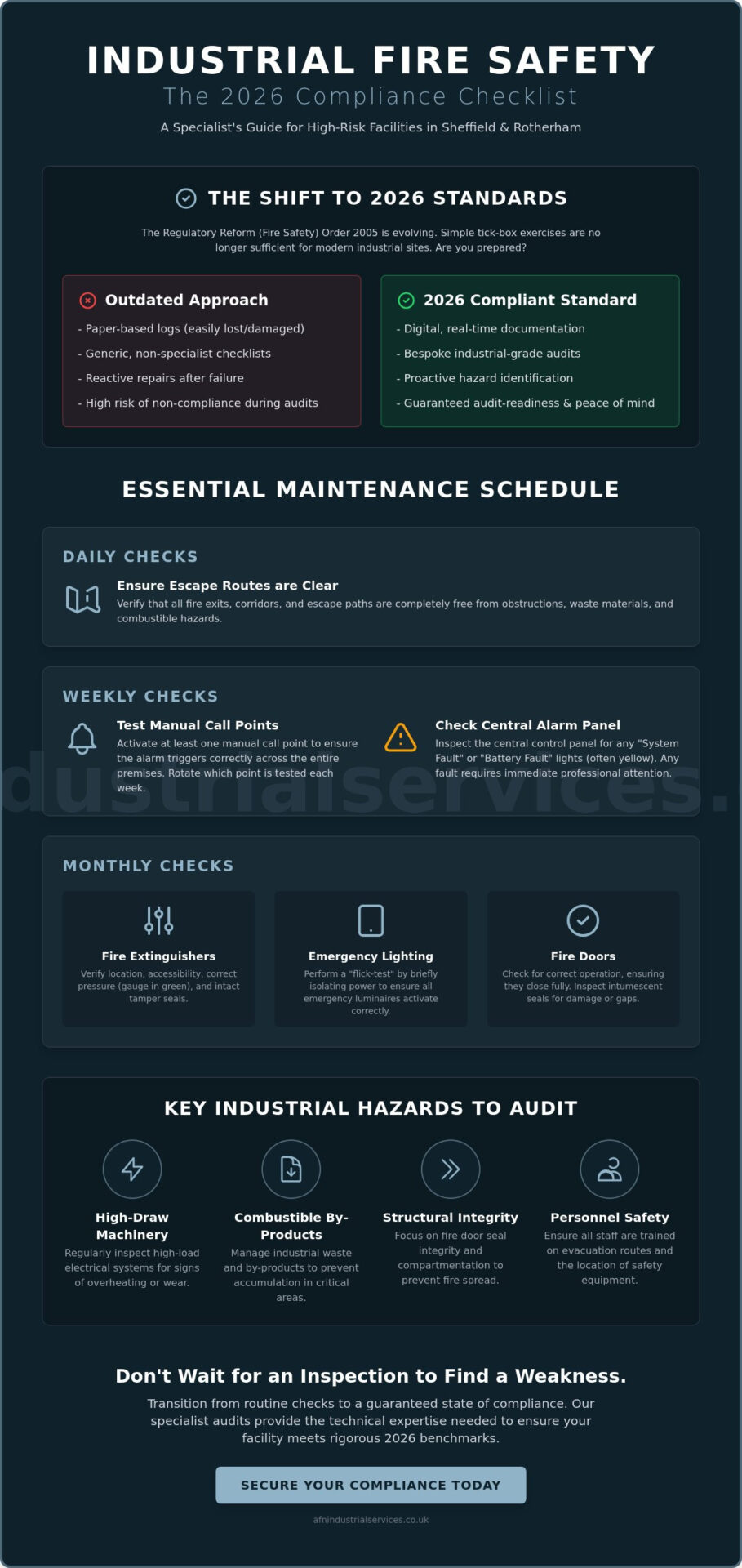
Routine maintenance should follow a strict schedule to remain compliant with UK regulations. Weekly tasks must include testing at least one manual call point to ensure the fire alarm triggers correctly across the entire premises. During this test, check the central control panel for any “system fault” or “battery fault” lights. If your panel shows a yellow warning light, it requires immediate professional attention to avoid system failure.
Monthly inspections focus on the physical state of your hardware. You must verify that every fire extinguisher is in its designated location and remains unobstructed. Check that the pressure gauge needle sits firmly in the green zone and that the plastic tamper seal is intact. Simultaneously, perform a “flick-test” on your emergency lighting. This involves briefly isolating the power to the lighting circuit to ensure the battery-powered lamps activate instantly. Look for the small green LED charge indicators on each unit; if the light is off, the battery or bulb has failed.
Signage is often overlooked but remains a critical part of your fire safety checklist. Every “Fire Exit” and “Extinguisher Point” sign must be visible from 20 metres away. In busy industrial environments, stock or machinery often blocks these signs. Clear these obstructions immediately to ensure staff can find exit routes in low-visibility conditions. For detailed requirements on sign placement, refer to the official government guidance for small businesses.
Professional Fire Extinguisher Servicing
A visual internal check is only the first step. To meet legal requirements, you must arrange for fire extinguisher servicing conducted to BS 5306 standards. A technician will verify the internal weight, check the hose for blockages, and ensure the extinguisher is appropriate for the specific class of fire in that zone. For example, a CO2 unit is required for electrical hazards, while Water or Foam is used for combustible materials like wood and paper. Ensure all service labels are signed and dated by a competent technician to prove compliance during an inspection.
Emergency Lighting and Alarm Integrity
While monthly tests are vital, commercial buildings also require a full 3-hour discharge test annually. This test confirms that batteries can sustain illumination for the full duration required for a safe evacuation and emergency service intervention. Every test result, whether weekly, monthly, or annual, must be recorded in a dedicated fire safety logbook. Failure to maintain these records can lead to insurance claims being rejected. If you’re concerned about the age or reliability of your system, speaking with expert fire safety consultants in Rotherham and Sheffield will help you identify hidden vulnerabilities in your infrastructure.
Structural and Operational Fire Safety Measures
Industrial facilities in Sheffield and Rotherham often house complex layouts where escape routes can quickly become obstructed. Your fire safety checklist must prioritize the total removal of combustible materials from corridors and stairwells. Pallets, packaging, and surplus stock often migrate into these areas during busy production shifts, creating a lethal hazard. Just as factories require rigorous floor management, residential properties also need consistent upkeep to prevent fire risks; for instance, Apartment Clean provides the professional servicing needed to keep communal areas and living spaces free from hazardous clutter. A clear path must be maintained at all times to ensure compliance with legal fire safety responsibilities. External assembly points require similar attention. These areas must remain accessible 24/7, even during heavy South Yorkshire winters or when industrial deliveries are arriving. Clear, weather-resistant signage is a specialist requirement that ensures every employee knows exactly where to gather.
Fire Door and Exit Integrity
A comprehensive fire door inspection is a non-negotiable monthly requirement for industrial units. You must verify that every door closes fully against the rebate and that intumescent seals haven’t been damaged by heavy machinery or trolley impact. Propping doors open is the most frequent safety failure we encounter in local warehouses. It renders fire compartments useless and allows smoke to travel freely. Check that final exit doors operate via push-bars or simple latches. They must never require a key for egress during an emergency. If a door sticks or doesn’t latch, it fails the fire safety checklist and requires immediate repair to maintain building integrity.
Personnel and Training Protocols
Operational safety relies on your team knowing exactly how to act when an alarm sounds. Review your fire marshal training records to ensure all certifications are current. For businesses running 24/7 operations, you must have enough trained marshals present on every single shift to account for all staff. Your records should confirm a full fire drill has occurred within the last 6 months. This practice ensures that 100% of staff, including those on night shifts, understand the evacuation process. New starters require a full fire safety induction on their first day without exception. This proactive approach to training creates a culture of safety that protects both your personnel and your physical assets.
Effective management of these structural elements prevents small incidents from turning into catastrophic losses. We provide bespoke solutions that help facility managers maintain these standards throughout the year. By treating these checks as a core part of your daily efficiency, you ensure the business remains resilient and fully compliant with national standards.
Managing Industrial Fire Hazards: Electrical and Personnel Safety
Industrial environments in South Yorkshire demand a rigorous approach to risk management. Electrical failure is the leading cause of industrial fires in the UK. Because of this, your fire safety checklist must prioritize the integrity of high-voltage systems and the daily habits of your workforce. Neglecting these areas creates a point of failure that can bypass even the most advanced suppression systems. For multi-storey facilities, this also means ensuring that dry riser systems are regularly inspected and fully operational to provide emergency services with the water access they need during a critical incident.
Beyond fire suppression, multi-storey sites must also maintain vertical transport systems to the highest standards. To see how specialist providers manage these complex requirements, you might explore Contrat de maintenance étendu for comprehensive lift and elevator maintenance solutions that ensure total building safety.
Follow these four critical steps to secure your floor:
- Step 1: Inspect all portable electrical equipment for visible cable damage, frayed wiring, or scorch marks on plugs.
- Step 2: Verify that all high-draw machinery is plugged directly into wall sockets. Extension leads are temporary solutions and often overheat under heavy industrial loads.
- Step 3: Check that flammable waste, such as oily rags and combustible packaging, is stored in metal, lidded bins to prevent rapid fire spread.
- Step 4: Audit smoking areas to ensure they’re at a safe distance from the main building and hazardous stores or chemical silos.
Electrical Safety and PAT Compliance
Routine portable appliance testing forms the backbone of electrical fire prevention. It provides a documented trail of safety that protects your business from liability and ensures equipment is fit for purpose. During your walk-through, confirm that every appliance displays a valid PAT label within its re-test date. You must also identify “hot spots” in server rooms or battery charging stations. These areas generate constant heat. They require clear ventilation and a dedicated fire safety checklist review to prevent thermal runaway or circuit overloads.
Hazardous Materials and Respiratory Safety
If you’ve introduced new chemicals to your Rotherham site within the last 12 months, your COSHH assessments need an immediate update. Fire safety involves more than just stopping flames; it’s about managing toxic byproducts. Face-fit testing is a legal necessity to ensure your staff can safely use evacuation respirators if a chemical fire occurs. Without a verified seal, protective gear fails in high-smoke environments. Maintain a clear inventory of all hazardous materials and ensure their storage locations are marked on your site plan for emergency responders.
Don’t leave your facility’s compliance to chance. Contact AFN Industrial Services to schedule a specialist site maintenance audit and protect your workforce today.
Implementing Your Fire Safety Strategy in South Yorkshire
While your internal fire safety checklist serves as a vital first line of defense, complex industrial settings in South Yorkshire demand more than a basic tick-box approach. Moving from a self-managed list to a professional audit ensures that your facility meets the rigorous standards set for 2026. AFN Industrial Services brings 25 years of specialist experience to businesses across Sheffield and the Midlands. We understand that facility managers face immense pressure to maintain compliance without disrupting production. Our bespoke maintenance packages are designed to take the administrative load off your shoulders, providing a single point of contact for all safety protocols.
Professional Support in Sheffield, Rotherham & Doncaster
Local businesses across South Yorkshire rely on AFN’s fire safety consultants to navigate high-risk environments. We provide 24/7 availability because safety issues don’t follow a nine-to-five schedule. If a system fault occurs at 2:00 AM, our team responds immediately to restore protection. We don’t offer generic templates; we customise your safety documentation to fit the specific chemical or mechanical processes unique to your industrial site.
Your Next Steps for 2026 Compliance
To secure your 2026 compliance, the most efficient step is to book a comprehensive site audit. This validates your internal fire safety checklist against current UK legislation and identifies hidden risks. You can consolidate your PAT testing, extinguisher servicing, and emergency light checks with AFN to reduce contractor traffic on site. This streamlined approach ensures nothing is missed during the transition between different maintenance cycles.
- Daily: Verify that fire exit routes are clear and that the fire alarm control panel shows no faults or isolations.
- Weekly: Conduct a manual call point test and check that all fire doors close correctly against their frames.
- Monthly: Visually inspect all fire extinguishers for pressure and integrity; perform a “flick test” on emergency lighting.
- Annual: Schedule a full professional service for alarms, extinguishers, and PAT testing to maintain legal certification.
The transition from a manual checklist to a managed safety strategy is the most effective way to protect your workforce and your assets. By partnering with a local specialist that understands the industrial heritage and modern regulations of the Sheffield region, you ensure your business remains resilient. Secure your facility with AFN’s professional fire safety maintenance today.
Secure Your South Yorkshire Facility for 2026
Maintaining a safe industrial environment requires a proactive strategy that integrates structural integrity with rigorous equipment maintenance. By 2026, UK fire safety standards demand precise risk mitigation and documentation. Your fire safety checklist must account for everything from specialized electrical safety protocols to the physical layout of your Sheffield or Rotherham facility. Proactive management reduces the likelihood of costly downtime and ensures your business meets its legal obligations under current UK legislation.
AFN Industrial Services brings over 25 years of industrial safety experience to every project. We provide specialist support across Sheffield, Rotherham, and Doncaster, ensuring your operations remain in comprehensive compliance with all UK fire and electrical standards. Our team delivers bespoke solutions that prioritize staff safety and business continuity. Don’t leave your compliance to chance when expert help is available to handle the complexities of industrial maintenance and safety audits.
Contact AFN Industrial Services for a Professional Fire Safety Audit
We’re ready to help you build a safer and more resilient workplace today.
Frequently Asked Questions
Is a fire safety checklist a legal requirement for UK businesses?
Yes, maintaining a fire safety checklist is a core component of your legal obligations under the Regulatory Reform (Fire Safety) Order 2005. UK law requires the “Responsible Person” to demonstrate proactive management of fire risks at all times. Failure to maintain these records can lead to enforcement notices or prosecution. Keeping documented evidence ensures your facility remains compliant during snap audits.
How often should I go through my fire safety checklist?
You should perform specific checks on a daily, weekly, and monthly basis to ensure total site safety. Daily checks include clearing fire exits; weekly checks involve testing the alarm system. A comprehensive fire safety checklist review should occur at least monthly to identify emerging hazards. Regular intervals prevent small oversights from becoming critical safety breaches in high-stakes industrial environments.
Can I perform my own fire risk assessment using a checklist?
You can perform your own assessment if you’re a “competent person” with the necessary training and experience. However, complex Sheffield industrial sites often require specialist knowledge to identify technical risks. While a checklist helps with daily monitoring, a formal Fire Risk Assessment must be “suitable and sufficient” to satisfy Section 9 of the Fire Safety Order. Most facility managers hire professionals to ensure absolute compliance.
What are the most common fire safety failures found in industrial audits?
Blocked fire exits and wedged-open fire doors account for 65% of common failures in industrial audits. Inspectors also frequently cite outdated fire extinguisher services and missing logbook entries as major non-compliance issues. In 2023, poor maintenance of emergency lighting remained a top three reason for failed inspections across South Yorkshire manufacturing hubs. These simple errors can lead to immediate site closures.
Do I need a different checklist for a warehouse versus an office?
You need bespoke checklists for different environments because the risk profiles vary significantly. A warehouse checklist focuses on high-bay lighting, pallet storage heights, and forklift charging stations. An office checklist prioritizes PAT testing for computers and clear evacuation routes through partitioned spaces. Using a generic template often misses site-specific hazards that lead to accidents in complex industrial settings.
What happens if a South Yorkshire Fire and Rescue inspector finds my checklist is incomplete?
If a South Yorkshire Fire and Rescue inspector finds an incomplete fire safety checklist, they can issue an informal notification or a formal enforcement notice. Serious or persistent failures result in “alterations notices” or “prohibition notices” that can shut down operations immediately. In severe cases, unlimited fines or prison sentences of up to 24 months apply for non-compliance with safety standards.
How long should I keep my fire safety logbook and checklist records?
You should keep your fire safety logbook and checklist records for at least 5 years to demonstrate a consistent history of compliance. This duration provides a reliable audit trail for insurance providers and health and safety executives. Storing these documents securely ensures you can prove your commitment to safety standards during any retrospective incident investigation or insurance claim process.
Does a fire safety checklist replace the need for professional extinguisher servicing?
A checklist doesn’t replace the need for professional extinguisher servicing. British Standard BS 5306-3 requires a basic service by a qualified technician every 12 months. Your internal checklist serves as a monthly visual inspection to ensure units aren’t damaged or discharged. Professional servicing involves internal component checks that internal staff can’t perform without specialist certification and tools.