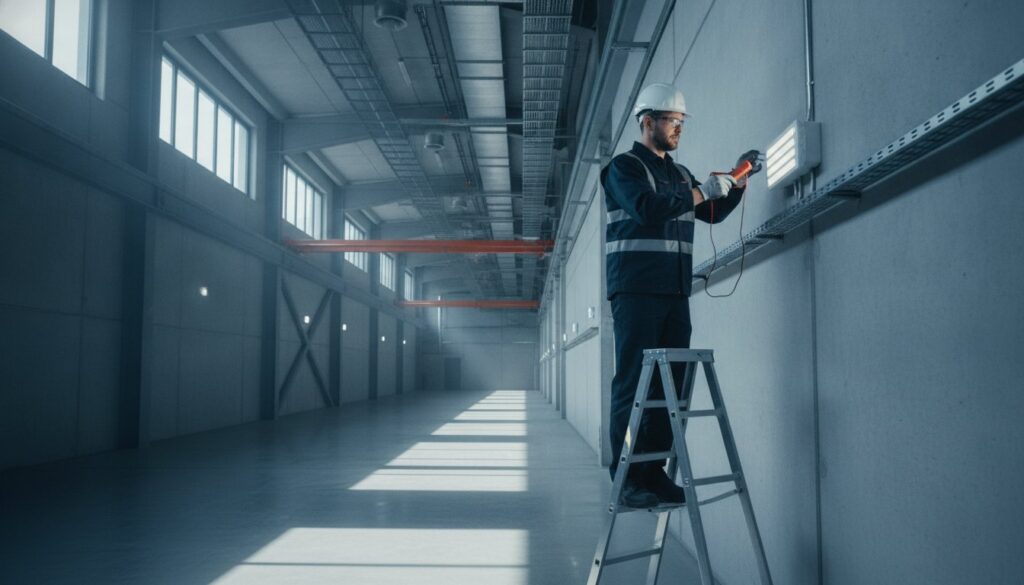
A failed emergency lighting test in 2026 is more than a minor technical glitch; it is a significant legal risk that can invalidate your building insurance. With the mandatory shift to BS 5266-1:2025, many facility managers now face stricter requirements for wiring resilience and photometric verification. If your system has failed its annual discharge test, securing a professional commercial emergency lighting repair Retford service is the most direct route to restoring safety and maintaining compliance.
We understand the pressure of avoiding heavy non-compliance fines while trying to minimize disruption to your daily business operations. You deserve a clear, methodical approach to safety maintenance that doesn’t involve guesswork. This guide explains how to resolve failures cost-effectively while meeting the latest 2025 standards. You’ll learn the practical differences between repairing and replacing units, how to handle the new five-year verification rules, and the exact steps needed to secure a valid entry in your fire safety logbook.
Key Takeaways
- Understand your legal obligations under the Regulatory Reform (Fire Safety) Order 2005 and the critical technical updates introduced in BS 5266-1:2025.
- Identify the primary causes of system failure, such as battery depletion and control gear malfunctions, to streamline the troubleshooting process.
- Learn how to evaluate whether a component-level repair or a full luminaire replacement provides the best long-term value for your specific facility.
- Secure professional commercial emergency lighting repair Retford to ensure your safety systems pass rigorous five-year photometric verification requirements.
- Maintain a compliant fire safety logbook with accurate remediation records that satisfy both insurance providers and local fire authorities.
The Legal and Operational Risks of Faulty Emergency Lighting in Retford
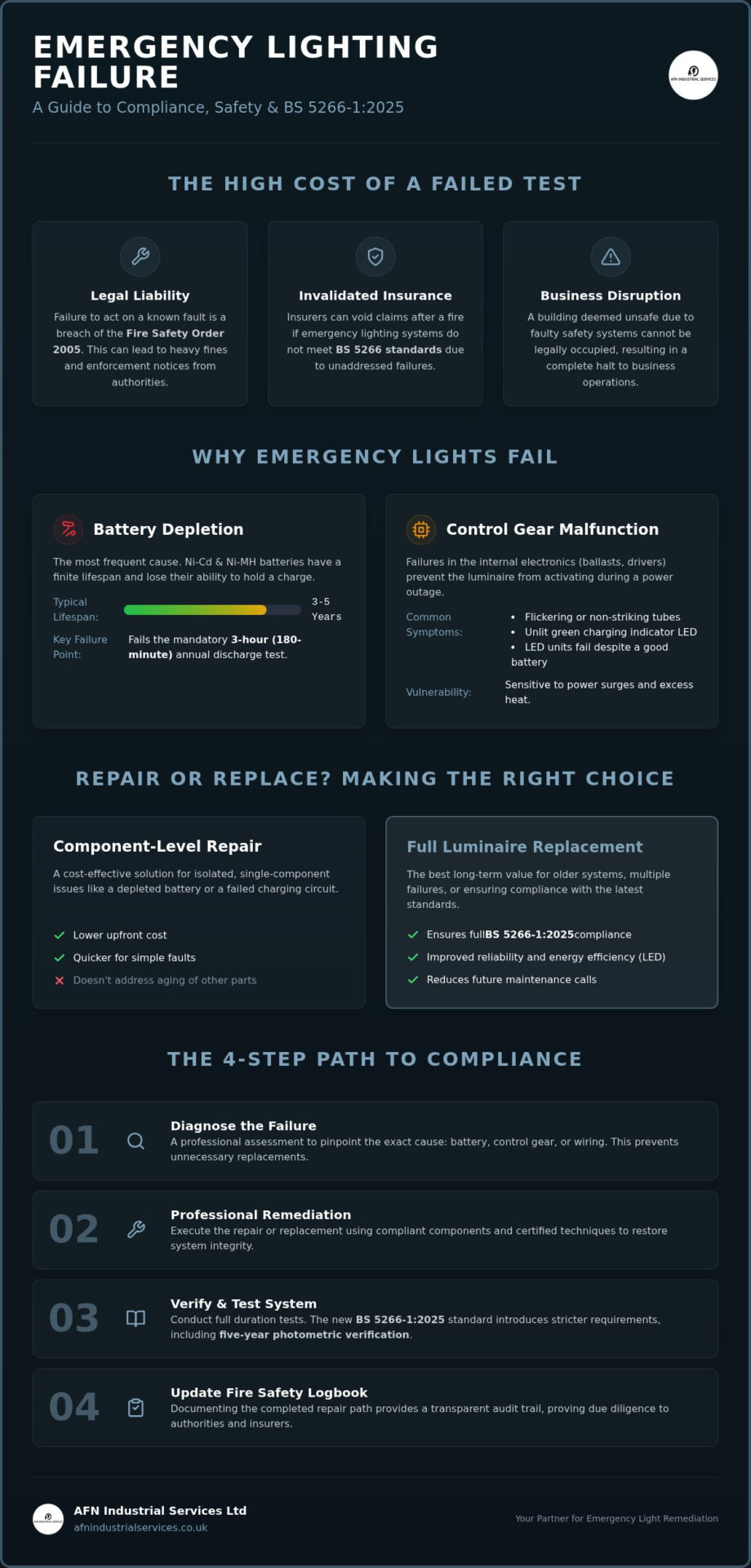
Under the Regulatory Reform (Fire Safety) Order 2005, every non-domestic building in Retford must provide adequate illumination during a power failure. This isn’t a suggestion; it’s a legal mandate. An Emergency light system is designed to activate automatically, guiding occupants to safety during a fire or utility failure. If a system fails its monthly or annual test, the burden of proof for safety falls squarely on the “Responsible Person,” usually the facility manager or business owner. Failure to act on a known fault transforms a technical issue into a legal liability, making prompt commercial emergency lighting repair Retford a priority for any local facility manager.
For businesses in North Nottinghamshire, the stakes extend to financial protection. Most commercial insurance policies require strict adherence to BS 5266 standards. A documented failure that hasn’t been addressed through professional commercial emergency lighting repair Retford can give insurers grounds to void a claim after a fire or accident. In 2026, the updated BS 5266-1:2025 standard emphasizes that remediation must be proactive. Simply recording a “fail” in your logbook is no longer sufficient to demonstrate due diligence; you must show a completed repair path to maintain your legal standing.
Consequences of Non-Compliance for Local Businesses
Nottinghamshire Fire and Rescue Service has the authority to issue enforcement notices or heavy fines if safety systems are found wanting. Beyond the legal penalties, faulty lighting halts business continuity. If a building is deemed unsafe, it cannot legally remain occupied. A precise, up-to-date fire safety logbook acts as your primary defense during an inspection, proving that every identified fault was rectified by a competent professional. This documentation provides a transparent audit trail that protects the “Responsible Person” from personal liability during official safety audits.
Common Commercial Settings in Retford Requiring Specialised Care
Identifying Common Faults: Why Your Emergency Luminaires Fail Testing
Battery failure remains the most frequent reason systems fail their annual three-hour duration test. Most emergency luminaires rely on Nickel-Cadmium (Ni-Cd) or Nickel-Metal Hydride (Ni-MH) batteries that have a finite chemical lifespan, typically ranging from three to five years. Over time, these cells lose their capacity to hold the 180 minutes of charge required by the Regulatory Reform (Fire Safety) Order 2005. When a unit fails to remain illuminated for the full duration, it usually indicates the battery has reached its end of life. Addressing these specific battery issues is a primary focus of professional commercial emergency lighting repair Retford.
Control gear and ballast malfunctions are also prevalent, particularly in older fluorescent fittings. You might observe a tube flickering or failing to strike even when the battery is fully charged. In modern LED systems, the “fit and forget” marketing often masks the reality of driver failure. While the LED chips themselves are durable, the electronic drivers are sensitive to voltage spikes and heat. If the driver fails, the luminaire will not activate during a power outage, regardless of how new the battery is. These technical nuances require a methodical diagnostic approach to ensure the correct component is replaced.
The Anatomy of an Emergency Light Failure
Distinguishing between maintained and non-maintained faults is the first step in any diagnostic. A maintained fitting operates continuously as part of the standard lighting, while a non-maintained fitting only activates during a power cut. If the green charging indicator LED is unlit, the unit is not receiving a mains charge or the internal charging circuit is faulty. Local grid fluctuations in North Nottinghamshire can sometimes cause “ghost” failures where the system appears faulty but simply needs a controlled reset. Identifying these subtle signs early can prevent more costly repairs later.
Environmental Factors in North Nottinghamshire
Retford’s industrial and manufacturing sites present harsh conditions that accelerate equipment wear. Heavy dust accumulation in Randall Park units can settle on internal circuitry, causing heat to build up and components to fail prematurely. Unheated warehouses also pose a threat; extreme temperature drops during winter months significantly reduce battery efficiency and chemical stability. In certain chemical-heavy or high-moisture environments, corrosion on the battery terminals can break the charging circuit entirely. Regular emergency light drain tests are essential for spotting these environmental impacts before they compromise your safety exit routes.
Physical damage is another common issue in high-traffic commercial settings. Forklift movements in industrial units or stock handling in retail basements often lead to cracked diffusers or loose internal connections. Even a minor impact can dislodge the battery connector, rendering the unit useless in an emergency. Ensuring these physical vulnerabilities are addressed is a core component of our commercial emergency lighting repair Retford services, providing a reliable solution for local facility managers.
Maintenance vs. Reactive Repair: Strategies for Retford Facility Managers
Facility managers in North Nottinghamshire often face the choice between patching a failing system and investing in a total overhaul. Reactive repair, while addressing immediate failures, frequently leads to higher long-term costs and repeated operational downtime. Integrating your repair strategy into a regular emergency light testing schedule transforms your approach from crisis management to controlled maintenance. By identifying degraded batteries or failing ballasts during routine inspections, you can schedule a commercial emergency lighting repair Retford at a time that suits your business, rather than waiting for a critical system failure.
The hidden costs of “cheap” reactive repairs by non-specialists can be substantial. Using non-compliant components or incorrect battery types may restore the green charging light, but it often fails to provide the mandatory three-hour discharge duration. Professional remediation ensures that every replacement part is fully compatible with the original luminaire design and meets the rigorous requirements of the latest safety protocols. This methodical approach protects the integrity of your fire safety logbook and ensures your insurance remains valid.
The Repair vs. Replace Decision Matrix
The age of your current installation is the primary factor in the repair versus replace debate. For legacy fluorescent systems over ten years old, sourcing compatible control gear for Retford commercial buildings is increasingly difficult. In these scenarios, a full LED retrofit is often the most cost-effective path. LED luminaires provide superior energy efficiency and significantly longer maintenance intervals. However, for systems less than five years old, a targeted commercial emergency lighting repair Retford, such as a battery or inverter swap, maintains full compliance with BS 5266-1:2025 Standards without the unnecessary expense of replacing functional housings.
Budgeting for Compliance in 2026
Predictable budgeting requires a clear understanding of your building’s assets. While fixed costs for annual testing are easy to forecast, variable material fees for repairs can disrupt financial planning if not managed correctly. Implementing an asset tagging system allows you to track the age and performance of every unit, helping you predict exactly when clusters of lights will require battery changes. This data-driven approach allows for the bulk purchase of components, reducing the per-unit cost of remediation. Systematic asset management ensures that no single luminaire is overlooked, effectively eliminating safety blind spots within your facility.
The Professional Repair Process: BS 5266-1:2025 Standards Explained
Professional commercial emergency lighting repair Retford follows a four-stage methodology to guarantee compliance with the latest safety benchmarks. The transition to BS 5266-1:2025, published in October 2025, has turned standard maintenance into a rigorous verification procedure. We treat every repair as a critical safety intervention, ensuring the hardware is restored to its original design specification. This methodical approach eliminates the guesswork often associated with reactive maintenance.
- Step 1: Systematic Isolation and Diagnostics. We isolate the specific circuit to perform component-level testing. This identifies whether the fault lies in the internal battery, the charging circuit, or the luminaire’s control gear.
- Step 2: Sourcing Certified Components. We only use batteries and ballasts that match the manufacturer’s technical requirements. Using generic parts can alter the discharge curve, potentially failing a future three-hour test.
- Step 3: Precision Installation. Components are installed according to the BS 5266-1:2025 photometric requirements. This ensures the light distribution remains consistent with the building’s fire safety strategy.
- Step 4: Verification and Re-testing. Once repaired, the unit undergoes a functional test to verify immediate operation and a full duration test to confirm battery integrity.
This structured process ensures that every commercial emergency lighting repair Retford we perform is fully documented and legally defensible. We prioritize the stability of your safety systems, providing a clear path from failure to formal certification.
What is Photometric Verification?
The 2026 compliance landscape introduces stricter rules regarding light output. Photometric verification ensures that a repaired luminaire still provides the minimum required illumination of 1 lux along the centre line of an escape route. Simply making the light turn on isn’t enough. If a replacement LED or diffuser changes the beam angle, the escape route might fall into shadow, creating a safety hazard. We verify that your system resilience remains intact after any significant component change, maintaining the safety of use for all occupants.
Logbook Updates and Certification
Every repair must be documented with a “Certificate of Remediation.” This document is legally necessary to close any “fail” entries in your site logbook. During a Health and Safety Executive (HSE) audit, these certificates prove that you have acted on identified risks with professional diligence. In the 2026 compliance landscape, a competent person is defined as an individual with sufficient technical training and experience to ensure the emergency system operates as originally designed. If you need to clear a failed test from your records, you can request a professional remediation survey today to secure your building’s safety status.
AFN Industrial Services: Your Local Partner for Emergency Light Remediation
Reliability in safety maintenance is built on experience and local accountability. AFN Industrial Services Ltd brings over 25 years of expertise in workplace safety across the Midlands, providing facility managers with a steadfast partner for complex compliance challenges. We understand that commercial emergency lighting repair Retford requires more than a simple bulb change. It demands a sophisticated understanding of the industrial landscape, from the high-bay requirements of Randall Park to the intricate layouts of town centre retail units. Our approach focuses on delivering individualized solutions that ensure your building remains legally occupied and fully protected.
We prioritize business continuity by executing repairs with minimal disruption to your operations. Our team doesn’t just fix hardware; we provide the formal validation required to satisfy insurance providers and fire authorities. By choosing a local specialist, you benefit from a partner who is familiar with North Nottinghamshire’s specific regulatory environment and industrial standards. This proactive service model ensures that every remediation project is completed to the highest professional benchmarks, moving your facility from a state of non-compliance to total safety readiness.
Why Retford Businesses Trust AFN Industrial Services Ltd
Transparency is the foundation of our service delivery. Unlike national firms that rely on call-centre dispatchers, AFN Industrial Services Ltd provides direct access to senior safety consultants who understand the technical nuances of BS 5266-1:2025. We provide clear, actionable rectification plans alongside transparent reporting, so you know exactly what work is required and why. Our comprehensive support structure also allows you to bundle essential services, including PAT testing and fire extinguisher maintenance. This integrated approach simplifies your safety management, ensuring all critical systems are maintained by a single, reliable expert.
Next Steps for Your Compliance
Restoring your safety systems starts with a methodical assessment of your current installation. You can book a site survey or remediation visit to identify specific faults and develop a tailored repair schedule. Before our professional repair team arrives, ensure that your fire safety logbook is available and that access to all luminaires is clear. This preparation allows us to work efficiently, completing the necessary commercial emergency lighting repair Retford without unnecessary delays. We are ready to help you navigate the 2026 compliance landscape with precision and authority.
Contact AFN for an Emergency Lighting Repair Quote
Securing Your Building’s Safety for 2026 and Beyond
Adhering to the latest BS 5266-1:2025 standards is a critical operational requirement that protects both your personnel and your legal standing. As we have discussed, addressing battery failures and control gear malfunctions through a methodical repair process ensures your system remains resilient during a power failure. By prioritizing professional commercial emergency lighting repair Retford, you move away from the uncertainty of reactive fixes and toward a structured, compliant maintenance strategy that satisfies both insurers and fire safety authorities.
AFN Industrial Services Ltd provides the authoritative expertise needed to navigate these technical requirements. With 25+ years of industrial experience and deep specialization in BS 5266 compliance, we act as a reliable partner for facilities across North Nottinghamshire. We handle the technical diagnostics and the essential logbook documentation, allowing you to focus on your core business operations with total peace of mind. Taking action today ensures your safety systems are ready for any emergency.
Secure your 2026 compliance with AFN—Book a Retford repair visit today. Our team is ready to provide the local support and technical precision your facility requires.
Frequently Asked Questions
How often should emergency lighting be tested in a commercial building?
Emergency lighting requires a brief functional test every month and a full three-hour discharge test annually. The monthly “flick test” ensures each luminaire activates correctly when the mains supply is simulated to fail. The annual test is more rigorous, confirming the battery can sustain the light for the full duration required by BS 5266 standards. Regular testing is the only way to identify hidden faults before an actual emergency occurs.
Can I repair emergency lights myself if I am a business owner?
Business owners shouldn’t perform their own repairs unless they meet the legal definition of a “competent person” with specific technical training. The Regulatory Reform (Fire Safety) Order 2005 places the liability on the “Responsible Person” to ensure all safety equipment is maintained correctly. Professional commercial emergency lighting repair Retford ensures that all work is certified, protecting you from personal liability and potential insurance complications.
What is the difference between a monthly flick test and a full duration repair?
A monthly flick test checks for immediate activation, whereas a full duration repair addresses the battery’s capacity to provide light for three hours. If a light passes the monthly test but fails the annual one, it’s often a sign of battery degradation. Remediation focuses on restoring the system’s ability to meet the full legal duration rather than just a momentary switch-on. This ensures the system works when it’s needed most.
My emergency light is showing a red LED; does it need a repair?
A red LED typically signals a system fault, such as a failed battery or a charging circuit malfunction. While a green LED indicates the battery is charging correctly, any other color or a flashing pattern requires immediate investigation. You’ll need a professional diagnostic to determine if the unit needs a simple battery swap or a more complex component repair. Ignoring these indicators can lead to total system failure during a power cut.
How long do emergency light batteries typically last before needing replacement?
Emergency lighting batteries typically last between three and five years under normal operating conditions. Factors like extreme temperatures in unheated warehouses or frequent power fluctuations can shorten this lifespan significantly. Regular testing helps you identify when a battery is nearing the end of its useful life. This allows you to schedule a replacement before the unit fails its mandatory three-hour discharge test.
Does emergency lighting repair require a full building power shutdown?
Repairing emergency lighting doesn’t require a full building power shutdown. Specialists use localized isolation or dedicated test switches to work on specific circuits while the rest of your facility remains operational. This targeted approach ensures that your business continuity isn’t compromised while we restore your safety systems to full compliance. It’s a methodical process designed to be as non-intrusive as possible for your daily operations.
What documentation do I need after an emergency light has been repaired?
You need a formal Certificate of Remediation and a signed entry in your fire safety logbook after any repair is completed. These documents provide the necessary audit trail for the Health and Safety Executive or your insurance provider. They prove that identified faults have been rectified by a qualified professional and that the system is fit for purpose. Accurate paperwork is just as important as the physical repair itself.
Are LED emergency lights easier to repair than fluorescent ones?
LED emergency lights aren’t necessarily easier to repair, but they have different failure points compared to older fluorescent units. While fluorescent lights often suffer from ballast or starter failures, LED systems are more sensitive to electronic driver malfunctions. A commercial emergency lighting repair Retford specialist ensures that replacement drivers or LED modules are perfectly matched to the original luminaire’s photometric specifications. This maintains the correct light levels throughout your escape routes.