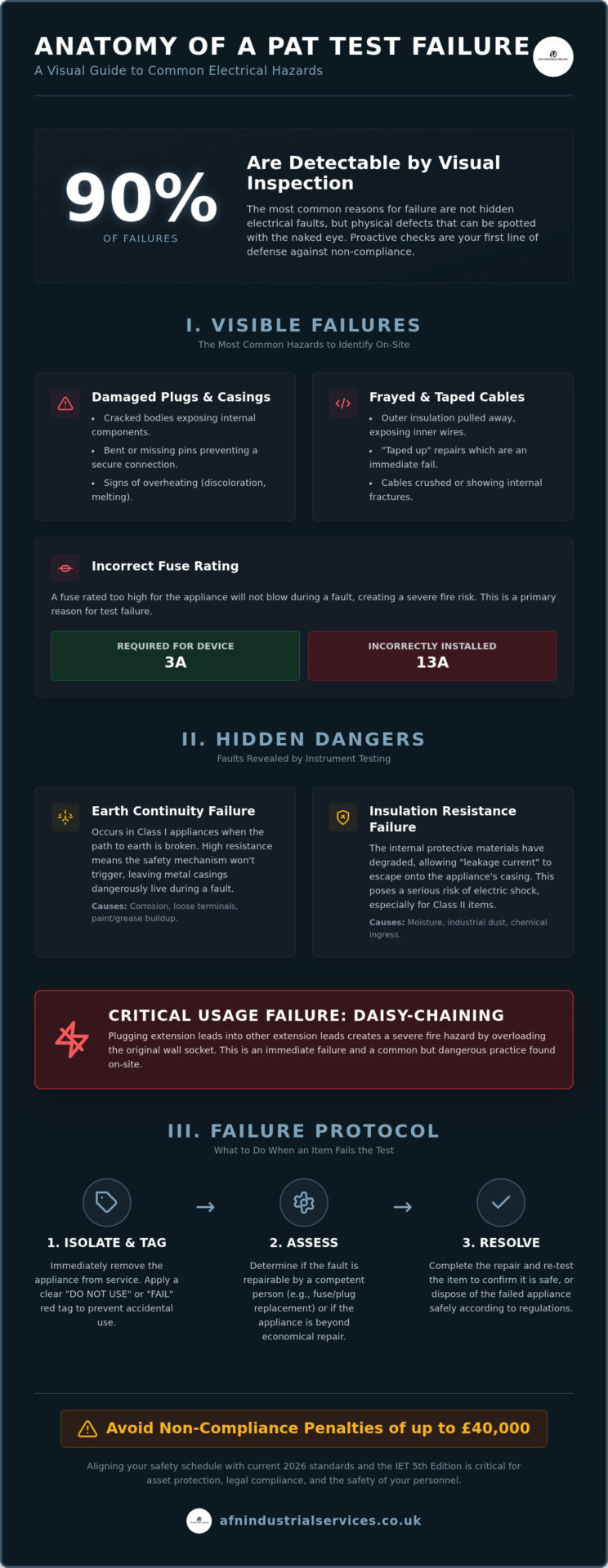
Approximately 90% of all electrical safety failures are visible to the naked eye, yet they remain the most common reasons businesses fall short of compliance. Understanding exactly what fails a PAT test is no longer just a matter of best practice. With new 2026 regulations for social landlords carrying penalties of up to £40,000, and the IET 5th Edition shifting toward a risk-based approach, the stakes for facility managers have never been higher.
It’s natural to feel concerned about technical jargon or the potential cost of replacing failed equipment during a safety audit. You need a straightforward way to ensure your site remains compliant without the guesswork. We promise to demystify the inspection process by highlighting the most frequent hazards and teaching you how to spot them before a professional tester arrives.
This guide provides a functional checklist of common electrical faults and explains the difference between a simple fuse replacement and a terminal failure. We will walk you through the essential steps to maintain your legal standing and protect your assets with the precision of a seasoned industry partner.
Key Takeaways
- Identify the visual defects like frayed cables and cracked casings that account for 90% of all safety failures.
- Understand the technical differences between Class I and Class II appliance testing to ensure every item is measured accurately.
- Discover what fails a PAT test beyond the appliance itself, such as the common hazard of daisy-chaining extension leads.
- Establish a clear red tag protocol to isolate hazardous equipment and determine if minor on-site repairs are a viable option.
- Align your safety schedule with current 2026 standards to avoid the heavy financial penalties associated with non-compliance.
Visual Inspection Failures: The Most Common PAT Test Issues
The visual inspection is the most critical stage of the safety process. It serves as the first line of defense in identifying what fails a PAT test, as most electrical hazards are physically detectable before they cause a circuit failure. Portable appliance testing (PAT) procedures mandate a rigorous check of the cable, the plug, and the appliance body to ensure they remain fit for purpose in demanding environments.
One of the most dangerous findings during an inspection is the presence of “taped up” cables. Whether it’s standard electrical tape or heavy-duty duct tape, these DIY fixes result in an immediate failure. Tape lacks the structural integrity to protect internal conductors and often hides frayed wires that are prone to arcing. We also look for bent pins or cracked plug casings. These defects compromise the electrical connection and significantly increase the risk of fire or accidental contact with live components.
Cable Damage and Wear Patterns
Cable sheathing must be continuous and securely held by the cord grip. When the outer insulation pulls away from the plug, exposing the coloured inner cores, the item is no longer safe for use. This is a common occurrence in industrial settings where cables are dragged across rough floors or crushed by heavy machinery and foot traffic. Improper storage is another frequent culprit. When staff wrap cables too tightly around an appliance, they cause internal wire fractures. These fractures lead to high-resistance joints that generate dangerous levels of heat during operation, even if the outer sheath looks intact.
Plug and Fuse Discrepancies
The fuse inside the plug is a precisely calibrated safety device. We often discover 13A fuses installed in low-power items, such as lamps or small electronics, that specifically require a 3A fuse. This discrepancy is a primary reason what fails a PAT test because the fuse won’t blow quickly enough during a fault to prevent damage or injury. Our inspectors also check for signs of thermal damage, such as brown discolouration around the pins, which indicates internal arcing or poor contact. Additionally, non-standard travel adapters are prohibited in most commercial environments. They rarely feature the necessary shutter mechanisms or fuse protection required for high-stakes operational safety.
Electrical Instrument Failures: The ‘Hidden’ Safety Risks
While a visual inspection catches obvious defects, the instrument test identifies internal hazards that remain invisible to the naked eye. This stage utilizes a calibrated PAT tester to measure specific electrical properties against the benchmarks set by the IET Code of Practice. It’s often what fails a PAT test when an appliance looks pristine but harbours a “silent killer” fault, such as a breakdown in the internal circuitry or a compromised safety barrier.
The testing protocol differs significantly between Class I and Class II appliances. Class I equipment relies on an earth connection for safety, meaning the instrument must verify the integrity of the grounding path. Class II items are double insulated and do not require an earth, so the tester focuses on the quality of the insulation itself. Adhering to HSE guidance on maintaining portable electrical equipment ensures that these tests aren’t just a box-ticking exercise but a robust verification of workplace safety. For complex industrial sites, professional portable appliance testing provides the technical precision needed to manage these high-stakes risks.
Earth Continuity and Bonding Failures
Earth Continuity is the path that prevents a metal casing from becoming live. During this test, the PAT machine injects a small current to measure the resistance between the plug’s earth pin and the appliance’s metal exterior. If the resistance is too high, the safety mechanism won’t trigger during a fault, leaving the user at risk of a fatal shock. Common causes for failure include internal corrosion, loose terminals inside the plug, or paint and grease buildup that prevents a solid connection. These issues are frequent in heavy-duty environments where vibration and moisture are constant factors.
Insulation Resistance and Leakage Current
Insulation resistance testing measures how well the internal protective materials prevent electricity from escaping the circuit. Over time, moisture, industrial dust, or chemical vapours can seep into an appliance, causing the insulation to degrade. This leads to “leakage current,” where small amounts of electricity “leak” onto the casing. We use “Touch Current” tests to ensure these leaks don’t reach levels that could cause a painful shock or trigger a fire. Older appliances are particularly susceptible to these failures as internal components naturally perish with age and heavy usage cycles.
Environmental and Usage Failures: Beyond the Appliance
Safety inspections must account for the context in which equipment operates. An appliance that passes a bench test might still be what fails a PAT test once placed in a hazardous or inappropriate environment. The IET Code of Practice emphasizes a risk-based approach, meaning the surrounding conditions dictate the safety requirements. Using domestic-grade equipment in heavy industrial settings often leads to premature failure because the components aren’t designed to withstand the vibration, dust, or moisture levels found on a factory floor.
Inadequate Ingress Protection (IP) ratings are a significant concern. If a device is used near liquids or in high-dust areas without the correct IP rating, internal components will eventually corrode or short-circuit. Our experience over 25 years shows that environmental factors are just as likely to cause a failure as the appliance’s internal mechanics. Identifying these environmental risks is a core part of maintaining a compliant workplace.
The Dangers of Extension Lead Overloading
Extension leads are frequently the weakest link in a power chain. “Daisy-chaining,” or plugging one extension lead into another, is a major safety violation. This practice bypasses designed load limits and creates high-resistance points that can lead to electrical fires. It’s essential to calculate the total wattage of all connected devices; high-draw items like space heaters or industrial vacuums should never share a single lead. For more detailed local requirements, consult our Portable Appliance Testing (PAT): The Complete Guide for South Yorkshire Businesses.
Coiled extension leads present a hidden thermal risk. When a lead is left coiled while in use, it acts as an induction coil, generating significant heat that can melt the insulation. Always fully unwind leads before operation to ensure proper heat dissipation. Failure to do so is a common reason for equipment being red-tagged during an inspection.
Suitability for Environment
Equipment must be fit for its specific location. A standard office kettle will likely fail an inspection if moved into a high-vibration workshop where the base could become unstable or the casing could crack. The same logic applies to mobile devices used in the field; ensuring a professional iPhone scherm reparatie for damaged screens is vital to prevent environmental ingress and maintain device safety. Similarly, cable management is a key part of what fails a PAT test in high-traffic areas. Cables trailing across walkways without proper ramping or protection are classified as immediate hazards because they are prone to mechanical damage.
On construction sites across Rotherham and Sheffield, the use of 110V yellow-plug equipment is standard for safety. Bringing 230V domestic tools onto these sites is a direct breach of safety protocols and will result in a failure. We prioritize checking that the voltage and build quality of each tool match the specific demands of the industrial environment it serves.
When an engineer identifies what fails a PAT test, the priority shifts immediately to risk mitigation. Any item that does not meet the safety benchmarks must be withdrawn from service. We use a ‘Red Tag’ system to clearly mark hazardous equipment. This ensures no employee accidentally uses the device before it’s repaired or replaced. Isolation is the first step in a professional failure protocol, preventing immediate danger to your staff and facility.
Managing these failures effectively is a core component of our professional health and safety services. We don’t just find faults; we help you navigate the necessary steps to restore compliance. This includes advising on the disposal of equipment under Waste Electrical and Electronic Equipment (WEEE) regulations. Compliance ensures your business meets environmental standards while fulfilling your legal safety duties.
On-Site Remedial Works
Not every failure requires the disposal of the appliance. Many issues fall under “minor repairs” that we can often resolve on-site. Replacing a damaged 13A plug or installing the correct 3A fuse are common quick fixes that restore an item to a safe condition. However, if the internal components are severely degraded or the casing is compromised, the item is classified as Beyond Economic Repair (BER). In these cases, the equipment must be decommissioned and removed from the active workplace. Any item repaired on-site undergoes an immediate re-test to verify that the fault is fully resolved before a ‘Pass’ label is applied. This methodical approach ensures that what fails a PAT test at 9:00 AM can often be safely back in service by 10:00 AM.
The Documentation Trail
A failed PAT test is a legal record that requires immediate action to mitigate risk. Every inspection generates an individual asset register and a formal certificate. These documents are vital for insurance purposes and health and safety audits. You must keep a dedicated ‘Failed Items’ register that tracks the history of the appliance from the point of failure to its eventual repair or disposal. Never remove a ‘Fail’ label yourself. Only a competent person can remove this marker after a successful repair and re-test. This structured approach provides a clear audit trail, proving that your business takes its duty of care seriously and manages electrical hazards with precision.
Ensuring Compliance in South Yorkshire: The AFN Approach
AFN Industrial Services Ltd delivers a methodical, results-driven approach to electrical safety across South Yorkshire and the Midlands. We understand the unique operational pressures facing heavy-duty facilities in Rotherham, Sheffield, and Doncaster. With over 25 years of industry experience, our team doesn’t just identify what fails a PAT test; we provide the technical expertise to resolve those failures and keep your site moving. Our scalable per-item pricing model offers commercial clients total transparency, ensuring you only pay for the work completed without hidden fees or complex contracts.
Integrating these inspections into a broader workplace safety strategy is essential for long-term compliance. We view portable appliance testing as a critical maintenance function that prevents costly equipment downtime and protects your most valuable assets: your people. By identifying faults before they escalate into fires or shocks, we help you maintain a stable and productive work environment that adheres to the highest professional benchmarks.
Local Expertise for Local Businesses
Our commitment to businesses in Wakefield, Barnsley, and Mansfield is built on a foundation of reliability and rapid response. Being a Rotherham-based consultancy means we’re never far from your site when you require urgent inspections or follow-up visits. We understand the specific industrial landscape of the region and tailor our service to match your operational schedule. Beyond the physical test labels, we assist with the complex safety documentation required by modern regulators. This includes providing digital asset registers that simplify the management of high-volume equipment across multiple locations, giving you a clear map of your electrical estate.
Reducing Insurance and Accident Risks
A consistent testing schedule is one of the most effective ways to lower commercial insurance premiums in 2026. Most insurers now require documented proof of regular electrical maintenance as a condition of coverage. Regular PAT testing also fulfills your primary ‘Duty of Care’ under the Health and Safety at Work etc. Act 1974. Failing to demonstrate this care can lead to significant legal liabilities and the high-value fines associated with non-compliance. If you’re concerned about what fails a PAT test or need a reliable partner to manage your compliance calendar, we offer the stability and safety you need. Contact AFN Industrial Services Ltd today to book your 2026 compliance audit and ensure your facility remains a safe, productive place to work.
Securing Your Facility’s Electrical Compliance
Securing a facility involves a multi-layered approach that addresses both obvious and hidden defects. While visual checks identify the majority of hazards, instrument testing remains the only way to verify internal safety barriers. Understanding what fails a PAT test, whether it’s an overloaded extension lead or a high-resistance earth bond, empowers you to maintain a compliant workplace and avoid the severe penalties associated with the 2026 regulatory updates.
AFN Industrial Services Ltd brings over 25 years of health and safety experience to every inspection. Serving Rotherham, Sheffield, and the wider Midlands, we provide the stability and precision needed for high-stakes industrial maintenance. Our comprehensive per-item pricing ensures commercial transparency, allowing you to manage compliance costs effectively while fulfilling your legal duty of care.
Don’t leave your facility’s safety to chance. Book your professional PAT testing with AFN Industrial Services Ltd today to ensure your operations remain secure and fully compliant. We are ready to help you protect your workforce and your business integrity.
Frequently Asked Questions
Can an appliance pass the visual check but fail the PAT test?
Yes, appliances frequently pass a visual inspection but fail the electrical instrument test. While 90% of faults are visible, internal issues like insulation breakdown or high earth resistance remain hidden. These internal defects are often what fails a PAT test for equipment that appears brand new. Our engineers use calibrated testers to identify these silent killers, ensuring your site in Rotherham or Sheffield remains fully compliant with current safety standards.
Is it illegal to use an item that has failed its PAT test?
Using an item that has failed its inspection is a direct breach of the Electricity at Work Regulations 1989. While the test itself is a safety benchmark, knowingly operating faulty equipment violates your legal duty of care. This negligence can lead to immediate prosecution or the invalidation of your commercial insurance. Once an item is red-tagged, it must be removed from service until a competent person performs a professional repair and re-test.
What are the most common items to fail in an office environment?
In a typical office environment in Doncaster or Wakefield, the most common failures involve extension leads and kitchen appliances. Extension leads often fail due to daisy-chaining or physical damage from being stepped on. Kettles and heaters are also high-risk items because they draw significant current, which can cause thermal damage to the plug and internal wiring. Regular inspections help identify these office hazards before they escalate into a fire or a circuit failure.
Do brand new electrical items need to be PAT tested?
Brand new equipment generally does not require a formal instrument test immediately. However, the IET Code of Practice suggests a visual inspection to ensure no damage occurred during transit. Many industrial operators in Barnsley and Worksop choose to test new items immediately to establish a clear asset register. This proactive approach ensures every piece of equipment is accounted for in your compliance documentation and safety audit trail from its first day of use.
How often should appliances be tested to avoid failure?
Testing frequency is determined by a risk assessment rather than a rigid calendar. Handheld tools used on construction sites in Scunthorpe may require testing every three months due to heavy wear. Conversely, stationary office equipment might only need an inspection every 24 to 48 months. Our Rotherham-based consultancy helps you determine the correct intervals based on the equipment type, its environment, and the intensity of its daily usage in your specific facility.
What happens if my business is caught with failed or untested equipment?
Failure to maintain safe equipment can result in severe penalties, including fines and criminal prosecution. For social landlords, new 2026 regulations carry non-compliance penalties of up to £40,000. For other businesses in the Midlands, untested equipment can lead to the immediate rejection of insurance claims following a fire or accident. Regular testing proves you have taken reasonable steps to ensure workplace safety, protecting your business from these high-stakes financial and legal consequences.
Can I repair a failed PAT test item myself?
You should only attempt repairs if you are a competent person with the necessary technical knowledge and equipment. Improper DIY fixes, such as using the wrong fuse or standard tape on a cable, are common examples of what fails a PAT test during a professional audit. It is safer and more reliable to have minor repairs, like plug replacements, handled by an experienced engineer who can immediately re-test the item to confirm its safety. If you need assistance with more specialized electronic devices such as smartphones or laptops, you can discover First Help Tech for professional repair solutions.
A cracked casing results in a failure if it compromises the protective insulation or exposes live internal components. Even if the device still functions, a crack allows dust, moisture, or fingers to enter the housing, creating a significant shock or fire risk. In high-stakes industrial environments like those in Pontefract or Retford, any physical breach in an appliance’s shell is treated as a terminal safety failure that requires immediate isolation and professional repair.
